
Similar to last year when I posted 5 favorites from the 1950s, my list spans genres and countries of origin. I selected what some may see as 'obvious' picks and then others that are lesser-known in hopes of raising their profile and getting some folks to check them out. Here they are, in chronological order of release date as reported in IMdB.com
 |
| These offspring don't seem like normal children to Mr. Sanders |
It's the first of series of films that build from society's paranoia about a nuclear catastrophe that pervaded the fifties and reached into the early 1960s. In this fable, a supernatural phenomenon causes a new species of killer blonde children to come into the world all at the same time. Only some clever planning and quick acting can save the village -- but at what cost? With children being both victim and perpetrator, will society ever recover? It's filmed in glorious black-and-white and captures mid-century small town British life charmingly, while the menace is growing first in the background, and then the foreground. It will only consume 77 minutes of your time.
The Manchurian Candidate (1962)
 |
| Angela Lansbury and screen son Laurence Harvey |
The communist menace is still front and center in this lauded surreal political thriller directed by John Frankenheimer. There is a deep malaise and cynicism in the USA of this film, which adds to its timeliness even if the circumstances are different. No one can be trusted, and our protagonists, played by Laurence Harvey and Frank Sinatra, seem at least a little complicit in their misadventures. Angela Lansbury is great as a Lady Macbeth-like character, and her husband is expertly played by James Gregory. Janet Leigh, a big star at the time, has a supporting role as a cipher who inserts herself into Frank Sinatra's character arc. At the end of the film, some issues are resolved, but the ending is far from a happy one. It's a trippy and enjoyable ride.
Dr. Strangelove (1964)
 |
| The "War Room" in Stanley Kubrick's satire |
What a biting piece of satire this film is, while being about as hilarious as any movie ever made. The irreverent take on diplomatic and military authority ushers in the transition from a simply cynical view of the post-nuclear societal order to a fully anti-establishment one that characterized much of the decade of the 60s. Renowned director Stanley Kubrick chooses, once again, a B&W palette to illuminate his bleak world.
Peter Sellers is at the top of his comic game playing multiple roles, from an ever-optimistic U.S. president trying to sweet-talk the Soviet ambassador to the title role of a truly mad scientist. The parade of stars is impressive -- all of them terrific, from Sterling Hayden to George C. Scott and Keenan Wynn.
 |
| A match made in heaven? |
And Christopher Plummer was extraordinarily dreamy. But the film has so much else going for it - Julie Andrews is just terrific, and, after all, we are talking Rodgers and Hammerstein here. Despite the nearly three hour running time, director Robert Wise keeps the pace swift and the production values are superb. Who wouldn't want to make a pilgrimage to old Salzburg after watching the film? And the 'true story' angle adds to the poignancy of what's on screen, even if details have been adjusted. Just put aside your skepticism and enjoy the spectacle of mid-century family-friendly Hollywood at its best.
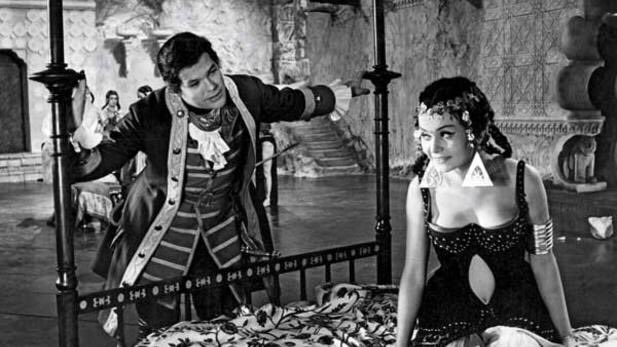 | |||
| Zbigniew Cybulski (left) and Iga Cembrzynska in an early erotic adventure. |
Based on the 1847 novel by Polish author Jan Potocki, it's set in the middle ages and describes the adventures of a Spanish officer as written in an old manuscript found by the officer's grandson in Zaragoza many years later. And the adventures are told in 'frame-tale' style, with story embedded in story like the Russian nesting dolls. It's a fascinating and challenging narrative, but Has unfurls it onscreen with a heavy dose of surrealism. Into the various narratives come gypsies, thieves, Moorish princesses, and of course, soldiers of the Spanish Inquisition. Using black and white cinematography and outdoor locations, it's a visual treat but also an aural one, with a haunting, 'electroacoustic' soundtrack by Krzysztof Penderecki. The film has captivated new audiences from the restoration work started by the Grateful Dead's Jerry Garcia and finished by Martin Scorcese. Scorcese included this film in his traveling exhibition 21 Masterpieces of Polish Cinema. Watch, and don't try to understand it, just experience it.
 Le Samourai (1967) On a film podcast a few years back I heard the host say that in his opinion Jean-Pierre Melville is the best director ever. "Who??" I thought. I'd obviously missed something. Over the past few years I've been able to learn a bit more about this French director (who adopted his last name as a homage to the American author of Moby Dick) through a few of his films. Known now as a precursor to the lauded 'French new wave' of film-making, his output was relatively small -- only 14 director credits from the late 1940s through the early 1970s. There isn't a better place to start exploring his work than through his neo-noir Le Samourai. It's rather a French This Gun for Hire, starring France's biggest, or at least handsomest, star, Alain Delon, who is still with us at the time of this writing. He radiates a coolness rather like Alan Ladd in his breakout role in TGFH. Melville films in color, though, and every shot is interesting, a window into mid-century French style that makes one wish to stop time in a series of freeze-frames that could be admired.
Honorable Mention: The Hustler, A Hard Day's Night


