Search This Blog

Showing posts with label Sidney Poitier. Show all posts

Wednesday, January 19, 2022

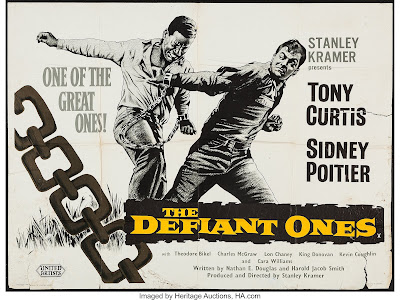
Fifty Years of Film in 50 Weeks, #38: The Defiant Ones, 1958

"You can't go lynchin' me--I'm a white man!"

The Defiant Ones, 1958

Director: Stanley Kramer
Writer: Nedrick Young, Harold Jacob Smith
Cinematographer: Sam Leavitt
Producer: Stanley Kramer
Starring: Tony Curtis, Sidney Poitier, Theodore Bikel, Charles McGraw, Lon Chaney, Jr., Cara Williams

Why I chose it
I had just heard about the death of icon Sidney Poitier at age 94, and immediately searched his filmography to see which of his films I hadn't seen, and this one from 1958 popped up. With the good reviews it garnered, it was the perfect choice.

'No-spoiler' plot overview 
A prison van transporting convicts crashes in a rainstorm at night in the rural South. Most of the convicts are injured, but two, John Jackson (Tony Curtis) and Noah Cullen (Poitier), have escaped when the authorities respond to the crash. The catch: the two, one Black and one white, are chained together at the wrists and must work together to avoid capture. The swamps, rushing rivers, and cold rain that they deal with serve as metaphors for the racism that they must also confront to both become free. During their experience, John ("Joker") and Noah begin to form a bond that leads to some surprising choices. All along, we also follow the efforts of the local sheriff (Theodore Bikel) and a state police sergeant (Charles McGraw), whose inability to get along may hinder their efforts to capture the convicts.
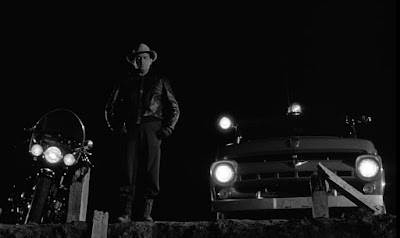
Sheriff Muller (Theodore Bikel) surveys the wreckage
that allowed two convicts to escape.

Production Background
Aram Goudsouzian's excellent biography of Poitier, Sidney Poitier: Man, Actor, Icon, goes into great detail about this film. I learned that Poitier's participation in the 1959 film Porgy and Bess, a role that he didn't want, came about largely as a negotiation piece because he coveted the role of Noah in The Defiant Ones. The latter story he believed was much more relevant to the state of racial politics and true to Black dignity. It didn't hurt that Stanley Kramer, a socially progressive director, was helming the piece. Interestingly, Tony Curtis, who had made his reputation on lighter or comedic roles, copped the role of "Joker" over many others who Kramer had sought, like Marlon Brando, Frank Sinatra, Gregory Peck, and Burt Lancaster, and during filming Poitier praised Curtis to Kramer, helping him to be satisfied with the casting.

During filming, both men punished themselves during the rigorous scenes by rarely using stuntmen. At one point, the latter, when standing around waiting for the stars to finish their scene in the river, had to rescue them downstream when they got in a bit of trouble in the rapids!

The film became a critical and commercial hit after its premiere at the Berlin Film Festival in June 1958, where Poitier won Best Actor.  He was presented with the trophy by Eleanor Roosevelt at her home in New York. Later, both Curtis and Poitier were nominated for Best Actor Oscars. The film also was an early step in breaking the blacklist, as its writer, Nedrick Young, one of those writers having refused to testify in front of the House UnAmerican Activities Committee (HUAC), won an Oscar for the screenplay. At first he was credited in the film with his pseudonym, Nathan E. Douglas, but when he revealed his involvement in the script prior to the Oscar ceremony, the Academy had to make an exception to their policy of not allowing awards for blacklisted writers. 

Not surprisingly, the film didn't get shown in many places in the South because theater owners feared white backlash. And even in the Black communities, the reception was mixed, because of the sacrifices the script demands of Noah Cullen, which played better to white liberals. Ultimately Poitier was proud of the picture, but downplayed the script's role, and his, in making an impact toward greater societal goals. The Civil Rights Movement was not yet in full swing.
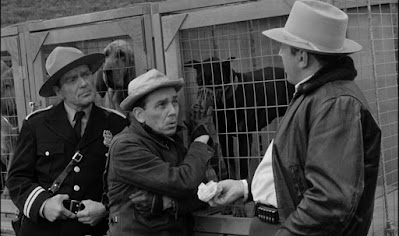
In a bit of recurring comic relief, King Donovan as Solly is always
fussing over his dogs that he is loaning to the convict search.

Some other notable film-related events in 1958 (from Filmsite.org):

  • The number of drive-in theaters in the U.S. peaked near 5,000.
  • Orson Welles' Touch of Evil (1958), with its breathtaking, three-minute, uninterrupted crane tracking shot under the opening credits, was the last of the film noirs in the classic period (from the early 40s to the late 50s). Universal was so unimpressed with the film that it was double-billed as the second B-movie film when first released, following the main feature The Female Animal (1958).
  • The Best Picture-winning musical Gigi, directed by Vincente Minnelli, set a new Oscar record by winning nine awards. It remains one of the few films to win all the awards for which it had been nominated. It also has the shortest title of a film to win a Best Picture Oscar.
  • A 21 year-old Jack Nicholson made his screen debut in producer Roger Corman's low-budget juvenile delinquent drama The Cry Baby Killer (1958).
My Random Observations
  • If anyone has any doubt that Poitier was a top-tier actor, I present this film as evidence. Two things stood out to me. First, his perfect accent and mannerisms convinced us that he could only be a Black man in the southern U.S. Remember, Poitier himself was born and raised in the Bahamas and spent his early adult years in New York City.  Second, his line readings sparkle. Listen to his short speech to "Joker" bemoaning how as a Black man he would have to suppress any instinct to stand up to injustice; his wife would always remind him to "be nice." And every time he repeated the words "be nice," his pitch went up as he imitated his wife, making it a brilliant and believable little speech. Watch that speech in the clip below.
  • Tony Curtis was excellent, too. He projected just the right blend of toughness, or rather "punk", and vulnerability that made his interactions with Poitier's character poignant. Yes, he's racist, but he's not a villain. What about that fake nose, though? Ugh! The makeup department added a prosthetic to his nose that was just enough to be noticed...and I was constantly distracted trying to determine if that really was his real nose or not. It turns out that it was used to make him look tougher and maybe uglier. Results are mixed. 
    Tony Curtis in profile: his nose looks like it may have been broken.
    Nope, just the makeup department trying to make him look tougher.
    It's still Tony Curtis, though, and he gets to attract women,
    even as an escaped convict.
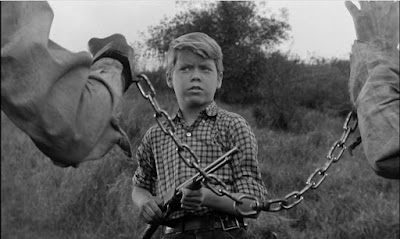
  • The script by Young and Smith, among other things, poignantly and unapologetically dealt with systemic racism. In the 21st century in which there is such an active discourse about the extent and power of systemic racism, I felt that the film could have been made so much more recently. The fact that it was made before the launch of the Civil Rights Movement in the U.S., is even more remarkable. There is a scene where Joker says, referring to a racial epithet, "I didn't make up those names!" Noah retorts: "No, you breathe it in when you're born, and you spit it out from then on." The visual representation of this truth happens later in the film where a young boy, roaming the fields with a gun, comes across the two prisoners and immediately assumes Noah is up to no good and Joker needs rescuing.
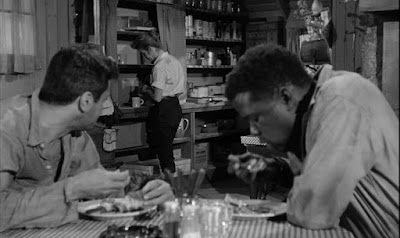
The men eat after Billy's reluctant Mom is told to feed
Noah as well as Joker.
Billy wonders what the white man must have done to be
shackled together with a Black one.

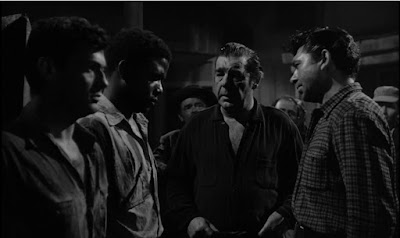
In small roles, Lon Chaney Jr., and Claude Akins discuss
the lynching of the two convicts they caught trying to steal food.
  • With one major theme being "coming together as a team when forced to confront challenges together", I couldn't help but think of the various "wilderness experiences" that are designed for groups as varied as corporate executive teams and troubled adolescents, as a way of enhancing leadership, empathy and collaboration. This film was literally a "wilderness experience" for John and Noah, and it certainly had the desired effect.
  • John "Joker" Jackson and Noah Cullen a little worse for
    wear after digging themselves out of a clay pit while shackled together.
  • In this week's edition of 'Bit Player Bingo", I present Carl "Alfalfa" Switzer, in his final film role as one of the locals called out to hunt for the escaped convicts. He would sadly die a few months after filming as a result of an altercation with guns. Like many child stars, he gained fame and fortune early in life but then struggled as an adult.
    Carl "Alfalfa" Switzer, with cap, center.
Where to Watch
At this writing, the film is streaming for Amazon Prime Video subscribers. It's also available on DVD.

Further Reading
Read the article on TCM here, and check out the excellent biography of Poitier here.

RIP, Mr. Poitier, and thank you.

Wednesday, March 29, 2017

And even more decisions -- my plan for TCM Film Festival 2017


I consider myself extremely fortunate to be off to sunny LA next week:  airline ticket, hotel, and festival pass are all ready to go--Hollywood, here I come!  My brain doesn't feel as fortunate at the moment, as I just completed going through the schedule day by day, time slot by time slot, trying to plan what films and events I'll attend.  Those of you who've attended the festival know that the struggle is real.  Last year, I did pretty well -- see my plan here and my post-conference blog report here.  Despite the pre-conference teeth-gnashing, I did find the exercise very helpful in minimizing the daily struggle once in Hollywood, and I'm hoping for the same result this year!

A post about the festival would not be complete without a mention of the patriarch of the network, the eminent Mr. Robert Osborne, who sadly passed away earlier this month at age 84, and will be sorely, sorely, missed.  He was the voice and face of TCM for so many years.  I was glad I had the opportunity to see him live at my first #TCMFF in 2013.  It's been announced that this year's festival is dedicated to Mr. Osborne's memory.  Good for them.

In reviewing the schedule and making selections, my general strategy is to program for myself a combination of the following -- a healthy dose of 'lesser-known' films for which this is a great opportunity; 'gap-filling' -- seeing classics that I'd missed until now; followed by old favorites that I would be thrilled to see on the big screen, and finally unique explorations of film history that the festival offers.  So here is my *tentative* plan for the festival. 

Thursday, April 6, PM

Early Show:  Thursday is opening night, and unless we move up considerably on the waiting list for the "Essential" pass, I doubt we'll be seeing Sidney Poitier's appearance for the screening of In the Heat of the Night.  Bummer!  There are some great films programmed in parallel, and I've seen all of them and don't have a strong desire to see them again this year (Some Like it Hot, Jezebel, Love Crazy) so the film history lover in me is thinking about going to the "Dawson City: Frozen Time" screening, in which selections of over 500 films that were lost but preserved due to being frozen under an old hockey rink near the Arctic Circle(!) will be shared.  I'm still on the overall fence on this so could be talked into Love Crazy (1941) with a favorite comedy team of William Powell and Myrna Loy.  

Late Show:  No question here, it's Harold and Maude.  Never seen this 1971 classic about May-December romance and am excited for it.  I'll be guzzling coffee beforehand.
Bud Cort and Ruth Gordon as Harold and Maude
Friday, April 7, AM
So now that we are initiated, the marathon begins.  At the nine-o'clock hour, I still need to decide between Rafter Romance (1933) starring Ginger Rogers before she teamed with Fred Astaire, and Cry, The Beloved Country (1952) with honoree Sidney Poitier.

Late morning it's Beat the Devil (1953), which spoofs the international caper film, starring Jennifer Jones and Humphrey Bogart, and directed by John Huston.  It's new to me, but sounds hilarious.  

Friday, April 7, PM
The first screening of the afternoon for me is likely to be Barefoot in the Park (1967), the classic based on the play by Neil Simon, starring Robert Redford and Jane Fonda.  Again, filling a movie-viewing 'gap' .  The final film before dinner is likely to be my first silent of the festival, an early Ernst Lubitsch called So This is Paris (1926).  I rarely pass up the chance to see silents on the big screen with live musical accompaniment, and this is no exception.  On the piano will be Donald Sosin, who I've seen perform at my neighborhood Coolidge Corner Theatre, with his wife Joanna.  
Dana Andrews & Gene Tierney
in Laura 

My evening selections will be Vigil in the Night (1940), a hospital melodrama starring comedienne Carole Lombard in a rare dramatic role.  I heard the Lux Radio Theatre radio recording of this, which included one of my favorites, Herbert Marshall, as the doctor, and I'm eager to see the film on which it's based.  That George Stevens directed is a bonus here.  Wrapping up the evening will be the noir/mystery Laura (1944), my choice among a tantalizing line up.  I've seen it, but I'm eager to see it again.  

Saturday, April 8, AM
Likely feeling the need to get 15 more minutes of sleep, I'll start the morning at 9:15 with Stalag 17 (1953), directed by Billy Wilder, and another 'essential' I haven't yet seen.  Jeopardy host Alex Trebek will be on hand to introduce the film.  After brunch, also known as a bag of popcorn while standing in line, I'll head over to see The Last Picture Show (1971) at 12:15. I have a soft spot for Westerns since my 'Western Movie Summer' last year. Actor Ben Johnson, a noted veteran of director John Ford's films,who was late in his career, won an Oscar for his role here. And a very young Jeff Bridges also has a prominent role. Director Peter Bogdanovich got his name on the map with this film, and will be present to screen his 'director's cut' version.  I anticipate enjoying this one quite a bit. 
Ben Johnson in The Last Picture Show
Saturday, April 8, PM
In the early afternoon, I'll take a break from movies and head to Club TCM to get to know Lee Grant in a Q&A discussion with the actress, and then stick around for a special presentation of home movies of famous classic Hollywood stars.  I've heard great things about this annual featured presentation.

After a quick dinner I plan on my first pre-code film of the festival, from 1931 it's Street Scene with lovely Sylvia Sidney, and directed by the fantastic King Vidor.  

The final film of the day is Preston Sturges' Unfaithfully Yours (1948) a dark comedy starring Rex Harrison and Linda Darnell.  The 'Czar of Noir' Eddie Mueller will be introducing the film.  

Sunday, April 9 AM
Assuming I'm still alive on Sunday, you'll find me first at Cock of the Air (1931), another pre-code, independently produced by maverick Howard Hughes, OR, at the film announced as the 'TBA' of the morning if it's more enticing.  Sticking with producer Hughes' work, the film version of The Front Page, also from 1931, is calling my name for the 11:30 slot.  Ben Hecht and Charles MacArthur wrote the play that inspired Hughes, and it also recently had a revival on Broadway with John Slattery, John Goodman and Nathan Lane.  It's a newsroom comedy with themes that are more than relevant today.  
Sunday, April 9, PM
Down the festival home stretch, after lunch I choose The Landlord (1970), a film with Lee Grant, whom I'll have gotten to know better from her live interview on Saturday afternoon.  The film is a 'dramedy' and directed by Hal Ashby, who also directed Harold and Maude.  If I'm in the mood for a bit of history, I might instead attend the "Republic Preserved" presentation about discoveries from 'Poverty Row' studio Republic Pictures.
At 4:30, it's time to wind things up with Detective Story (1951) with Kirk Douglas, William Bendix and Eleanor Parker, directed by William Wyler.  It will be hard to turn away from Singin' In the Rain, a picture I love but have seen recently, with Todd Fisher in attendance.  If my sentimental side wins out you'll find me there instead.
Harold Lloyd as a taxi driver, with Babe Ruth
 in Speedy
Last but definitely not least, is the classic silent clown Harold Lloyd in Speedy (1928), accompanied by the metallic sounds of the Alloy Orchestra, a group I've had the pleasure of seeing several times.  This film is perfect to kick off baseball season, as Babe Ruth, slugger and sometime movie actor, has a small role here!

After we've laughed ourselves silly, it will be time to party with all our friends, new and old, to wrap up the festival.  If I make it that far, and if I see half the films on this list, I'll consider the 2017 festival to be a success.

Sunday, February 19, 2017

Sidney Poitier Directs: Buck and the Preacher (1972)

The great Sir Sidney Poitier is celebrating his 90th birthday tomorrow, Feb 20, and in honor of his unique, distinguished career, this weekend a number of movie bloggers are participating in the '90 Years of Sidney Poitier' blogathon, hosted by Virginie of The Wonderful World of Cinema. Check out all the fabulous posts here.  I'm contributing a review of his first directorial effort, Buck and the Preacher, in which he also starred and produced along with his good friend Harry Belafonte.

In 1972 Poitier was an established star with his most iconic films behind him.  For this first directorial effort, Poitier worked in the film genre which enthralled him the most growing up -- the Western.  In fact, his earliest dreams of Hollywood involved him becoming a cowboy.  This immigrant from the Bahamas, who epitomized the American dream when he, in fact, rose from abject poverty, without a formal education, to the pinnacle of fame, chose the most American cinematic form to tell a story that illuminates a little known piece of African-American history.  Buck and the Preacher entertains and educates, and is a must-watch for fans of Poitier, Belafonte, or Western movies. 

Poitier wasn't originally supposed to direct the film.  His long-time friend actor/producer Harry Belafonte reached out to him with a movie he wanted to make based on story by Drake Walker about African-Americans in the West.  Belafonte and Poitier would co-star and co-produce the film, and engaged Ernest Kinoy to finish the script.  The director they hired was Joseph Sargent, whose credits at that point were mostly television serials.  Early on, though, Sargent was fired when it was apparent to the producers that their epic vision of black heroes wasn't being adequately captured.  Long interested in taking up directing, Poitier did not hesitate to slide into the director's chair at Belafonte's urging, after some difficult negotiations with the Columbia studio execs. 

The narrative is a fictional account of real events -- former Southern slave families migrating west (primarily to Kansas) during the Reconstruction era, only to find themselves embattled by white bounty hunters paid to 'convince' these 'exodusters' to return to the South as sharecroppers to struggling white landowners.  The character of Buck (Poitier) is the wagon-master making a living helping the emigres, and goes on the lam after a shoot-out with a particularly nasty gang of mercenaries led by Deshay, played by Cameron Mitchell.  The gang is after Buck when he happens upon the itinerant con man-cum-preacher (Belafonte).  At first wary of each other, they forge a partnership when the Buck finds his strength is a match for his latest foes only when paired with the wiliness of the Preacher.  The two team up to lead a group of Louisiana emigres through dangerous Indian country while avoiding the mercenary gang.  In an underwritten character, Buck's wife, Ruth (Ruby Dee) only wants Buck to give up his dangerous profession so they can make a life for themselves.
Poitier as 'Buck' coming across a scene of carnage and destruction
In the early 1970s, traditional Westerns were in a decline, and the revisionist Westerns, in response to the war in Vietnam and changing cultural mores, arguably had peaked as well (think The Wild Bunch, Little Big Man, and many more).  But films marketed to black audiences ("Blaxploitation'), and films with significant African-American characters were gaining traction with the broader market. Both Belafonte and Poitier were uniquely positioned, as civil rights champions and powerful stars in Hollywood, to capitalize on this trend and make a film that they felt would reclaim some of the history of African descendants in a new land.  

In plot outline and thematically, Buck and the Preacher is a very traditional Western.  You have your heroes, or anti-heroes (cowboys or lawmen in other films), defending the helpless settlers against the powerful (ranchers, railroaders, etc.), who wish to maintain an older order, and must combat external threats (Indians) as well.  The good guys succeed due to their smarts, their willingness to fight and kill, their understanding of their enemy, and of Indians.  They are at odds with female characters over the choices they make.  Shades of Shane, Rio Grande, etc.  At the same time, here the Indians were portrayed as equals to the blacks, with legitimate claims to their land on which passage had to be negotiated.  The primary discontinuity here is that the besieged and their heroes are black, underscoring the fact that blacks in the West in the 19th century were not all servants or marginal to the action of settling the West.  In parallel, the white characters, with a minor exception, were brutal villains who deserve to be cut down at the hands of the former slaves.  These paradoxes didn't escape the notice of critic Vincent Canby of the New York Times, who wrote at the time "the film is a loose, amiable, post-Civil War Western with a firm if not especially severe Black Conscience."
Our heroes (foreground) negotiate with leaders of the Native population (Enrique Lucero and Julie Robinson)
While Mr. Canby goes on to lightly praise the film, and while I don't totally disagree with his assessment, my experience of the film was that it was more than 'loose and amiable.'  As director/storyteller, Poitier kept a kinetic pace, with fast editing, especially in the early scenes where the first shootout occurs in the first 10 minutes.  Interesting high and low camera angles and stunning scenic visuals (the film was shot in Durango, Mexico) keep your attention.  There are some outstanding scenes, including a showdown in a whorehouse where our heroes cunningly ambush their enemies playing cards and visiting upstairs whores.  And great tension is built and released multiple times in this and other confrontations along the journey.  The soundtrack by jazz musician Benny Carter adds a bluesy-style jangle that punctuates key moments. (The main theme is on YouTube here).  There also is quite a bit of humor, especially with Belafonte's portrayal of the Preacher (of the 'High and Low Order of the Holiness Persuasion Church').  Contrasted with solemn, stoic Buck, Belafonte's Preacher is all slithery energy -- when not capturing him jumping around, the camera lingers on his expressive face, where all sorts of contortions play out.  Yet he has guts, as when he doesn't hesitate to punch Buck in the face for stealing his horse.
Belafonte as the 'Preacher'
As Poitier served as the film's co-producer, director, and star, we learn much about Poitier's sensibilities, his desire to do honor to his kinfolk of African origin while advancing the art of cinema. In my opinion, he succeeded. In addition, black cultural critics, including author and critic Nelson George of the Village Voice, generally praised the film. Unfortunately, while doing modestly at the box office, the film did not turn a profit, and Columbia did not renew Poitier's production contract.  Perhaps more unfortunately, Hollywood did not pick up the main threads in the story to produce more films exploring the life of African-Americans in the West.  While Poitier apparently was not completely satisfied with the final film, and found his own performance 'dull', he thoroughly enjoyed his experience as a director.  He went on to further hone his directorial skills, with a total of nine film credits to his name.

A final note: Harry Belafonte is also celebrating his 90th birthday soon -- on March 1st.  Happiest of days to both esteemed entertainers!  Enjoy the first encounter these two have in the film, courtesy of TCM, here.

Sources:
George, Nelson, Blackface: Reflections on African Americans in the Movies; Cooper Square Press, 2002.
Goudsouzian, Aram, Sidney Poitier:  Man , Actor, Icon; University of North Carolina Press, 2004.
Slotkin, Richard, Gunfighter Nation; University of Oklahoma Press, 1998.
TCM.com article on Buck and the Preacher