Search This Blog

Showing posts with label Olivia de Havilland. Show all posts

Sunday, September 12, 2021

Fifty Years of Film in 50 Weeks, #26: To Each His Own, 1946

"Although (screenwriters) Charles Brackett and Jacques Théry are not telling anything new in "To Each His Own," which follows the broad pattern of countless tales about the grief of unwed mothers, they have worked in a few refreshing twists."  
--NY Times reviewer Bosley Crowther, May 24th, 1946.

To Each His Own, 1946

Director: Mitchell Leisen
Writers: Charles Brackett and Jacques Théry
Cinematographer: Daniel L. Fapp
Producer: Charles Brackett for Paramount Pictures
Starring: Olivia de Havilland, John Lund, Mary Anderson, Roland Culver, Philip Terry, Bill Goodwin, Griff Barnett

'No-spoiler' plot overview 
In a tale told in flashback, middle-aged business executive Miss Jody Norris talks to her London colleague Lord Desham about why she gives her life over to work. As a young woman, helping her father in his drug store in Piersen Falls, USA, during the time of the Great War, she meets a young combat pilot (Capt. Cosgrove) with whom she has a secret and brief affair before he is killed in action. She retreats to NYC to have her baby, a son, and despite her wanting to keep him, he is adopted by her friends Corinne and Alex Piersen who don't know the truth about his birth parents. Jody plays nanny to the little boy until she can find a way to convince them to give her her son back. Meanwhile, she throws herself into work, and nearly single-handedly converts her friend and former beau Mac's bootlegging operation into a cosmetics factory that brings her wealth and status. Her efforts to get her son back don't go as planned, of course, and she must make a choice once her grown son crosses her path.

Production Background
To Each His Own was a significant film for Olivia de Havilland for at least two reasons. First, it won her first Oscar for Best Actress, and second, it was her "comeback" role after her legal battle with Warners' seeking early termination of her contract. She won the lawsuit, and what became known as the De Havilland Law, that prevented movie studios from indefinitely extended actors contracts that limited their options and creative freedom. She had been off the screen for two years prior; her previous film was 1943's Government Girl.

De Havilland campaigned to have Mitchell Leisen direct the film, as she thought the material would be elevated from its soap opera foundation, as she was thrilled with his work directing her in Hold Back The Dawn (1941), also a wartime romantic melodrama. A name largely unrecognized today, Leisen helmed many successful A pictures at Paramount (including Death Takes A Holiday (1934) that I wrote about here), and de Havilland and other actors felt supported by him. Leisen worked closely with Charles Brackett to polish the script and make de Havilland's character more nuanced. The film also marked the debut of actor John Lund, who played both Jody's lover and her grown son. 

Some other notable film-related events in 1946 (from Filmsite.org):

  • Disney's first live-action feature film The Song of the South was released, with three major segments of animation; it was based upon Joel Chandler Harris' Uncle Remus folk tales regarding Br'er Rabbit; due to extensive protests (mostly by the NAACP) over the stereotypical representations of blacks in the film and the film's romanticizing of slavery, the controversial film was never released on home video for US audiences
  • The most famous role and peak performance of WWII's GI "love goddess" - the beautiful, alluring, and provocative, red-haired pin-up Rita Hayworth - with her sleek and sophisticated eroticism, lush hair and peaches and cream complexion, was in director Charles Vidor's Gilda
  • Director William Wyler's The Best Years of Our Lives won Oscars for Best Picture, Best Director, and Best Supporting Actor in 1947. It was a classic post-war film that poignantly portrayed the readjustment of veterans and their families after their return home. Double amputee and amateur actor Harold Russell became the only actor to win two Oscars for playing the same role, a returning GI named Homer Parrish. He was awarded a special Academy Award for "bringing aid and comfort to disabled veterans," and then also won the year's Oscar as Best Supporting Actor.
  • French critic Nino Frank was credited as being the first to coin the phrase "film noir" in reference to Hollywood movies in the 40s (dark crime dramas and gangster films, psychological thrillers, etc.) that combined gritty expressionistic cinematography and bleak, hard-boiled writing - from novelists such as James M. Cain, Raymond Chandler, and Dashiell Hammett. His article was published in the French film magazine L'Ecran Francais (August 28, 1946 issue).

My Random Observations

  • Olivia de Havilland owned this movie. In addition to being in nearly every scene, she in effect played two distinct characters: the ingenue and the hard-nosed businesswoman with a secret. The former was shades of Melanie Wilkes, and the latter was a warm-up for her older character in The Heiress. Come to think of it, that was another film requiring her to portray great range. 
    Middle-aged Jody immediately before the flashback begins...

    And with the power of lighting and makeup, she
    is transformed to a younger woman.
  • It was refreshing that the main character was allowed to be unsympathetic at times. When she blackmailed Corinne to get her son back (then at schoolboy age) you rather rooted against her. But when she was sympathetic it wasn't just when she was a young innocent following her heart; it was when she showed a better business head than her male colleagues and worked circles around them.  And she clearly enjoyed the success her career gave her.
Jody gets to work to convert Mac's (Bill Goodwin,
right) bootlegging operation to a cosmetics plant.
  • Any film about unwed motherhood made in the 1940s will be dated, and while you do feel for Jody here, and rue the societal forces that conspired against her, to me adoption by a loving (if vain) mother is a special calling that should be honored. So I winced during those moments when Jody was trying to wrestle "Griggsy" away from Corinne and Alex. And the ending was sour for me (Warning: Spoiler ahead). While it seemed a fait accompli that the adult Griggsy would be made aware and be reunited with his birth mother, the fact that that revelation was made during his wedding I felt was wrong. Even though it was lovely that Lord Desham arranged for the quick wedding before Griggsy was to ship out, the evening should have been about the wedding and not a reunion that really wasn't needed. (And I 100% with Bosley Crowther's statement at the beginning of this post).
Jody preparing to blackmail the unsuspecting
Corinne (Mary Anderson) by offering to bail her husband
 out of financial ruin if they give her back their/her son.
Lord Desham (Roland Culver) encouraging Jody
to tell about her younger years.
  • Who were all these wonderful character actors?! I've been used to recognizing well-loved character actors over and over again, so my experience with this film was just...odd. Perhaps because I've seen fewer Golden-age films from Paramount? Regardless, one I recognized slightly was Griff Barnett as de Havilland's father, as he had some small roles in some Alan Ladd films of the era. He was wonderful.
    Griff Barnett as the wise father.
  • Speaking of Alan Ladd, John Lund bore an uncanny resemblance to Ladd, although Lund was, of course, taller. Ladd and de Havilland had worked together in 1958 in the underrated and heartwarming The Proud Rebel.
    John Lund as Capt. Cosgrove
  • This picture was lush and evocative. I've learned Mitchell Leisen was apparently very attuned to period detail in set design and costuming and insisted on 100% accuracy. That gave his films a sense of time and place that elevated his films.
First indication she's pregnant -- she very deliberately
drinks milk in her father's small-town drug store.

Stylish and successful, Jody takes no prisoners.
Where to Watch
Unfortunately, this one is difficult to find commercially. It isn't available on DVD in the U.S., although it was released on VHS. A rough print is available on archive.org here

Further Reading
A detailed analysis of the film is provided in this article in Film Comment magazine.

Saturday, July 2, 2016

Elegance on Television -- Olivia de Havilland on 'What's My Line?'

I'm pleased to help celebrate the great Olivia de Havilland as part of her 'Centenary Blogathon' hosted by Phyllis Loves Classic Movies and Crystal from In the Good Old Days of Classic Hollywood.  Check out the great posts over the past couple of days HERE.
Not unlike today, movie stars of the classic Hollywood era were in high demand beyond their film appearances.  They made public showings at film premieres, war bond drives, and other charity fundraisers. They were, of course, featured in popular film publications, and were paid to hock all kinds of products, often liquor and cigarettes, in print ads.  With the advent of television in the 1950s, movie stars had the opportunity to promote themselves in this new medium by joining game shows such as Password, and the popular panel show "What's My Line?".

Now that so many of the show's episodes can be sourced online, we can treat ourselves to a fascinating time travel experience, when even well-acquainted men and women addressed each other primarily as "Mister", "Miss" or "Missus."  The primary portion of the show was devoted to panelists asking non-celebrities questions to identify their 'line' of work.  Often these were unusual, like, 'Mud Bath Attendent' or 'Dynamite Salesman'.  The later part of the show always featured celebrity 'mystery guests'.  I find it fascinating to watch these classic stars as they were in real life, interacting with the host, John Daly, or the panelists, who, while blindfolded, tried to guess the star's identity using only yes or no questions.  Despite the stars' often humorous attempts to disguise their voices, they could not conceal their basic personalities, nor their natural wit (when present).  It was a special joy to see the lovely Ms. de Havilland in her four appearances on the program between 1958 and 1965, when she was an already long-established star in semi-retirement, but only halfway through her life to that point.

Her first appearance: May 25, 1958.  


Note for this and the other clips -- fast forward to about 2/3 of the way through
Here she initially appeared a bit nervous as she took her seat alongside Daly, at first wearing a broad charming smile but then turning serious as she contemplated being 'interrogated'.  She answered the questions yes or no in French, and then put on a charming French accent for her longer, English, responses.  This approach is not surprising because she'd been living in France for a few years by this time and seemed to be very happy there -- she'd moved there to start a life with second husband Pierre Galante.  She is altogether delightful in the mode of a modest French coquette.

Panelist Arlene Francis:  "Are you a happily married actress?"
de Havilland: "OUI!" (with a big smile).  And "call me madame!"

Her identity is revealed by Ms. Francis asking "are you the star of THE PROUD REBEL?" which Ms. Francis and long-time panelist Bennett Cerf had just seen the night before; both commented about how much they loved it, to which de Havilland said "I haven't seen it yet."  Cerf then made the insightful comment "It's a tender, beautiful picture".  In this western, featured in the blogathon here, De Havilland starred with Alan and David Ladd, and according to Ladd's biographer, Beverly Linet, had warmed the elder Ladd considerably when she told him she thought he'd have made a great Ashley Wilkes.

2nd Appearance: March 4, 1962

In this appearance Ms. de Havilland is as charming as before, but she seemed a bit more worldly, or less coquettish.  After eight years of marriage, this is the year she would separate from her husband.   Instead of French, she put on a rather Appalachian-sounding accent -- instead of 'yes', it's 'YAY - ess' .  It's delightful  how she surprised herself with that accent, almost chuckling after her answers.
At this time, de Havilland was in New York starring in the Garson Kanin play "A Gift of Time" alongside Henry Fonda.  The play ran 92 performances and about three months.  It was common for Hollywood stars, when acting in a show in New York, to stop by 'What's My Line?'; if so, it was easy for the panelists to ask about this and quickly identify the guest. In this episode we learn that Random House, panelist Bennett Cerf's company, was in the process of publishing de Havilland's memoir Every Frenchman Has One.  He very shrewdly mentioned the book, without its title, to what I expect was a very interested audience.

3rd Appearance: August 9, 1964
In this episode the panel includes regular, noted journalist Dorothy Kilgallen, Cerf, Francis, and as special guest panelist, celebrated film writer Joseph Mankiewicz, who, in case you've never seen him before, as I hadn't, provides an extra bonus to viewers. While a guest panelist in only three episodes, he added an interesting depth and seriousness to the proceedings.  One of the questions to de Havilland, asked by Francis, was "Have you ever appeared in a picture written by Mr. Mankiewicz?", to which de Havilland had to say no, with a look of regret.  Bennett Cerf, again, slyly referenced his publisher relationship with de Havilland, when she sweetly mentioned how all the panelists were her friends.  In this episode, rather than putting on an accent or speaking a language other than English, de Havilland disguised her voice by using a husky, hoarse whisper.  This prompted a joke among the panelists that they should have recognized her from her low husky voice!

While appearing in this episode, de Havilland had recently finished LADY IN A CAGE, a horror/thriller also starring James Caan, released a couple months before the show aired.   She seemed a bit embarrassed when the film was brought up, and no wonder -- it hadn't been particularly well received.  New York Times critic A.H. Weiler had commented on its "aimless brutality", although he said some positive things about de Havilland's performance.  Kilgallen was nice enough to compliment de Havilland by stating 'Another wonderful performance, Olivia."

4th Appearance:  August 8, 1965


Almost a year to the day since her previous appearance, and now an 'old friend' according to John Daly, de Havilland joined the show again as mystery guest.  She now answered the questions in Russian, using the familiar 'Da' and 'Nyet', and some other longer Russian words that were the source of great amusement for the panel.  The guest panelist this time was the humorous Carol Channing.  In quite the contrast from her previous film, de Havilland was now fresh off the critical success of HUSH HUSH SWEET CHARLOTTE, with Bette Davis, Robert Aldrich's follow-up to the highly successful WHATEVER HAPPENED TO BABY JANE?  This one was nominated for seven Oscars and won a Golden Globe for Agnes Moorehead.  Check out this post on the film for the current blogathon.

One glimpse into de Havilland's acting style and preference could be gained from her definitive 'Nyet! when asked whether she had been associated with the Actors' Studio, at this point quite notorious for turning out a new style of method actor like Marlon Brando. She also denied being anything other than a serious, as opposed to comic, actress, and also to not being associated with singing or dancing in her films.  Interestingly, despite this being her fourth time on the program, none of the panelists guessed her identity and Daly had to call time and reveal her.

It was fun to learn more about Ms de Havilland through her appearances on this popular show. While there were no great revelations, my image of her as a gracious, generous, strong, and charming woman were all reinforced, and I felt as if I had met her, even for only a brief moment. Here's adding my wish for her for many more years of health and happiness!

Wednesday, June 15, 2016

Western Movie Summer Part 1: DODGE CITY and JESSE JAMES

I had such a fantastic experience with last year's "Summer of Darkness"--studying film noir with TCM, Ball State University, and several thousand other eager 'students'--that I found a big hole this summer in my film-studying agenda.  To address that, I've decided to learn about the western genre with the help of a course recorded in 2008 by Richard Slotkin at Wesleyan University and now available in podcast form from "iTunes University."  The course is "Western Movies: Myth, Ideology, and Genre."  The western is a film genre that I wouldn't call my favorite, but one that I've come to appreciate more lately.

Professor Slotkin is an English professor, author, and American cultural historian. Understanding the historical context of film is one of the many reasons I love the classics, and this series offers the opportunity to focus on this aspect of the films.  The course recordings include 18 separate lectures featuring that many films, and proceed roughly chronologically.  While it seems unfortunately that some lectures featuring westerns in the silent era were not recorded, the earliest lectures available start with some classics from 1939.  Approximately every other day during my work week I'll listen to a lecture on my morning commute, and in the same week I'll view the films.

As shared by Prof. Slotkin, the Western was starting to make a resurgence in the late 30s, as standard depression-themed films or pure escapism in screwball comedy was starting to run its course.  Westerns now presented an opportunity to reclaim an optimistic past while still commenting on the pros and cons of capitalism, of which 1930s audiences were all too aware.  The course starts with two films made in 1939 that are new to me: DODGE CITY and JESSE JAMES.  These two films present a view of the west through two very different philosophical lenses, according to Prof. Slotkin.  I enjoyed both of them.

DODGE CITY
This Warner Bros. film, starring Errol Flynn and Olivia de Havilland, and directed by Michael Curtiz, is not dissimilar to the swash-buckling adventure films that catapulted Flynn to stardom, often alongside de Havilland.  It has a light-hearted tone through most of it.  Flynn plays an opportunistic cattle trader who helps the railroad establish a foothold in west by making Dodge City, KS, a booming cattle town and prominent new railroad stop, safe from those Western-style gangsters that are extorting citizens for their own gain and benefiting by ensuring lawlessness and violence prevail.

Of the two, this film, argues Prof. Slotkin, has a more pro-capitalistic outlook, as the railroad is presented as a herald of technological and societal progress.  As long as society has heroes like Flynn who will step up and make it safe for women and children, order and progress will win and benefit all.  There is a bit of tension in that *too* much domesticity is ridiculed in the figures of the older women of the "Pure Prairie League", in contrast to the fun women in the neighboring saloon as represented by singer Ann Sheridan, and all the drinking, partying men who raise hell in an extended barroom brawl sequence that is as fun as it is frenzied.

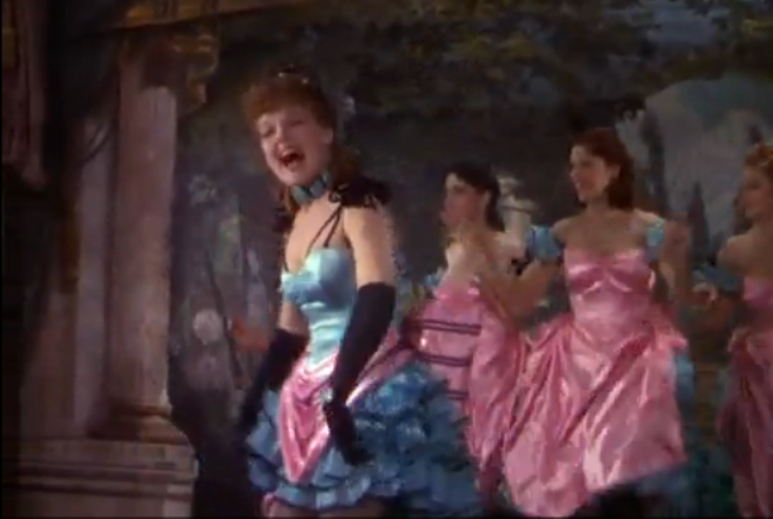
Ann Sheridan and her fellow saloon ladies in bright,
crisp pastels
Alan Hale reluctantly accepts a cup of tea
from the ladies in the 'Pure Prairie League'.  His
being inducted as a member is a wonderful comic touch.
I would agree that this film did capture a sense of optimism, of expansion, using 'right' along with 'might'.  I felt that, unlike JESSE JAMES, the point of view or message of the film was not overly heavy-handed.  Of course, the film stayed away from controversial topics such as the human cost of western expansion for the Native Americans.  For pure enjoyment and joyful tone this film is close to DESTRY RIDES AGAIN, another film from 1939 that I really enjoyed, and wrote about here.  I am not particularly a fan of Errol Flynn, and while he was fine here, I found myself taken with Alan Hale's portrayal of the loyal, and somewhat comic sidekick.  Olivia de Havilland was lovely and feisty, and while eventually succumbing to Flynn's wishes for domesticity, she did have an opportunity to earn a living at the local newspaper.

A very different, but equally enjoyable 1939 big budget western, is 20th Century Fox's  JESSE JAMES, starring Tyrone Power and Henry Fonda, with Henry King directing.  This one apparently started the 'cult of the outlaw' in popular culture, and there have been upwards of a dozen films on the subject of James.  Here, the railroad figures prominently again, but instead of a sign of progress, it's a sign of capitalist oppression, a sentiment that would be understood by a great number of Americans in the late 1930s.  James himself is initially portrayed somewhat fictionally as being driven to becoming an outlaw as a result of his family and farmer neighbors being illegally threatened by corrupt (railroad) businessmen.  He's someone we root for, and then he goes wrong as he finds he can't resist the criminal life even when better forces, namely the women in his life try to bring him back to the straight and narrow.

Unlike Olivia de Havilland's prominent role in DODGE CITY, the female lead here, Nancy Kelly, has not much to do other than moon and grieve over her man.  Nearly of the shots of the couple together feature Power over Kelly.  Power, obviously, was the big matinee idol, and was playing against type as the scruffy outlaw.  His acting chops were on display, as he was convincing and rather good in the role, as was Henry Fonda as his brother Frank James.  It's a well-paced western with action, pathos, and beautiful on-location vistas in and around Pineville, Missouri. (While the cast and crew were celebrated by residents of Pineville while on location, I was horrified to learn that at least one horse was killed by the stunt it was forced to do in a key scene). While punctuated by comic touches, especially from Henry Hull's blustering newspaperman, the tone of the film is darker than DODGE CITY.  Despite the fault of the opportunistic capitalists, the message that a life of crime doesn't pay, and ultimately can't be justified, is clear.

Power as James cannot be talked out of his next criminal venture.
It was a film that left me interested enough to consider watching the sequel.  Incidentally I recently watched a lesser western called KANSAS RAIDERS (1950) about James' early experiences with renegade confederate leader William Quantrill.  This film, starring Audie Murphy, was also greatly fictionalized but the portrayal of James as a 'misunderstood kid trying to do good but going wrong' is fully intact in this one as well.
The clear message would have been appreciated by 1930s audiences.
Next up in the lecture series:  STAGECOACH and OX-BOW INCIDENT.

Tuesday, February 2, 2016

Dramatic actors go all screwball in IT'S LOVE I'M AFTER

This is a first in a series of posts honoring Ms. Olivia de Havilland, one of the great ladies of classic cinema, who is celebrating her 100th birthday this year.

So, you have Leslie Howard, Bette Davis, and Olivia de Havilland in a film, and you end up with ... a screwball comedy?  Well, if the movie gets made in 1937 and all three stars are coming off dramatic roles, perhaps it's understandable. The movie is IT'S LOVE I'M AFTER.
In looking for an early and lesser known film of Ms. De Havilland's to watch for the first time, I came across this one and was delighted.  All three stars are up to the comic demands of their roles, and despite a bit of over-the-top silliness (not altogether unexpected), I highly recommend the film.  It's on DVD from the Warner Archive label.

Leslie Howard, who I've only recently seen outside GONE WITH THE WIND where I find him sadly miscast, is a revelation here.  He is in full ham mode as celebrated Shakespearean stage actor who is a stereotypical egotist and in love, although constantly engaged in a snipe-fest with, his leading lady Bette Davis.  He prances and poses throughout the film but retains our sympathy while we laugh at him.  As for Ms. Davis, her role could be considered a warm up for, or younger version of, her Margo Channing in 1950's ALL ABOUT EVE. Ms. de Havilland is perfect as the young innocent who develops a consuming crush on Howard just by watching him act.  She is beyond lovely; her luminous beauty and infatuation are both depicted in the shot in which we see her for the first time watching Romeo's death scene:
"Oh Romeo, drop that poison right now and run away with ME!"
Her frustrated fiance, played straight by a handsome but somewhat wooden Patric Knowles, looks on, not anticipating the lengths he's about to go on trying to win back her affections.

Directed by Archie Mayo, the screenplay makes the most of propelling the plot forward by overtly incorporating plots and dialogue from contemporary and Shakespearean plays.  Shakespearean dialogue is also injected with insults when the dead Romeo whispers to his hovering Juliet that she has been eating too many onions again.  A play called "A Lover's Triangle" forms the framework of the plot as Howard agrees to Knowles' plan to drive de Havilland back into her fiance's arms by playing the cad and wreaking havoc after moving into her home as a barely-invited guest.  Eric Blore as the butler (!) has an unusually large role and makes the best of it, always in an advanced state of frustration trying to keep Howard from indulging the lesser angels of his nature.  His comic energy most often comes from bouncing off of Howard, and is at its apex in a scene where he acts and sounds out different types of birds to keep Howard in line (interestingly TimeOut London calls his performance 'execrable'):
Davis is trying to figure out why Eric Blore is doing jumping jacks while making bird calls at a refined garden party.
Apparently this project was initiated by Howard, who wanted to have some fun after several dramatic roles including in THE PETRIFIED FOREST, also with Bette Davis.  Warner Bros. had to put pressure on Davis to work with Howard again, as their relationship was rocky, and who had also wanted some vacation time after an exhausting year of dramatic roles.  Ms. de Havilland was on her way up, and, unfortunately, had to fend off the advances of Howard quite vociferously during filming.  With two beautiful leading ladies, clearly Howard was enjoying every second of the attention he was getting.

Notable tidbits to recommend the film:
--Likability of the three main characters
--Terrific comic ensemble scenes.  There is a scene early on where Howard noisily pushes his way into de Havilland's mansion in the middle of the night and is going on loudly about how raised is his 'ire', when all the servants think they hear "FIRE" and come to the rescue with filled water buckets.  [Ok, I guess you just have to trust me on that one.]
--Apparently men in tights were a thing to contemporary women of the time:  a joke is made near the end of the movie about how women love to see male actors wearing this kind of costume.  Uh huh, yeah.
--A film inside joke (and GWTW connection) when de Havilland claims how she had a crush on Clark Gable (!) before the one on Howard's character. "I was in love with Clark Gable last year and if I can get over him I can get over you!" "Who's Clark Gable?"

What I disliked:
--Bonita Granville overplayed her signature spoiled brat part and should have been dialed down several notches, even if this was a screwball.
--Not enough George Barbier, who played de Havilland's exasperated father with perfection, or Spring Byington, as her mother.
--As mentioned earlier, Patric Knowles comes across too wooden here for my taste.
--Eric Blore's extreme characterization - at times - would have bothered me more if not for how well he worked with Howard.

Here are a few key moments from the film:
Romeo (Howard) and Juliet (Davis) battling over who gets the first curtain call
Howard strikes a dramatic pose as he contemplates the next move in his complicated love life
Blore as Howard's faithful, if continually frustrated, conscience
Knowles is dismayed when de Havilland seems unfazed by Howard's caddish ways
George Barbier is at his wits end thanks to his daughter's fascination for uninvited houseguest Howard
Howard tells de Havilland she has too many moles(!)
"Remember, my darling, 'all the world's a stage'"