Search This Blog

Showing posts with label Tyrone Power. Show all posts

Friday, June 25, 2021

Fifty Years of Film in 50 Weeks, #19: The Rains Came, 1939

"Who is the pale copper Apollo?"
(Myrna Loy, meet Tyrone Power).

The Rains Came, 1939

Director: Clarence Brown
Writer: Phillip Dunne and Julien Josephson, from the novel by Louis Bromfield
Cinematographer: Arthur C. Miller
Produced by: Darryl F. Zanuck and Harry Joe Brown for 20th Century Fox Studios
Starring: Myrna Loy, Tyrone Power, George Brent, Brenda Joyce, Nigel Bruce, Maria Ouspenskaya, Joseph Schildkraut

Why I chose it
My Twitter polls have been slowly adding votes with every new poll, and this had a total of 15. This film won appxoimately 2:1 over the next two runners-up (Midnight and The Adventures of Sherlock Holmes). As I had no other criteria to choose this time, I was pleased to follow the wishes of my voters and watch this star-studded disaster/melodrama.

'No-spoiler' plot overview 
In a fictional small town in India called Ranchipur, a motley group of natives and foreigners, the latter being mostly English and Americans, get caught in a series of natural disasters that devastate the town: an earthquake followed by a tsunami and then a breakout of the plague. The main characters are Tom Ransome (George Brent), a cynical womanizer who is pursued by Fern (Brenda Joyce), the ingenue daughter of the local American missionaries; we learn Ransome has history with newly arrived Lady Edwina Esketh (Myrna Loy). Lady Esketh, for her part, married for money (we think?) to a much older Lord (Nigel Bruce) and continues her man-eating ways by pursuing the stoic, dedicated local 'high caste' doctor, Major Rama Safti (Tyrone Power). When she joins up to help the Major as a hospital volunteer working with the sick and dying plague patients, she's faced with a difficult decision when the Major can be appointed Maharaja only if he gives her up.

Production Background 
This film was Fox head Darryl Zanuck's moment in the sun. He bought the rights to the Louis Bromfield novel and went about putting his dream team together in 1939 style. He borrowed Myrna Loy and director Brown from MGM, and Brent from Warner Bros. Apparently no one was to his liking for the ingenue role, Fern, so he recruited a college student, Brenda Joyce (who went on to have a successful, if not exceptional, career in front of the camera). The fantastic scenes of torrential rains and flooding dominated the picture and the set. Credit special effects man Fred Sersen, who with his department won the first-ever special effects Oscar for his work. Apparently Brown loved his time at Fox, stating that the departments worked well together, unlike at MGM where feuds and one-upmanship were the norm. Upon release the film garnered lukewarm reviews, but it did well at the box office; however, the expenses were only recouped years later on re-release. 

Some other notable film-related events in 1939 (from Filmsite.org):

  • Swedish actress Ingrid Bergman made her American film debut (and English-speaking debut) as piano teacher/concert pianist Anita Hoffman in Intermezzo: A Love Story
  • The California Child Actor's Bill, better known as the Coogan Law, was enacted. The child labor reform act took place after 24-year-old Jackie Coogan, who had starred in The Kid (1921) opposite Charlie Chaplin, sued his parents (mother and stepfather) in 1938 for mismanaging and exploiting his career and spending his acquired fortune as a young star. 
  • The future rival to film -- television -- was formally introduced at the New York World's Fair in Queens. The Radio Corporation of America (RCA) unveiled a display of its first TV sets for sale to the American public.
  • British actor Basil Rathbone, as Sherlock Holmes - with an Inverness cape and curved-stem pipe, was accompanied by dull-witted, pipe-smoking Nigel Bruce as Dr. Watson, in their first appearance together as the crime-fighting duo, in 20th Century Fox's The Hound of the Baskervilles

My Random Observations

  • I must have reached the level of film fan who can instinctively associate stars and directors with particular studios; it's for that reason that the mixing of Brent, Loy, and Power had me doing double-takes at the screen watching this film. Sort of a patchwork quilt of a production!
  • While I absolutely adore black and white films, I feel this one may have been more impactful on viewers if in color, especially during the year that produced The Wizard of Oz and Gone With The Wind at competing studios. (Yes, I know other great pictures that year, like Stagecoach and Mr. Smith Goes To Washington, were filmed in B&W).
  • At times I felt that Alfred Newman's score was overbearing and distracted from the dialogue or action. I loved the Indian music interludes, but the European orchestral part of the score could have been dialed back (as I write this, I recognize a parallel between the use of music in this film and the Western influence in Indian culture especially during the colonial era).
  • I have a totally new appreciation for George Brent. Before, whenever he showed up in a movie, I would wince or sigh in resignation. I realize that is largely my prejudice. But here, he astonished me. His character may have been the best written, with the roguish and generous elements in his personality dueling at times, and Brent knew exactly how to play it. His performance was, in my opinion, the best of the entire cast. Even with Tyrone Power at his peak of handsomeness, I couldn't take my eyes off of him.
  • I was having a sense of deja vu and realized it was because of the similar themes and plot points of The Painted Veil, the Somerset Maugham novel that was filmed in 1934 and 2006. In that novel, a young wife, who is superficial and selfish, follows her physician husband to Hong Kong, takes up with a handsome colonial official, but ultimately finds purpose and true love by working alongside her husband to curb a deadly outbreak of cholera in China.

Screenshots
The opening titles appear to wash away, one after another.

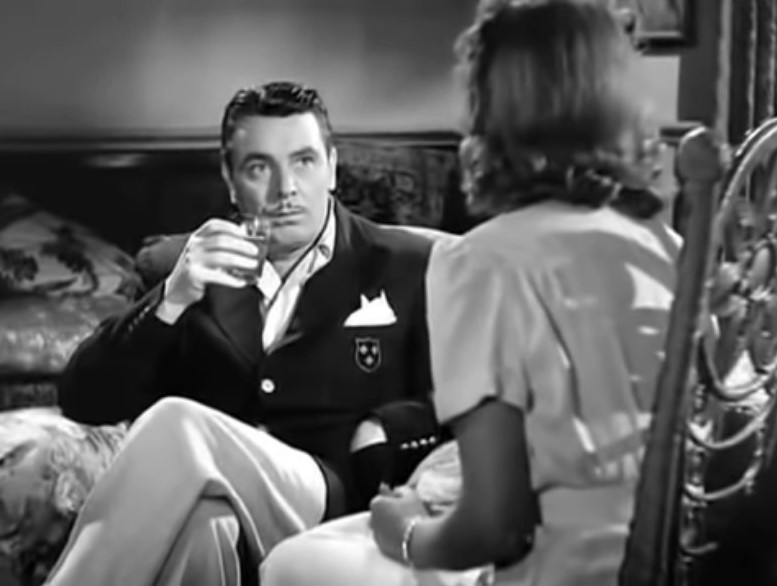
Ransome (George Brent) is content to sling pebbles at monkeys
outside his patio.

Elegant Tyrone Power dons brownface and a turban here
as Major Rama Safti.

Jane Darwell and Henry Travers run the American
Missionary School, and allow Ransome a respite from the
pretentious Mission owners next door.


Ransome not sure which part of his nature should win
when it comes to young Fern (Brenda Joyce).

H. B. Warner and Maria Ouspenskaya as Ranchipur's
Maharaja and Maharani.

Not a glimpse of a happy marriage (Loy and Bruce).

Ransome has his eye on the clouds as he takes a moment
to reflect on his past with Lady Esketh.

An unexpected romance begins to take root.

Lord Esketh's diary of his wife's dalliances.

During the floods, Fern comes to rescue Ransome and prepares
for a rest afterward.

Tom Ransome clings to the top of the statue of Queen 
Victoria, now mostly immersed in the rushing tsunami.
Symbolism, anyone?

Major Safti attends to the dying Maharajah.

Lady Esketh ponders her next move--in cards and in life.

Lady Esketh, masked against the plague, tends to a critically 
ill patient.

Major Safti's heart is pierced by the newly selfless Edwina.

Tom confronts Safti on his career choices.

Safti dressed for success, admired by the Maharani.

Where to Watch: I found a somewhat inferior print on YouTube here, and would instead recommend checking the DVD ("Studio Classics" line) out of your local library.

Further Reading
A major source for me was Mark Vieira's book Majestic Hollywood, The Greatest Films of 1939 (2013).
I also recommend Jeremy Arnold's article for TCM on the film with many juicy production tidbits, including Myrna Loy's relationships with others on the set and the tricks used by cinematographer Miller.

Thursday, September 1, 2016

September Classic Film Screenings in Greater Boston

After August delivered an abundance of classic film screening riches in the Boston area, with a bit of a chill in the air fast approaching, September is 'cooling down' on the number of options for cinephiles.  However, there are some exciting and notable offerings to report.

Somerville Theatre  -- Sept 16-24
The Somerville in Davis Square celebrates the start of fall with a Festival of screenings mostly devoted to the 70 mm format -- this includes both classic film in the era of epics shot originally on 70 mm, in addition to some more modern films adopted this format.  Films in this format are weightier, and in many cases offer more detail than even you'll see on your home Blu-Ray.  This is what makes these films ideal for big screens, as film-makers in the 1950s and 1960s learned, to compete with the increasing popularity of television.  Today, film-makers use this format to draw people to cinemas in the age of advancing home video technology and the proliferation of quality visual media offerings.
For those interested in attending most or all screenings, you can buy a festival pass for $200 (adult); individual features will cost $15.00 (The cost of making or restoring 70mm prints is higher than digital or 35 mm).  

Great classic & modern titles will be screened, including: LAWRENCE OF ARABIA (1962), BEN-HUR (1959), WEST SIDE STORY (1961), SLEEPING BEAUTY (1959), just to name a few.  I'm particularly excited to see THE WILD BUNCH (1969) on Monday Sept 19 & SPARTACUS (1960) on Saturday Sept 24.

Shockingly, both these well-regarded films have yet to be seen by me.  THE WILD BUNCH would continue my exploration of the Western film, and is directed by Sam Peckinpah and showcases aging classic actors known to apparently good effect:  William Holden, Ernest Borgnine, Robert Ryan, and two personal favorites, Ben Johnson and Edmond O'Brien.  In a film that is more than mildly influenced by Vietnam War politics, if I can tolerate the violence, I'm sure I'll enjoy it.
THE WILD BUNCH
SPARTACUS is a picture known for Kirk Douglas showing off his pecs, and more seriously defying the blacklist by hiring famed screenwriter Dalton Trumbo back under his own name.  Stanley Kubrick directed this period epic, and if I load up on caffeine for the 3+ hour running time, I'm sure the 70mm presentation on the big screen will provide quite the experience, indeed.
SPARTACUS
The retrospective of the films of Rouben Mamoulian finishes up Friday Sept 2 with BLOOD AND SAND (1941) starting at 7PM and THE SONG OF SONGS (1933) to follow.  I'm thrilled to be attending these screenings. Again, neither film I've seen, but I did see the 1922 Valentino version of the famous tale of the ill-fated love triangle in 19th century Spain, which was nothing if not entertaining.  In the 1941 technicolor version we get three of the brightest and most gorgeous stars to feast our eyes on: Tyrone Power, Rita Hayworth, and Linda Darnell.  The mise-en-scene created by Mamoulian is said to take on 'painterly dimensions' with masterful use of color and noir shadows (HFA website).
Rita Hayworth and Tyrone Power throw sparks in BLOOD AND SAND
Rudolph Valentino and Nita Naldi as lovers in the earlier BLOOD AND SAND
THE SONG OF SONGS is a lesser-known film made in the pre-code era (1933), and it stars Marlene Dietrich coming off of her apex with director Josef von Sternberg.  Here she apparently starts out as a naive young country girl but rapidly changes her character after getting involved with Brian Aherne. It seems to be an interesting melodrama with 'touches of humor.'  If I can stay awake I will definitely catch this one (in 35 mm)!
Brian Aherne & Marlene Dietrich in THE SONG OF SONGS
Coolidge Corner Theatre
The Coolidge is presenting their perennial favorite JAWS (1975) on Monday Sept 5 (Labor Day), which is a great choice of a date because I doubt anyone is planning to return to the beach after that date anyway(!).  It will no doubt be a fun crowd.
Richard Dreyfuss, Roy Schneider and Robert Shaw in JAWS
It's not my favorite Hitchcock, but it is for many and deserves a shout-out for Sunday Sept 25 -- REAR WINDOW (1954) screens in 35 mm film format at the Brattle.  Starring a mostly immobile James Stewart character and the lovely Grace Kelly playing amateur sleuth.  
REAR WINDOW
Sat Sept 24 deserves special mention here as it is the first annual "Art House Theater Day" -- in which over 160 theaters around the country have joined on to take part in showcasing their role in "celebrating the legacy of independent theaters as advocates for cinema arts."  For participating theaters there will be special screenings and giveaways.  In the Boston area both the Coolidge and the Brattle are taking part.  The Brattle is even extending the celebration to 'Art House Theater Week' from Sept 16-24, for which their screening of REAR WINDOW is a part.  Sounds like the start of a great tradition.  


A final 'special mention' for New Englanders is the weekend Telluride-by-the-Sea film festival Sept 16-18 in Portsmouth, New Hampshire.  This quaint seaside town and its historic theater 'Music Hall' bring patrons a selection of 6 films that are screened at the Telluride Film Festival in Colorado earlier in the month.  This is a lot of fun and a nice way to welcome in fall while seeing some newer films making the festival rounds -- highly recommended!

Wednesday, June 15, 2016

Western Movie Summer Part 1: DODGE CITY and JESSE JAMES

I had such a fantastic experience with last year's "Summer of Darkness"--studying film noir with TCM, Ball State University, and several thousand other eager 'students'--that I found a big hole this summer in my film-studying agenda.  To address that, I've decided to learn about the western genre with the help of a course recorded in 2008 by Richard Slotkin at Wesleyan University and now available in podcast form from "iTunes University."  The course is "Western Movies: Myth, Ideology, and Genre."  The western is a film genre that I wouldn't call my favorite, but one that I've come to appreciate more lately.

Professor Slotkin is an English professor, author, and American cultural historian. Understanding the historical context of film is one of the many reasons I love the classics, and this series offers the opportunity to focus on this aspect of the films.  The course recordings include 18 separate lectures featuring that many films, and proceed roughly chronologically.  While it seems unfortunately that some lectures featuring westerns in the silent era were not recorded, the earliest lectures available start with some classics from 1939.  Approximately every other day during my work week I'll listen to a lecture on my morning commute, and in the same week I'll view the films.

As shared by Prof. Slotkin, the Western was starting to make a resurgence in the late 30s, as standard depression-themed films or pure escapism in screwball comedy was starting to run its course.  Westerns now presented an opportunity to reclaim an optimistic past while still commenting on the pros and cons of capitalism, of which 1930s audiences were all too aware.  The course starts with two films made in 1939 that are new to me: DODGE CITY and JESSE JAMES.  These two films present a view of the west through two very different philosophical lenses, according to Prof. Slotkin.  I enjoyed both of them.

DODGE CITY
This Warner Bros. film, starring Errol Flynn and Olivia de Havilland, and directed by Michael Curtiz, is not dissimilar to the swash-buckling adventure films that catapulted Flynn to stardom, often alongside de Havilland.  It has a light-hearted tone through most of it.  Flynn plays an opportunistic cattle trader who helps the railroad establish a foothold in west by making Dodge City, KS, a booming cattle town and prominent new railroad stop, safe from those Western-style gangsters that are extorting citizens for their own gain and benefiting by ensuring lawlessness and violence prevail.

Of the two, this film, argues Prof. Slotkin, has a more pro-capitalistic outlook, as the railroad is presented as a herald of technological and societal progress.  As long as society has heroes like Flynn who will step up and make it safe for women and children, order and progress will win and benefit all.  There is a bit of tension in that *too* much domesticity is ridiculed in the figures of the older women of the "Pure Prairie League", in contrast to the fun women in the neighboring saloon as represented by singer Ann Sheridan, and all the drinking, partying men who raise hell in an extended barroom brawl sequence that is as fun as it is frenzied.

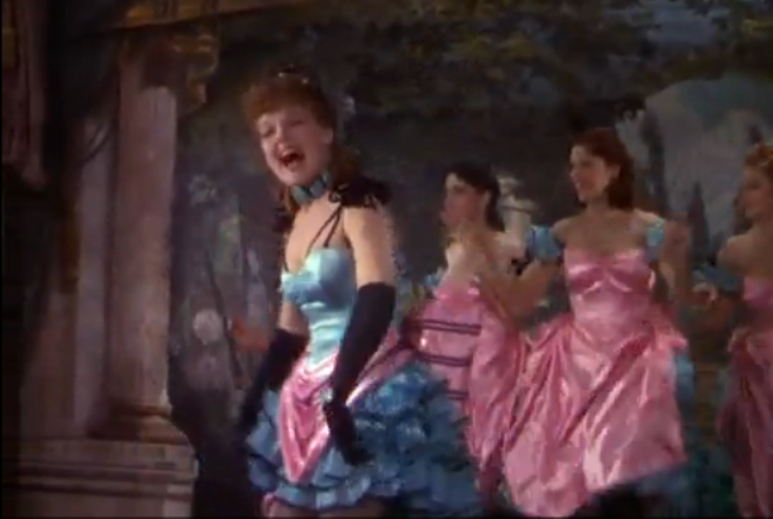
Ann Sheridan and her fellow saloon ladies in bright,
crisp pastels
Alan Hale reluctantly accepts a cup of tea
from the ladies in the 'Pure Prairie League'.  His
being inducted as a member is a wonderful comic touch.
I would agree that this film did capture a sense of optimism, of expansion, using 'right' along with 'might'.  I felt that, unlike JESSE JAMES, the point of view or message of the film was not overly heavy-handed.  Of course, the film stayed away from controversial topics such as the human cost of western expansion for the Native Americans.  For pure enjoyment and joyful tone this film is close to DESTRY RIDES AGAIN, another film from 1939 that I really enjoyed, and wrote about here.  I am not particularly a fan of Errol Flynn, and while he was fine here, I found myself taken with Alan Hale's portrayal of the loyal, and somewhat comic sidekick.  Olivia de Havilland was lovely and feisty, and while eventually succumbing to Flynn's wishes for domesticity, she did have an opportunity to earn a living at the local newspaper.

A very different, but equally enjoyable 1939 big budget western, is 20th Century Fox's  JESSE JAMES, starring Tyrone Power and Henry Fonda, with Henry King directing.  This one apparently started the 'cult of the outlaw' in popular culture, and there have been upwards of a dozen films on the subject of James.  Here, the railroad figures prominently again, but instead of a sign of progress, it's a sign of capitalist oppression, a sentiment that would be understood by a great number of Americans in the late 1930s.  James himself is initially portrayed somewhat fictionally as being driven to becoming an outlaw as a result of his family and farmer neighbors being illegally threatened by corrupt (railroad) businessmen.  He's someone we root for, and then he goes wrong as he finds he can't resist the criminal life even when better forces, namely the women in his life try to bring him back to the straight and narrow.

Unlike Olivia de Havilland's prominent role in DODGE CITY, the female lead here, Nancy Kelly, has not much to do other than moon and grieve over her man.  Nearly of the shots of the couple together feature Power over Kelly.  Power, obviously, was the big matinee idol, and was playing against type as the scruffy outlaw.  His acting chops were on display, as he was convincing and rather good in the role, as was Henry Fonda as his brother Frank James.  It's a well-paced western with action, pathos, and beautiful on-location vistas in and around Pineville, Missouri. (While the cast and crew were celebrated by residents of Pineville while on location, I was horrified to learn that at least one horse was killed by the stunt it was forced to do in a key scene). While punctuated by comic touches, especially from Henry Hull's blustering newspaperman, the tone of the film is darker than DODGE CITY.  Despite the fault of the opportunistic capitalists, the message that a life of crime doesn't pay, and ultimately can't be justified, is clear.

Power as James cannot be talked out of his next criminal venture.
It was a film that left me interested enough to consider watching the sequel.  Incidentally I recently watched a lesser western called KANSAS RAIDERS (1950) about James' early experiences with renegade confederate leader William Quantrill.  This film, starring Audie Murphy, was also greatly fictionalized but the portrayal of James as a 'misunderstood kid trying to do good but going wrong' is fully intact in this one as well.
The clear message would have been appreciated by 1930s audiences.
Next up in the lecture series:  STAGECOACH and OX-BOW INCIDENT.