Search This Blog

Showing posts with label Lon Chaney Jr.. Show all posts

Wednesday, January 19, 2022

Fifty Years of Film in 50 Weeks, #38: The Defiant Ones, 1958

"You can't go lynchin' me--I'm a white man!"

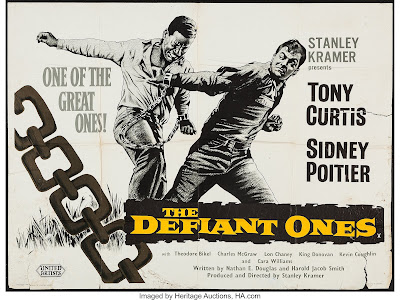
The Defiant Ones, 1958

Director: Stanley Kramer
Writer: Nedrick Young, Harold Jacob Smith
Cinematographer: Sam Leavitt
Producer: Stanley Kramer
Starring: Tony Curtis, Sidney Poitier, Theodore Bikel, Charles McGraw, Lon Chaney, Jr., Cara Williams

Why I chose it
I had just heard about the death of icon Sidney Poitier at age 94, and immediately searched his filmography to see which of his films I hadn't seen, and this one from 1958 popped up. With the good reviews it garnered, it was the perfect choice.

'No-spoiler' plot overview 
A prison van transporting convicts crashes in a rainstorm at night in the rural South. Most of the convicts are injured, but two, John Jackson (Tony Curtis) and Noah Cullen (Poitier), have escaped when the authorities respond to the crash. The catch: the two, one Black and one white, are chained together at the wrists and must work together to avoid capture. The swamps, rushing rivers, and cold rain that they deal with serve as metaphors for the racism that they must also confront to both become free. During their experience, John ("Joker") and Noah begin to form a bond that leads to some surprising choices. All along, we also follow the efforts of the local sheriff (Theodore Bikel) and a state police sergeant (Charles McGraw), whose inability to get along may hinder their efforts to capture the convicts.
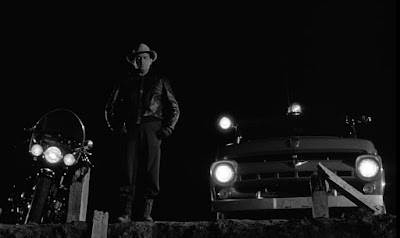
Sheriff Muller (Theodore Bikel) surveys the wreckage
that allowed two convicts to escape.

Production Background
Aram Goudsouzian's excellent biography of Poitier, Sidney Poitier: Man, Actor, Icon, goes into great detail about this film. I learned that Poitier's participation in the 1959 film Porgy and Bess, a role that he didn't want, came about largely as a negotiation piece because he coveted the role of Noah in The Defiant Ones. The latter story he believed was much more relevant to the state of racial politics and true to Black dignity. It didn't hurt that Stanley Kramer, a socially progressive director, was helming the piece. Interestingly, Tony Curtis, who had made his reputation on lighter or comedic roles, copped the role of "Joker" over many others who Kramer had sought, like Marlon Brando, Frank Sinatra, Gregory Peck, and Burt Lancaster, and during filming Poitier praised Curtis to Kramer, helping him to be satisfied with the casting.

During filming, both men punished themselves during the rigorous scenes by rarely using stuntmen. At one point, the latter, when standing around waiting for the stars to finish their scene in the river, had to rescue them downstream when they got in a bit of trouble in the rapids!

The film became a critical and commercial hit after its premiere at the Berlin Film Festival in June 1958, where Poitier won Best Actor.  He was presented with the trophy by Eleanor Roosevelt at her home in New York. Later, both Curtis and Poitier were nominated for Best Actor Oscars. The film also was an early step in breaking the blacklist, as its writer, Nedrick Young, one of those writers having refused to testify in front of the House UnAmerican Activities Committee (HUAC), won an Oscar for the screenplay. At first he was credited in the film with his pseudonym, Nathan E. Douglas, but when he revealed his involvement in the script prior to the Oscar ceremony, the Academy had to make an exception to their policy of not allowing awards for blacklisted writers. 

Not surprisingly, the film didn't get shown in many places in the South because theater owners feared white backlash. And even in the Black communities, the reception was mixed, because of the sacrifices the script demands of Noah Cullen, which played better to white liberals. Ultimately Poitier was proud of the picture, but downplayed the script's role, and his, in making an impact toward greater societal goals. The Civil Rights Movement was not yet in full swing.
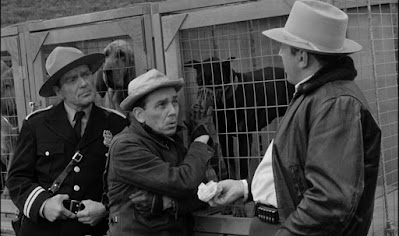
In a bit of recurring comic relief, King Donovan as Solly is always
fussing over his dogs that he is loaning to the convict search.

Some other notable film-related events in 1958 (from Filmsite.org):

  • The number of drive-in theaters in the U.S. peaked near 5,000.
  • Orson Welles' Touch of Evil (1958), with its breathtaking, three-minute, uninterrupted crane tracking shot under the opening credits, was the last of the film noirs in the classic period (from the early 40s to the late 50s). Universal was so unimpressed with the film that it was double-billed as the second B-movie film when first released, following the main feature The Female Animal (1958).
  • The Best Picture-winning musical Gigi, directed by Vincente Minnelli, set a new Oscar record by winning nine awards. It remains one of the few films to win all the awards for which it had been nominated. It also has the shortest title of a film to win a Best Picture Oscar.
  • A 21 year-old Jack Nicholson made his screen debut in producer Roger Corman's low-budget juvenile delinquent drama The Cry Baby Killer (1958).
My Random Observations
  • If anyone has any doubt that Poitier was a top-tier actor, I present this film as evidence. Two things stood out to me. First, his perfect accent and mannerisms convinced us that he could only be a Black man in the southern U.S. Remember, Poitier himself was born and raised in the Bahamas and spent his early adult years in New York City.  Second, his line readings sparkle. Listen to his short speech to "Joker" bemoaning how as a Black man he would have to suppress any instinct to stand up to injustice; his wife would always remind him to "be nice." And every time he repeated the words "be nice," his pitch went up as he imitated his wife, making it a brilliant and believable little speech. Watch that speech in the clip below.
  • Tony Curtis was excellent, too. He projected just the right blend of toughness, or rather "punk", and vulnerability that made his interactions with Poitier's character poignant. Yes, he's racist, but he's not a villain. What about that fake nose, though? Ugh! The makeup department added a prosthetic to his nose that was just enough to be noticed...and I was constantly distracted trying to determine if that really was his real nose or not. It turns out that it was used to make him look tougher and maybe uglier. Results are mixed. 
    Tony Curtis in profile: his nose looks like it may have been broken.
    Nope, just the makeup department trying to make him look tougher.
    It's still Tony Curtis, though, and he gets to attract women,
    even as an escaped convict.
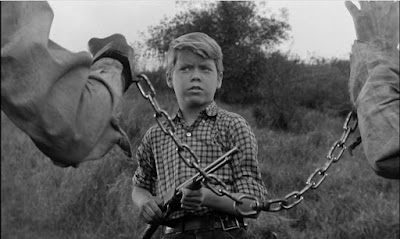
  • The script by Young and Smith, among other things, poignantly and unapologetically dealt with systemic racism. In the 21st century in which there is such an active discourse about the extent and power of systemic racism, I felt that the film could have been made so much more recently. The fact that it was made before the launch of the Civil Rights Movement in the U.S., is even more remarkable. There is a scene where Joker says, referring to a racial epithet, "I didn't make up those names!" Noah retorts: "No, you breathe it in when you're born, and you spit it out from then on." The visual representation of this truth happens later in the film where a young boy, roaming the fields with a gun, comes across the two prisoners and immediately assumes Noah is up to no good and Joker needs rescuing.
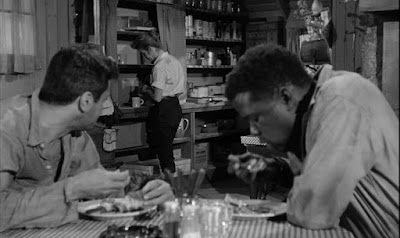
The men eat after Billy's reluctant Mom is told to feed
Noah as well as Joker.
Billy wonders what the white man must have done to be
shackled together with a Black one.

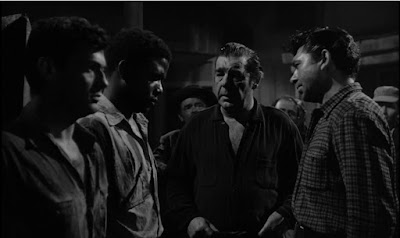
In small roles, Lon Chaney Jr., and Claude Akins discuss
the lynching of the two convicts they caught trying to steal food.
  • With one major theme being "coming together as a team when forced to confront challenges together", I couldn't help but think of the various "wilderness experiences" that are designed for groups as varied as corporate executive teams and troubled adolescents, as a way of enhancing leadership, empathy and collaboration. This film was literally a "wilderness experience" for John and Noah, and it certainly had the desired effect.
  • John "Joker" Jackson and Noah Cullen a little worse for
    wear after digging themselves out of a clay pit while shackled together.
  • In this week's edition of 'Bit Player Bingo", I present Carl "Alfalfa" Switzer, in his final film role as one of the locals called out to hunt for the escaped convicts. He would sadly die a few months after filming as a result of an altercation with guns. Like many child stars, he gained fame and fortune early in life but then struggled as an adult.
    Carl "Alfalfa" Switzer, with cap, center.
Where to Watch
At this writing, the film is streaming for Amazon Prime Video subscribers. It's also available on DVD.

Further Reading
Read the article on TCM here, and check out the excellent biography of Poitier here.

RIP, Mr. Poitier, and thank you.

Monday, July 12, 2021

Fifty Years of Film in 50 Weeks, #21: The Wolf Man, 1941

"Even a man who is pure in heart and says his prayers by night, may become a wolf when the wolfbane blooms and the autumn moon is bright."
Curt Siodmak, Screenwriter


The Wolf Man1941

Director: George Waggner
Writers: Curt Siodmak
Cinematographer: Joseph Valentine
Produced by: George Waggner and Jack J. Gross for Universal Studios
Starring: Claude Rains, Warren William, Evelyn Ankers, Maria Ouspenskaya, Lon Chaney Jr., Ralph Bellamy, Patric Knowles

Why I chose it
This blog series has made it through 20 years of cinema without a legitimate horror film...and there were plenty during those early years. Further, Universal Studios was lauded at that time for its output of classic 'monster' films, including Dracula, the Frankenstein series, The Invisible Man, and this one. I had not had the chance to see this one until now. Validating my choice were the voters in my Twitter poll, who chose it over It Started With Eve, Suspicion, and Swamp Water.

'No-spoiler' plot overview 
Larry Talbot (Lon Chaney Jr.) returns to his family estate in England after growing up in the U.S., and finds his father, Sir John Talbot (Claude Rains), grieved over the death of his eldest son so he decides to stay on a while. Larry meets and quickly becomes enamored of Gwen, who works at the antique shop in the small town. Unfortunately, things go downhill quickly. A friendly visit to a small contingent of gypsies in the country bordering the town turns to disaster when Gwen's friend Jenny is pursued and killed by a werewolf, who only minutes before was the fortune teller Bela (Bela Lugosi). Larry jumps to the rescue and kills the wolf (and also Bela) with his special silver wolf-headed cane he had just bought. Having barely escaped this incident, and with a pentagon-shaped wolf bite to prove it, Larry becomes terrified by the idea of becoming a werewolf, which he indeed does. Struggling with trying to get appropriate help from the coterie of his father's friends, who are largely in denial about what is happening, he fears that his happily-ever-after with Gwen is in serious jeopardy.

Production Background 
Classic film enthusiasts and scholars generally regard Universal Studios' monster films among the most compelling and trend-sitting in cinema. After a string of these in the 1930s, including the werewolf movie Werewolf of London (1935), output was spotty in the 1940s, with the production of lower-budget sequels and send-ups of the genre like Abbott and Costello Meet Frankenstein. Occasionally a seminal picture like The Wolf Man sneaked out of the studio with a top cast and production values. 

English actor Claude Rains, so impactful in classics such as Now, Voyager and Mr. Smith Goes to Washington, was no stranger to horror films: he made The Invisible Man in 1933 and Phantom of the Opera in 1941, both for Universal. Apparently, he won the lead role over Lon Chaney, Jr. in Phantom, but here supports Chaney, the son of the famous 'Man of A Thousand Faces' (see my write-up on He Who Gets Slapped here). Chaney got his first role in horror with this but had a second one the same year with director George Waggner. Dracula star Bela Lugosi had also hoped to play the lead, but was relegated to the small role of the gypsy/werewolf.

According to TCM, Chaney was not the most popular man on set, as he complained about his heavy 'wolf' make-up, but also played practical jokes on co-star Evelyn Ankers, until she was completely fed up. The entire cast struggled with the noxious fog fumes in the outdoor scenes, and Ankers passed out at one point. 

Some other notable film-related events in 1941 (from Filmsite.org):

  • 24-year-old Orson Welles, called America's "boy wonder" or wunderkind, directed and acted in Citizen Kane (1941), a movie about a powerful newspaper publisher named Charles Foster Kane (modeled after William Randolph Hearst). "Boy genius" Welles was the first to ever receive simultaneous nominations in four categories: as producer, actor, director, and writer. 
  • Reclusive Swedish actress Greta Garbo retired early at age 36, after the release of her disastrous comedy, the box-office flop Two-Faced Woman (1941). She announced that she was quitting the film business, left Hollywood, and remained out of the spotlight until her death of natural causes in 1990.
  • Approximately 500 animators and artists at the Walt Disney Studios conducted a five-week strike backed by the Screen Cartoonists' Guild, during the making of the animated film Dumbo (1941). The Disney workers demanded pay raises and the right to unionize, which they won when the strike was settled by federal mediation. 
  • The first, generally acknowledged film noir was released, John Huston's directorial debut film The Maltese Falcon (1941). It was the first detective film to use the shadowy, nihilistic noir style in a definitive way. The mystery classic was the pivotal work of novice director John Huston, and also starred former screen heavy Humphrey Bogart. 

My Random Observations

  • It's always a pleasure to learn that a film you plan to watch is, well, short. This one clocks in at 70 minutes and covers a lot of ground in that time. Kudos to Universal Studios and the production machine. 
  • The opening credits introduce all the main characters in short clips in pre-code Warner Bros. fashion! There is no mystery here about who is going to end up terrorizing the locals (see Screenshots section below). I have to remember, though, that in 80 years since this film was made, the general public has reaped the benefit of decades of 'Wolf Man' and 'Werewolf' movies and programs; I expect film-goers in 1941 found perhaps a bit more suspense in their experience watching this. For me, it was beautiful to watch but not the least bit suspenseful. 
  • I had to google "lycanthropy" -- the term introduced in the movie as related to Werewolfism (is that a word?). The Merriam-Webster dictionary defines it as follows:
    • 1: a delusion that one has become a wolf
    • 2: the assumption of the form and characteristics of a wolf held to be possible by witchcraft or magic. 
            My goal will be to use it in a sentence this week.
  • It seems that Lon Chaney, Jr. is not thought of as the film's best actor by reviewers. He loves to grin widely, as seen in the early part of the movie before his fate encroaches. I found him more convincing when he was distraught over his transformation into a killer. As the real tragedy of the story is a young man's life being torn from him and he having no power to take the necessary control, I felt Chaney conveyed this tragedy through his face and body.
  • Of course, the fact that two innocents lost their lives bears mentioning here. I couldn't help but think of the infamous Star Trek "red shirts" - those peripheral characters that appeared in an episode only to serve the function of meeting a brutal end, after which our main characters would need to jump into action.
  • Meme from screenrant.com here.
  • The rest of the male cast is populated with A-listers: Claude Rains, of course, and the always interesting Warren William, to start. I had to read up on Evelyn Ankers, as she was new to me. Not surprising, because she made her primary career in 1940s Univeral horror films (a segment I haven't explored yet).

Screenshots
This is the friendliest-looking werewolf I've ever seen.

The Talbot estate looks like nothing Larry had seen in the U.S.!

Larry (Lon Chaney, Jr.) and Sir John Talbot (Claude Rains) negotiate
 the terms of their relationship.

Larry inadvertently becomes a peeping Tom when he
catches sight of Gwen (Evelyn Ankers) using his Dad's telescope.

Larry is thrilled with his new silver-wolf-head cane
he bought from Gwen.
Gypsy fortune teller (Bela) prepares to entertain his 
client Jenny (Fay Helm), before he bites her.

If the English countryside is enshrouded in fog, beware!

Dr. Lloyd (Warren William) and family lawyer Colonel Montford
(Ralph Bellamy) discuss what to do about the problem that is Larry Talbot.

A country show adds a bit of fun before the unrelenting
doom to come.

Gypsy Maleva (Maria Ouspenskaya) warns Larry he has a 99.9%
chance of becoming a werewolf.

Extra hair begins to grow on poor Larry's ankles -- and this 
is just the start!

Werewolf seeks his prey in (where else?) the fog.

Suspicious townspeople rotate their heads to watch
Larry Talbot enter Sunday services.

I swear there were wolf paws in this trap just a moment ago!

Larry warns Gwen that both of them may be in
serious trouble.

Somehow I doubt that those straps will keep Wolf Man
from escaping when he gets hungry.

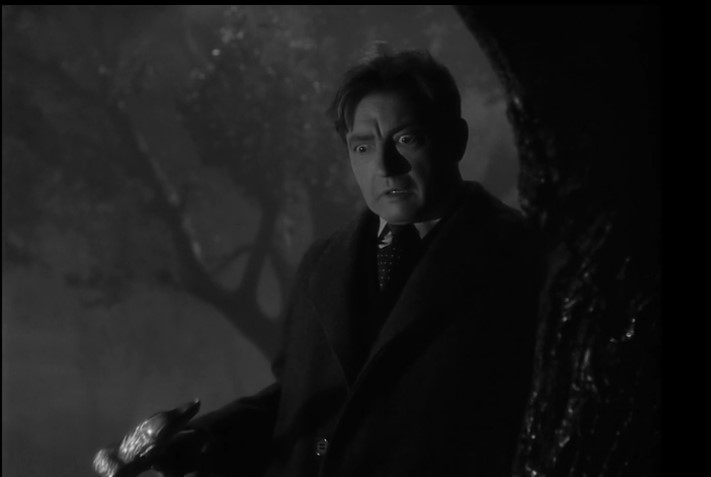
"What have I done? Why do I have this cane in my hand?"
-Sir John Talbot

Where to Watch
The film can be streamed from archive.org here, and also is available on DVD in several collections.

Further Reading
The excellent blogger and fellow CMBA member Aurora posted a piece on the film here. And in case you missed the link above, a useful production summary piece is on TCM's website here.