Search This Blog

Showing posts with label Norma Shearer. Show all posts

Saturday, July 3, 2021

Fifty Years of Film in 50 Weeks, #20: Escape, 1940

"This is far and away the most dramatic and hair-raising picture yet made on the sinister subject of persecution in a totalitarian land, and the suspense which it manages to compress in its moments of greatest intensity would almost seem enough to blow sizable holes in the screen." (from the 1940 NY Times review by Bosley Crowther.)

Escape1940

Director: Mervyn LeRoy
Writers: Arch Oboler and Marguerite Roberts, from a novel by Grace Zaring Stone
Cinematographer: Robert H. Planck
Produced by: Mervyn LeRoy and Lawrence Weingarten for MGM
Starring: Norma Shearer, Robert Taylor, Conrad Veidt, Nazimova, Felix Bressart, Albert Bassermann, Philip Dorn, Bonita Granville

Why I chose it
This one was recommended by two film friends. It was a tough choice, but I was in the mood for an MGM film with one of the "Queens" of MGM, Norma Shearer. Considering WWII was underway in Europe and looming for the US in 1940, it seemed appropriate to pick a war-themed adventure.

'No-spoiler' plot overview 
Mark Preysing (Robert Taylor) is an American who travels to Bavaria in 1936 to meet up with his actress mother Emmy Ritter (Nazimova), who as a German citizen had come back several years before to settle her husband's estate. What Mark learns, after considerable trouble, is that his mother has been captured by the Nazis and placed in a concentration camp because of perceived financial irregularities. He enlists the aid of a friendly doctor and local friends, along with the Countess von Treck, formerly an American, to navigate the hostile regime, personified by the Countess's boyfriend General von Kolb (Conrad Veidt), to get his mother out of Germany before she is executed for her "crimes." With the help of the doctor, they induce a death-like coma to try to smuggle Emmy out in a coffin. Complications ensue.

Production Background 
This film was the second of the year MGM star Robert Taylor made with director LeRoy; the first was the fan favorite Waterloo Bridge, another war-themed drama, with the emphasis on the romance. His romantic partner here, MGM queen Norma Shearer, was looking to end her acting career and was just finishing out her contract. Filling out the cast were several actors who had recently fled Germany: Conrad Veidt, whom LeRoy had pursued vigorously for the role of the General; Albert Bassermann, who made his Hollywood debut in 1940 and was cast in six films, including Hitchcock's Foreign Correspondent also in 1940; Felix Bressart, a reliable character actor playing parts calling for a European; and Philip Dorn, who worked in Germany but was originally from the Netherlands. Hitler banned the movie for its antagonistic stance towards his regime, and later banned all MGM films.

Some other notable film-related events in 1940 (from Filmsite.org):

  • Disney's groundbreaking Fantasia (1940), an outgrowth of the "Silly Symphony" series, was comprised of classical music pieces and matching animation. The film received a special certificate at the 1941 Academy Awards for its revolutionary Fantasound (early stereo or 'surround-sound').
  • Vaudeville and radio stars Abbott and Costello made their big-screen film debut in One Night in the Tropics (1940). However, the two comics were not the major stars of the film, but just minor contract players (they reprised some of their famous stage acts, including a rudimentary "Who's on First"). 
  • Actor/director/producer/writer/composer Charlie Chaplin released his first "all-talking, all-sound" feature film, The Great Dictator (1940). Charlie Chaplin was the first to ever receive three simultaneous nominations, as producer, actor, and screenwriter for the film. 
  • Walter Brennan became the first performer to win three Academy Awards for acting with his win in 1940. He won Best Supporting Actor for his performances in alternating years, for Come and Get It (1936), Kentucky (1938), and The Westerner (1940).
  • The musical Down Argentine Way (1940) featured the first starring role for Betty Grable. It also featured Don Ameche and Carmen Miranda in her US film debut.

My Random Observations

  • Escape grabbed my interest from the opening, in which we see Nazimova as Emmy Ritter prostrate in the hospital ward of a concentration camp. She's desperate but indignant and not afraid to mock her captors. Her heartreading emoting sets the tone for the film. 
  • Norma Shearer played her usual heroine combining elegance and pathos, but she seemed especially subtle here, especially when dealing with her Nazi lover (Veidt). I was delighted to find this tidbit: in his book The American Cinema, critic and writer Andrew Sarris briefly analyzes and categorizes the work of directors during the Golden Age, and places Mervyn LeRoy in the "lightly likeable" category. While he mostly points out his perceived flaws, Sarris singles out LeRoy's direction of Norma Shearer and Conrad Veidt's scenes together as a career high point. 
  • Is our hero Mark Preysing's naivete typical of the American public at the time? His mother is German, and yet he seems shocked everytime he faces examples of the totalitarianism and threats of the Nazi regime. I found it a stretch that it took him so long to realize he was facing tall odds to break his death-row Mom free. Of course, my twenty-first century perspective may warp my expectations of how characters behave in these situations. 
  • I need to see more of Philip Dorn's work; as the sympathetic doctor he was quietly charismatic. Despite his soft, friendly features, you never were sure he could be trusted. 
  • Overall, a compelling film, that despite some implausible plot developments and coincidences, captures the ominessness of the Nazi regime on the verge of the U.S. entry into WWII. I'm rather surprised it isn't better known. It's not a classic like Casablanca, but it's aided by innovative visuals and the committed performances of the leads and the European emigres.
Screenshots

The doctor (Philip Dorn) tells captured Emmy Ritter (Nazimova)
that he may be able to help get a message to her son.

Preysing (Robert Taylor) encounters his first unfriendly Nazi.

Dr. Henning (Albert Bassermann) struggles to tell Preysing
he needs to abandon the search for his mother.

Preysing walks into a Nazi minefield looking for his mother.

I love the position of the Nazi symbol here.

A winter scene in small-town Bavaria: Preysing meets the 
Countess.

The General holds his teenage girl audience captive with
his charm and storytelling skills.

The Countess and the General in a relationship reckoning.

You know it's love when the Countess blows off the town 
parade to have tea with Mark Preysing in an empty cafe.

An awkward situation at the opera when your American escort is 
under suspicion by the Gestapo and you have to introduce him around.

The Doctor has an unusual interest in Preysing's business,
but all can be settled over a couple of beers.

Old friend Fritz Keller (Felix Bressart) tries to talk 
sense into Preysing.

Preysing plays solitaire to calm his nerves when the Nazi guards
at the next table decide he needs their company.

Let's make sure that Emmy Ritter is really in that coffin!

Bonita Granville (right) plays her usual venomous teen role
while the Countess tries to be nonchalant.

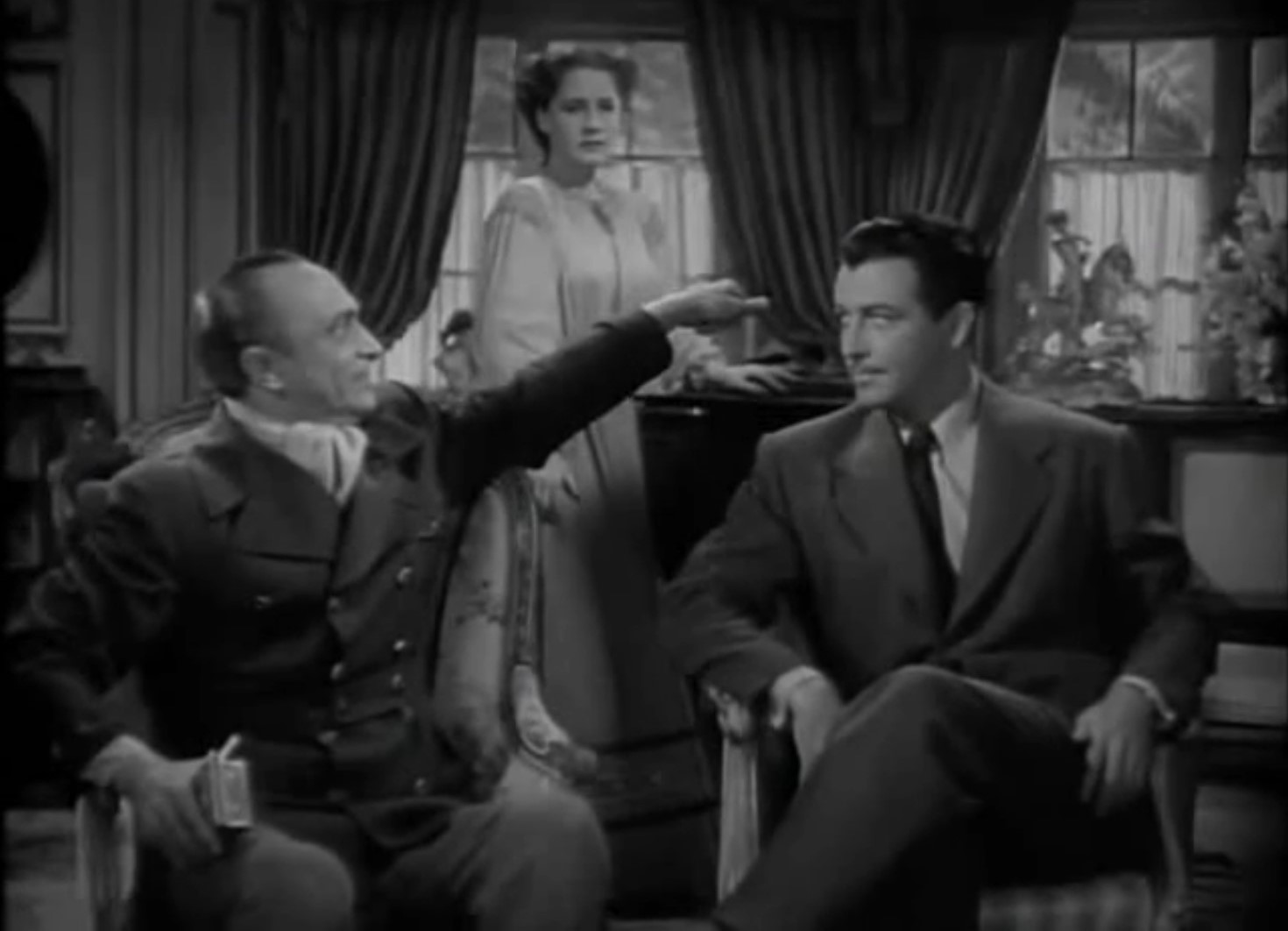
The General grills Preysing while a concerned Countess
contemplates how she'll get out of this jam.

Mother and son together--things are looking up.

Where to Watch
The film isn't available on any of the usual streaming services, but is released on DVD in the Warner Bros. Archive line. I borrowed a copy from a friend.

Further Reading
Read the TCM article here, full of production tidbits as usual.
The full text of Bosley Crowther's NY Times review is here.

Thursday, February 25, 2021

Fifty Years of Film in 50 weeks, #4: He Who Gets Slapped, 1924

From a classic western last week to a circus thriller/romance/tragedy, a bit of whiplash. But this film represents several film history milestones and I was thrilled to watch it for the first time.


He Who Gets Slapped (1924)

Director: Victor Sjöström (as Victor Seastrom)
Writer: Victor Sjöström & Carey Wilson (based on the play He, the One Who Gets Slapped by Leonid Andreyev)
Cinematographer: Milton Moore
Producer: Louis B. Mayer for MGM
Starring: Lon Chaney, Norma Shearer, John Gilbert, Marc McDermott, Ruth King, Tully Marshall 

Why I chose it
Because of the name? I had heard of this film; it hadn't registered strongly for me as a 'must-see' film yet I remembered the name. When it appeared, during my research, on a list of acclaimed 1924 films, I added it to my shortlist; my Twitter followers voted it to the top.

'No-spoiler' plot overview
Poor Parisian scientist Paul Beaumont (Chaney) lives on the generosity of his patron, Baron Regnard (Marc McDermott), unaware Regnard has designs on both Beaumont's scientific breakthrough and his wife Marie (Ruth King). He loses both to this embodiment of evil, and is further disgraced when both, separately, slap him across the face to put him in his place. When done in front of an audience of academics, they break into hysterical laughter. Fast forward a few years, and Paul has become the star clown of a circus act in which a posse of identically-dressed clowns slap him repeatedly until he tumbles around the circus ring to the delight of audiences. His circus moniker? You guessed it: 'He Who Gets Slapped', 'HE' for short. HE meets young circus horse-acrobat Consuelo (Norma Shearer) and becomes infatuated with her. She, however, has fallen in love with her handsome partner Bezano (John Gilbert). The Baron reappears when Consuelo's opportunist father bribes him into proposing marriage to Consuelo. These developments are discovered by HE, who is determined to have his revenge on his old enemy, and save Consuelo in the process.

Production Background and 1924 in Film History
This film emerged as the first production of newly formed MGM, with Louis B. Mayer at the helm. Mayer had concluded his deal with Samuel Goldwyn earlier in the year, and hired Swedish director Victor Sjöström to direct. Already an acclaimed director in Sweden, Sjöström used expressionistic visuals to illustrate his cinematic morality tales such as his wonderful The Phantom Carriage (1921), which I saw for the first time a few months ago. Norma Shearer and John Gilbert were not the 'stars above the title' yet in 1924. Lon Chaney was the star, and already had over 100 film credits to his name. Also appearing in the film was a live lion! The lion was not credited, but his appearance coincided with the first appearance of "Leo" the MGM Lion in the opening credits. I noticed that in those credits, this version of Leo did not open his mouth once.

Some other notable film-related events in 1924*:
  • Theaters started screening double features for the first time.
  • Prolific silent-era producer/director Thomas Ince died in what was rumored to be murder or accidental homicide aboard the pleasure boat of William Randolph Hearst, by Hearst, or Charlie Chaplin, or ??. It seems that the modern view is that despite some melodramatic antics on the boat, Ince likely succumbed to long-standing coronary disease.
  • Erich von Stroheim (featured in the first of my blog series, here) released his epic masterpiece Greed based on the novel McTeague.
  • C.B.C. Film Sales Company changed its name to Columbia Pictures Corporation.
*Thanks to filmsite.org

My Random Observations 
  • Ah, silent film - how I'd missed you before I started this blog project! 
  • Like last week, the visuals in this film are breathtaking, but for different reasons. Instead of panoramic vistas, we have expressionistic lighting, symbolic flourishes, and creative dissolves.
  • Lon Chaney. There aren't enough superlatives to describe his talent and performance here. While I loved him in Phantom of the Opera (1925), I didn't really appreciate the range of his pantomime abilities, including his mastery of his body as well as his face. I especially loved seeing him as rather normal-looking scientist Paul Beaumont before his transformation to "HE" the clown. He believably embodied the love and passion for discovery that the best scientists have. (He also looked a bit like Paul Muni as Louis Pasteur!)
  • Along those lines, I struggle to accept that Marie, Paul's wife, throws him over for the clearly slimy Baron. I mean, money is great and all, but for me having a nerdy scientist husband on the cusp of fame is the far better choice.
  • I find the fact that Paul/HE falls for Consuelo to be a sign of how much he's damaged psychologically. While she is lovely and kind, obviously NOT right for him even if she weren't in love with Benzano. The pity and sorrow we feel for him are more intense than if he saw himself as a big-brother or father-figure to Consuelo.
Screenshots 
Poor Paul Beaumont (Chaney, center) doesn't know
that he's about to be betrayed by these two.

That look! Beaumont listens to the Baron 
taking credit for his invention - the start of his
humiliation.

Academics laughing at the first 'slap'

Symbolic scene of a clown spinning a globe

More clowns enter the earths' orbit

And then the earth dissolves into a circus ring

Romance at the circus: Bezano (Gilbert)
and Consuelo (Shearer)

Kind Consuelo pins a fabric heart on HE's 
Clown costume, much to his delight.

Fabulous shot of clowns laughing at HE's antics

Two slimy opportunists (Marshall & McDermott)
plan their next scheme.

Some small questions the film asks us.

This lion is ready for his close-up.

Lighting on a hand (the Baron's) reaching to unlock an 
off-limits cabinet enhances the treachery of the moment.

Where to Watch
Check it out on YouTube here.

Monday, September 19, 2016

Answering fun film questions -- Liebster Award Edition!

If random but revealing observations from a movie fan will entertain you for fifteen minutes of your time, then please keep reading.  For anyone who is reading this I strongly encourage you to leave one or more comments in the comments section, and anyone who wishes, consider yourself tagged!
First, thank you!! to my new blogging friend Hamlette from Hamlette's Soliloquy for tagging me with the 'Liebster Award'.  This blogging award challenges me to answer 11 questions about my movie passions.  Alright, let's go!

1.  Is there a movie that has really yummy-looking food in it that you'd love to eat?
Well, I can eat anytime and anyplace, so there are very few movie meals that don't look good to me!  That said, I have to perhaps go with something obvious:  the meal in BABETTE'S FEAST (1987).  This is a lovely quiet Danish film about two unmarried sisters in a remote 19th century Danish village who take in a French expatriate down on her luck to be their servant. It turns out she is a gourmet chef and in the final scenes of the film, she prepares a meal that all the villagers will never forget.  The irony is that they have no idea what they're eating!
This is just the first course!
One of the most memorable scenes in the film for me was when a French opera singer comes to give lessons to one of the sisters in her younger years, and the two have a connection while singing Mozart's luscious duet 'La ci darem la mano' from Don Giovanni (in French).  The singer was portrayed by actual opera star Jean-Philippe Lafont. Below is the scene from the film .  I can remember when this film came out, rewinding and watching this scene over and over on my poor VHS tape.  
2.  What era do most of your favorite movies take place in?
Oh my gosh, this is a tough one, as my favorite films span many decades. If I think about those classic films that I recommend to people, probably more of them are set in the 1930s than any other single decade.  So much art deco loveliness, and class comedies, screwball comedies, and melodramas.  Think MY MAN GODFREY, TROUBLE IN PARADISE, UNION DEPOT.

3. What two actors/actresses have you always hoped would make a movie together, but didn't/haven't yet?
Maggie Smith as the Dowager Countess of Grantham in 'Downton Abbey' would give George Sanders as Addison DeWitt in ALL ABOUT EVE a run for his money in the snark department.  Both of these British actors dominated the big and small screen whenever they appeared and I would have loved to see them co-star in a film.

4.  If money, time, and supplies (and crafting ability) were not considerations, what movie character would you love to cosplay or dress up like for Halloween?
One rarely gets a chance to dress like a 18th century French queen, and so why not take the opportunity to be the center of attention by being Norma Shearer as Marie Antoinette in the lavish 1938 production?  If as a bonus Ty Power becomes infatuated with you, I would probably never take that outfit off.
Wondering how much that headdress weighs!
5.  Have you ever cosplayed or dressed up like a movie or TV character for Halloween?  
OK, once in graduate school I dressed up as Winnie the Pooh.  (Yeah, OK, it's lame.)  Dressing up isn't really my thing, and because Halloween usually falls during the World Series I've been known to impersonate my favorite baseball player.  This year it might have to be David Ortiz, aka Big Papi, the Red Sox slugger who is retiring after this season.
Good excuse to post a Big Papi pic, right here.
6.  What movie would your family/friends be surprised to learn you truly enjoyed?
My family and friends have been trained to expect any number of varied film recommendations from me.  From Russian silent films to modern Westerns, I enjoy so many.  I'm not a huge fan of Action/Sci Fi blend pictures, so perhaps it might be a surprise that I enjoyed BLADE RUNNER.  Then again, it's been seen as a Western in disguise, young Harrison Ford is in it (woo!), and now it's considered a classic of sorts, so I suppose wouldn't be a complete surprise that I loved it.  I probably can cite many more films that others loved and I didn't (I sense a new topic for a blog post!).

7.  What's one book you hope no one ever makes into a film?
I think most any good book, in the hands of the right director and production, could a good movie make.  I think the question is more about what book do I love so much that I would hate to have my own imagining of the tale ruined by assigning a real production to it.  As a child I adored the 'Little House' books and hated how the TV series distorted that universe.  The illustrator, Garth Williams, was so good in capturing the mood of Ingalls Wilder's text, that I would have a hard time appreciating a film version even if the story was not altered.  That said, I might enjoy a biopic about Laura Ingalls Wilder, or her daughter Rose Wilder Lane, both of whom had very interesting lives.
Garth Williams' illustration of 'Pa' fiddling for his daughters Laura and Mary
in Little House in the Big Woods.
8.  Do you know the Wilhelm Scream when you hear it?  Google is my friend.  The Wilhelm Scream is new to me.  So, the answer to this question WAS: no.  I'm feeling a little sheepish here.  However, believe me, I'll be sensitized to this for ever and ever, you can bet on it.  In the comments section, please let me know what your most memorable 'Wilhelm Scream' is -- I will learn from you!

9.  When a character onscreen has to hold their breath, do you try to hold your breath to match theirs?  I honestly can't remember ever doing this.  However, I suppose one can do it completely unawares!  I believe my breath was coming raggedly for the entire 92-minute running time of the ultra-suspenseful Western, the original 3:10 TO YUMA, and especially in the scene in the hotel where Glenn Ford and Van Heflin are holed up together.  If you've never seen it, watch watch watch!
Van Heflin tries to keep Glenn Ford at bay during 3:10 TO YUMA
I haven't yet seen the remake, but I can almost guarantee: it isn't better.
10.  What upcoming movies (or TV series) are you excited about?
Speaking about remakes, I just read in the Boston Globe here about the upcoming release of THE MAGNIFICENT SEVEN -- a 2016 remake with Denzel Washington and other assorted modern stars.  While advance reviews have been mixed, I am excited about this for the sheer fact that it may make people who haven't watched the original film, or the earlier Japanese film it's based on (SEVEN SAMURAI by Kurosawa) discover these films and become classic film lovers themselves.   What may be most fascinating is Peter Sarsgaard as the villain.  Check out the trailer below.  (In the comments section -- who wants to see this, and who wants to avoid it like the proverbial plague??)

11.  What are your favorite movie blogs?  I've listed these in my 'Recommended sites and blogs' list on the lower right side of my blog home page, but I want to also call out the wonderful writers at two of my local cinemas: Brattle Blog and Harvard Film Archive series pages -- check out the latest here about Russian Silent cinema.

So, I will ask anyone who is interested to answer one or more of the questions below, either in the comments section or as a separate post.
1. Who was your first movie crush that you can remember?
2. Who is your current or most recent movie crush?
3. Is there a film you refuse to see?  If yes, why.
4. If you could travel back in time to visit the set of one of your favorite films and tell the director in real time to change something, what would it be?
5. What is a comedy that most everyone loves and that you don't find the least bit funny?
6. What is the classic film stereotype that you hate the most?
7.  How do you attempt to debunk said stereotype?
8. Provide a link to one blog post that you really enjoyed and think others would, too.
9. Name a film director that should be better known, and your favorite film of theirs.
10. What upcoming film or TV series are *you* most excited about?
11.  What keeps you motivated to continue blogging?