Search This Blog

Showing posts with label Patric Knowles. Show all posts

Monday, July 12, 2021

Fifty Years of Film in 50 Weeks, #21: The Wolf Man, 1941

"Even a man who is pure in heart and says his prayers by night, may become a wolf when the wolfbane blooms and the autumn moon is bright."
Curt Siodmak, Screenwriter


The Wolf Man1941

Director: George Waggner
Writers: Curt Siodmak
Cinematographer: Joseph Valentine
Produced by: George Waggner and Jack J. Gross for Universal Studios
Starring: Claude Rains, Warren William, Evelyn Ankers, Maria Ouspenskaya, Lon Chaney Jr., Ralph Bellamy, Patric Knowles

Why I chose it
This blog series has made it through 20 years of cinema without a legitimate horror film...and there were plenty during those early years. Further, Universal Studios was lauded at that time for its output of classic 'monster' films, including Dracula, the Frankenstein series, The Invisible Man, and this one. I had not had the chance to see this one until now. Validating my choice were the voters in my Twitter poll, who chose it over It Started With Eve, Suspicion, and Swamp Water.

'No-spoiler' plot overview 
Larry Talbot (Lon Chaney Jr.) returns to his family estate in England after growing up in the U.S., and finds his father, Sir John Talbot (Claude Rains), grieved over the death of his eldest son so he decides to stay on a while. Larry meets and quickly becomes enamored of Gwen, who works at the antique shop in the small town. Unfortunately, things go downhill quickly. A friendly visit to a small contingent of gypsies in the country bordering the town turns to disaster when Gwen's friend Jenny is pursued and killed by a werewolf, who only minutes before was the fortune teller Bela (Bela Lugosi). Larry jumps to the rescue and kills the wolf (and also Bela) with his special silver wolf-headed cane he had just bought. Having barely escaped this incident, and with a pentagon-shaped wolf bite to prove it, Larry becomes terrified by the idea of becoming a werewolf, which he indeed does. Struggling with trying to get appropriate help from the coterie of his father's friends, who are largely in denial about what is happening, he fears that his happily-ever-after with Gwen is in serious jeopardy.

Production Background 
Classic film enthusiasts and scholars generally regard Universal Studios' monster films among the most compelling and trend-sitting in cinema. After a string of these in the 1930s, including the werewolf movie Werewolf of London (1935), output was spotty in the 1940s, with the production of lower-budget sequels and send-ups of the genre like Abbott and Costello Meet Frankenstein. Occasionally a seminal picture like The Wolf Man sneaked out of the studio with a top cast and production values. 

English actor Claude Rains, so impactful in classics such as Now, Voyager and Mr. Smith Goes to Washington, was no stranger to horror films: he made The Invisible Man in 1933 and Phantom of the Opera in 1941, both for Universal. Apparently, he won the lead role over Lon Chaney, Jr. in Phantom, but here supports Chaney, the son of the famous 'Man of A Thousand Faces' (see my write-up on He Who Gets Slapped here). Chaney got his first role in horror with this but had a second one the same year with director George Waggner. Dracula star Bela Lugosi had also hoped to play the lead, but was relegated to the small role of the gypsy/werewolf.

According to TCM, Chaney was not the most popular man on set, as he complained about his heavy 'wolf' make-up, but also played practical jokes on co-star Evelyn Ankers, until she was completely fed up. The entire cast struggled with the noxious fog fumes in the outdoor scenes, and Ankers passed out at one point. 

Some other notable film-related events in 1941 (from Filmsite.org):

  • 24-year-old Orson Welles, called America's "boy wonder" or wunderkind, directed and acted in Citizen Kane (1941), a movie about a powerful newspaper publisher named Charles Foster Kane (modeled after William Randolph Hearst). "Boy genius" Welles was the first to ever receive simultaneous nominations in four categories: as producer, actor, director, and writer. 
  • Reclusive Swedish actress Greta Garbo retired early at age 36, after the release of her disastrous comedy, the box-office flop Two-Faced Woman (1941). She announced that she was quitting the film business, left Hollywood, and remained out of the spotlight until her death of natural causes in 1990.
  • Approximately 500 animators and artists at the Walt Disney Studios conducted a five-week strike backed by the Screen Cartoonists' Guild, during the making of the animated film Dumbo (1941). The Disney workers demanded pay raises and the right to unionize, which they won when the strike was settled by federal mediation. 
  • The first, generally acknowledged film noir was released, John Huston's directorial debut film The Maltese Falcon (1941). It was the first detective film to use the shadowy, nihilistic noir style in a definitive way. The mystery classic was the pivotal work of novice director John Huston, and also starred former screen heavy Humphrey Bogart. 

My Random Observations

  • It's always a pleasure to learn that a film you plan to watch is, well, short. This one clocks in at 70 minutes and covers a lot of ground in that time. Kudos to Universal Studios and the production machine. 
  • The opening credits introduce all the main characters in short clips in pre-code Warner Bros. fashion! There is no mystery here about who is going to end up terrorizing the locals (see Screenshots section below). I have to remember, though, that in 80 years since this film was made, the general public has reaped the benefit of decades of 'Wolf Man' and 'Werewolf' movies and programs; I expect film-goers in 1941 found perhaps a bit more suspense in their experience watching this. For me, it was beautiful to watch but not the least bit suspenseful. 
  • I had to google "lycanthropy" -- the term introduced in the movie as related to Werewolfism (is that a word?). The Merriam-Webster dictionary defines it as follows:
    • 1: a delusion that one has become a wolf
    • 2: the assumption of the form and characteristics of a wolf held to be possible by witchcraft or magic. 
            My goal will be to use it in a sentence this week.
  • It seems that Lon Chaney, Jr. is not thought of as the film's best actor by reviewers. He loves to grin widely, as seen in the early part of the movie before his fate encroaches. I found him more convincing when he was distraught over his transformation into a killer. As the real tragedy of the story is a young man's life being torn from him and he having no power to take the necessary control, I felt Chaney conveyed this tragedy through his face and body.
  • Of course, the fact that two innocents lost their lives bears mentioning here. I couldn't help but think of the infamous Star Trek "red shirts" - those peripheral characters that appeared in an episode only to serve the function of meeting a brutal end, after which our main characters would need to jump into action.
  • Meme from screenrant.com here.
  • The rest of the male cast is populated with A-listers: Claude Rains, of course, and the always interesting Warren William, to start. I had to read up on Evelyn Ankers, as she was new to me. Not surprising, because she made her primary career in 1940s Univeral horror films (a segment I haven't explored yet).

Screenshots
This is the friendliest-looking werewolf I've ever seen.

The Talbot estate looks like nothing Larry had seen in the U.S.!

Larry (Lon Chaney, Jr.) and Sir John Talbot (Claude Rains) negotiate
 the terms of their relationship.

Larry inadvertently becomes a peeping Tom when he
catches sight of Gwen (Evelyn Ankers) using his Dad's telescope.

Larry is thrilled with his new silver-wolf-head cane
he bought from Gwen.
Gypsy fortune teller (Bela) prepares to entertain his 
client Jenny (Fay Helm), before he bites her.

If the English countryside is enshrouded in fog, beware!

Dr. Lloyd (Warren William) and family lawyer Colonel Montford
(Ralph Bellamy) discuss what to do about the problem that is Larry Talbot.

A country show adds a bit of fun before the unrelenting
doom to come.

Gypsy Maleva (Maria Ouspenskaya) warns Larry he has a 99.9%
chance of becoming a werewolf.

Extra hair begins to grow on poor Larry's ankles -- and this 
is just the start!

Werewolf seeks his prey in (where else?) the fog.

Suspicious townspeople rotate their heads to watch
Larry Talbot enter Sunday services.

I swear there were wolf paws in this trap just a moment ago!

Larry warns Gwen that both of them may be in
serious trouble.

Somehow I doubt that those straps will keep Wolf Man
from escaping when he gets hungry.

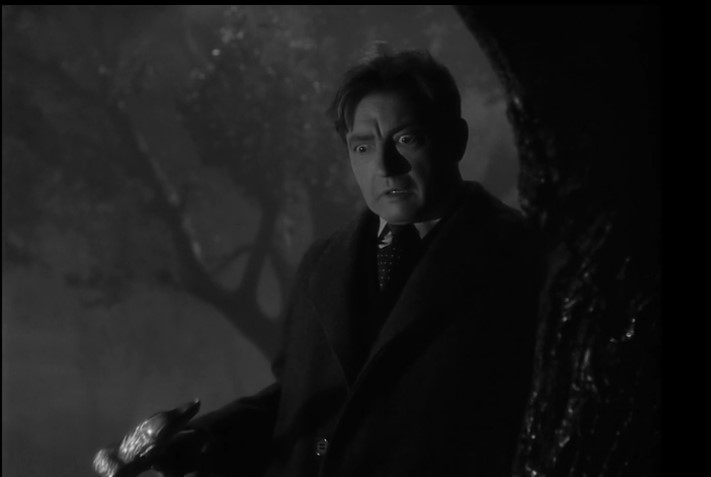
"What have I done? Why do I have this cane in my hand?"
-Sir John Talbot

Where to Watch
The film can be streamed from archive.org here, and also is available on DVD in several collections.

Further Reading
The excellent blogger and fellow CMBA member Aurora posted a piece on the film here. And in case you missed the link above, a useful production summary piece is on TCM's website here.

Tuesday, February 2, 2016

Dramatic actors go all screwball in IT'S LOVE I'M AFTER

This is a first in a series of posts honoring Ms. Olivia de Havilland, one of the great ladies of classic cinema, who is celebrating her 100th birthday this year.

So, you have Leslie Howard, Bette Davis, and Olivia de Havilland in a film, and you end up with ... a screwball comedy?  Well, if the movie gets made in 1937 and all three stars are coming off dramatic roles, perhaps it's understandable. The movie is IT'S LOVE I'M AFTER.
In looking for an early and lesser known film of Ms. De Havilland's to watch for the first time, I came across this one and was delighted.  All three stars are up to the comic demands of their roles, and despite a bit of over-the-top silliness (not altogether unexpected), I highly recommend the film.  It's on DVD from the Warner Archive label.

Leslie Howard, who I've only recently seen outside GONE WITH THE WIND where I find him sadly miscast, is a revelation here.  He is in full ham mode as celebrated Shakespearean stage actor who is a stereotypical egotist and in love, although constantly engaged in a snipe-fest with, his leading lady Bette Davis.  He prances and poses throughout the film but retains our sympathy while we laugh at him.  As for Ms. Davis, her role could be considered a warm up for, or younger version of, her Margo Channing in 1950's ALL ABOUT EVE. Ms. de Havilland is perfect as the young innocent who develops a consuming crush on Howard just by watching him act.  She is beyond lovely; her luminous beauty and infatuation are both depicted in the shot in which we see her for the first time watching Romeo's death scene:
"Oh Romeo, drop that poison right now and run away with ME!"
Her frustrated fiance, played straight by a handsome but somewhat wooden Patric Knowles, looks on, not anticipating the lengths he's about to go on trying to win back her affections.

Directed by Archie Mayo, the screenplay makes the most of propelling the plot forward by overtly incorporating plots and dialogue from contemporary and Shakespearean plays.  Shakespearean dialogue is also injected with insults when the dead Romeo whispers to his hovering Juliet that she has been eating too many onions again.  A play called "A Lover's Triangle" forms the framework of the plot as Howard agrees to Knowles' plan to drive de Havilland back into her fiance's arms by playing the cad and wreaking havoc after moving into her home as a barely-invited guest.  Eric Blore as the butler (!) has an unusually large role and makes the best of it, always in an advanced state of frustration trying to keep Howard from indulging the lesser angels of his nature.  His comic energy most often comes from bouncing off of Howard, and is at its apex in a scene where he acts and sounds out different types of birds to keep Howard in line (interestingly TimeOut London calls his performance 'execrable'):
Davis is trying to figure out why Eric Blore is doing jumping jacks while making bird calls at a refined garden party.
Apparently this project was initiated by Howard, who wanted to have some fun after several dramatic roles including in THE PETRIFIED FOREST, also with Bette Davis.  Warner Bros. had to put pressure on Davis to work with Howard again, as their relationship was rocky, and who had also wanted some vacation time after an exhausting year of dramatic roles.  Ms. de Havilland was on her way up, and, unfortunately, had to fend off the advances of Howard quite vociferously during filming.  With two beautiful leading ladies, clearly Howard was enjoying every second of the attention he was getting.

Notable tidbits to recommend the film:
--Likability of the three main characters
--Terrific comic ensemble scenes.  There is a scene early on where Howard noisily pushes his way into de Havilland's mansion in the middle of the night and is going on loudly about how raised is his 'ire', when all the servants think they hear "FIRE" and come to the rescue with filled water buckets.  [Ok, I guess you just have to trust me on that one.]
--Apparently men in tights were a thing to contemporary women of the time:  a joke is made near the end of the movie about how women love to see male actors wearing this kind of costume.  Uh huh, yeah.
--A film inside joke (and GWTW connection) when de Havilland claims how she had a crush on Clark Gable (!) before the one on Howard's character. "I was in love with Clark Gable last year and if I can get over him I can get over you!" "Who's Clark Gable?"

What I disliked:
--Bonita Granville overplayed her signature spoiled brat part and should have been dialed down several notches, even if this was a screwball.
--Not enough George Barbier, who played de Havilland's exasperated father with perfection, or Spring Byington, as her mother.
--As mentioned earlier, Patric Knowles comes across too wooden here for my taste.
--Eric Blore's extreme characterization - at times - would have bothered me more if not for how well he worked with Howard.

Here are a few key moments from the film:
Romeo (Howard) and Juliet (Davis) battling over who gets the first curtain call
Howard strikes a dramatic pose as he contemplates the next move in his complicated love life
Blore as Howard's faithful, if continually frustrated, conscience
Knowles is dismayed when de Havilland seems unfazed by Howard's caddish ways
George Barbier is at his wits end thanks to his daughter's fascination for uninvited houseguest Howard
Howard tells de Havilland she has too many moles(!)
"Remember, my darling, 'all the world's a stage'"

Tuesday, January 19, 2016

O.S.S.: A non-noir 1940s Alan Ladd wartime adventure.

In December, Turner Classic Movies, in partnership with Universal, released a packaged DVD set of three lesser-known Alan Ladd films from the 1940s (here).  Having recently tumbled headlong into the Alan Ladd fan club, I was excited to see this when the announcement was first made, and practically ran for my credit card to pre-order the set.  Originally supposed to have had four movies, the set only ended up with three in the finished product.  They are: O.S.S., TWO YEARS BEFORE THE MAST, and LUCKY JORDAN. All three of these films are reminders that Ladd's career during the 1940s extended well beyond film noir. This post focuses on my reactions to O.S.S., a well-made and well-acted WWII adventure film.


Directed by Irving Pichel, O.S.S. was made by Paramount in 1946, and uses the medium of film to inform the public about the heroic actions of the men and women of the 'Office of Strategic Services', the precursor to the C.I.A., during WWII.  To add verisimilitude an opening testimonial was captured on screen from General "Wild Bill" William Donovan, the real head of O.S.S. at the time. According to Marilyn Henry and Ron DeSourdis in their book The Films of Alan Ladd, 30 real O.S.S agents served as advisors on the film.

The story centers around Ladd and his cohort of Allied spies dropped into occupied France near the end of the war, to pose as French citizens and carry out clandestine and dangerous orders to thwart the Nazis at every turn.  Geraldine Fitzgerald is the leading lady, and the cast features terrific support from Patric Knowles, John Hoyt, and Harold Vermilyea.  The tone is quite dark and serious, with very rare touches of humor, quite a bit of irony, and a not insignificant dose of patriotic messaging, which was common in films like these during and after WWII.  There is a little bit of everything:  menacing Nazis, hairbreadth escapes, romance, plastic explosives disguised in sculptured busts (!), and snippets of "My Country Tis of Thee".

What I found fascinating about the film:

--The first episode of the film sets up Ladd, still in the U.S., stealing some important military papers, and leaves the audience initially unsure of who he is or what side he is on.  Eventually after a harrowing interrogation, all is made clear.
--There is a lovely composite scene showing Ladd in various scenarios learning the skills of a spy, with voice over that reads straight from the spy instruction manual.


--We learn early on that if you're an American spy posing as French during the war you must take care to always eat holding your fork in your left hand, and not switch it to the right, which is the custom in the U.S., or fear being found out.  One character lost his life because he slipped up with this!
--Ladd has his typical character arc going from tough cynic to believer through his experiences and the love of a good woman, but a special treat in this is that he has a scene of uncharacteristic emotion near the end of the film where he breaks down in grief and panic--it's a heart-wrenching scene, and makes one wish he'd been able to play more roles requiring him to drop his reserve from time to time.  Apparently Alan was nervous about playing this scene, yet it's really well done.


--There is a lovely little bit piece about a telegraph receptionist and the romance that starts up between her and one of the spies, whom she only knows via love notes he codes in the telegrams he sends her.

What I didn't like:
  • Ladd's character early on makes it very clear he doesn't approve of a woman being among his company of spies, and tells Fitzgerald she should be home raising kids in Cleveland Heights or something to that effect.  Although he was expressing a common point of view of the time it was still painful (ugh, come on now Laddie!). 
  • The chemistry between Ladd and Fitzgerald is lukewarm and while the two clearly grow in affection and respect during the film, the story and our experience would have benefited from a turning up of the heat just a bit.
  • The script ends with a bit too much propagandizing; again, not uncommon during the time.
All in all, a film worthy of Ladd's talents and those of the others, and if not a classic, certainly well worth the 2 hours spent to learn one's history in an intelligent and entertaining way.
Ladd and Fitzgerald surveying their surroundings
Tense meeting between Vermilyea and Hoyt

Fitzgerald is recruited by Knowles