Search This Blog

Showing posts with label Henry Fonda. Show all posts

Saturday, March 4, 2017

Greater Boston's March Classic Movie Scene

A few days behind because of a vacation in a warmer climate (!), but there are some exciting classic film screenings to check out this month.

First, my neighborhood Coolidge Corner Theatre comes back with another entry in the 'Sounds of Silents' series this Tuesday, March 7th, at 7:00.  It's billed as the comedic 'Battle of the Century', featuring two short films by the great Buster Keaton, going head to head with a very early short film from France, and a film from the classic duo of Laurel & Hardy.  The headliner is, of course, Battle of the Century (1927) with Laurel & Hardy; this film until now was considered a partially lost film, but it has been recovered and restored just in 2015.  So seeing this film at the cinema will be a rare treat.  The 'battle' referred to in the title apparently at least in part relates to an epic pie throwing scene (in fact, the blurb for the film at the Coolidge indicates there may be some *actual* pie-throwing antics at the screening.  Note to self: bring a change of clothes!).

However, first on the bill is The Dancing Pig (1907), a four-minute French film (Pathé Frères) featuring, you guessed it, a porcine actor light on his hooves.  The Coolidge website says no animals were harmed in making this film, and I really hope that's the case.

Once we're warmed up, we're treated to one of my favorite Buster Keaton shorts, Cops (1922), an absurdist masterpiece which in which poor Buster tries to elude several dozen traffic cops chasing him on foot through some city streets.  It's one of the greatest, and funniest, chase scenes ever.   This is followed by The Electric House, also 1922.  This one shows Buster gamely but ineptly trying to wire a house to do all kinds of tricks, such as setting up a toy train to bring food to the dinner table.

All films will be accompanied live by keyboard/percussion musicians Joanna Seaton and Donald Sosin.
Buster Keaton & Virginia Fox in The Electric House
Fast forwarding to Tuesday March 28th at 7:00 PM, the Coolidge will screen The Grapes of Wrath (1940) as part of its Science on Screen series.  For this screening, environmentalist and writer Bill McKibben will speak on his specialty, climate change, prior to the screening.  The film of course is the classic John Ford/Henry Fonda black and white interpretation of the John Steinbeck novel about the dust bowl during the 1930s and the migration of the 'Okies.'  I recently saw this for the first time and was blown away (pun intended!) by the cinematography.  Jane Darwell won an Oscar for her sensitive portrayal of 'Ma'.
Henry Fonda and Jane Darwell in The Grapes of Wrath
Moving across the river to Cambridge, the Brattle Theatre has announced a 'Year of Women in Cinema'.  Woo-hoo!  Patrons will be treated to multiple series showcasing the films that were significant for the women who contributed to them.  First up, just this week is Part 1, 'The Women who Built Hollywood'.  You can see the entire list here, several of which have already been screened, but Tuesday and Wednesday March 7 & 8 will feature pre-code 35 mm films from the 1930s: Red-Headed Woman (1932) -- screenwriter Anita Loos, starring the lovely Jean Harlow without her usual 'platinum' locks; The Big House (1930), a prison drama with screenplay by Frances Marion, Man's Castle with Loretta Young and Spencer Tracy, edited by Viola Lawrenceand Bombshell (1933)another Jean Harlow comedy (her blond locks are back), edited by Margaret Booth.   I really enjoy Jean Harlow -- to those less familiar with her work, her name might evoke glamour and sophistication, and rightly so, but she also conveys sweetness, innocence, and girl-next-door qualities that add to her captivating screen presence.
Gorgeous 1930s 'bombshell' Jean Harlow
I'm really looking forward to more series in this year-long celebration of women in cinema, and continue to highlight these, especially when special guests will be present.

Patricia Neal & Andy Griffith
Just up Massachusetts Ave. ("Mass ave") in the bustling Davis Square is the Somerville Theatre, which is also offering some classics that should be on your list.  First, on Wednesday, March 15th at 7:30 is A Face in the Crowd (1957), directed by Elia Kazan (A Streetcar Named Desire, On the Waterfront) starring Andy Griffith and Patricia Neal.  It tells the story of a country musician becoming a TV star, who then reveals all kinds of megalomaniacal characteristics (hmmm...).  Not the guy we know from TV's Mayberry.  It's a film I haven't seen, but would love to.  

Then on Saturday March 18 are two silent features accompanied by the terrific Alloy Orchestra.  The first is Douglas Fairbanks' The Black Pirate (1926) at 4:00 PM, and the second, at 8:00 PM, is the German silent Varieté (1925) with renowned actor Emil Jannings.  The latter is the same film screened at the Coolidge last year with the world premiere score from the Berklee Silent Film Orchestra.  I wrote about that here.  It will be interesting to see what the Alloy Orchestra does with it.
Douglas Fairbanks doing what he does best, in The Black Pirate

Tuesday, January 31, 2017

Feb '17 Classic Film Screenings in Greater Boston

It's now truly the deep dark winter despite the fact that days are slowly and visibly getting longer.  To brighten those days, there are a number of tempting offerings of classic film on the big screen.

The Brattle Theatre
The Brattle gets the prize this month for arguably the greatest number and diversity of its classic film screenings.

Weds Feb 8: A 'special event' screening of Peter Bogdanovich's 1968 film Targets.  This stars Boris Karloff as a B-movie star dealing with an encounter with a mass-murderer in a drive in (!).  I've not seen this one, but being familiar with Karloff's early work as Frankenstein's monster and most recently, the night club owner in Night World, I would enjoy seeing him in his late career.  The film will be introduced live by musician and writer John Darnielle, whose novel Universal Harvester references the film.
Boris Karloff (left) and Peter Bogdanovich, who wrote, directed,
and acted in Targets from 1968
St. Valentine is appropriately celebrated the week of Feb 10-15 with the 'Great Romances' series. A few old favorites should be savored:

Sun, Feb 10:  Roman Holiday (1953) with two of the most gorgeous and equally talented people in 1950s Hollywood, Audrey Hepburn and Gregory Peck.  This film is paired in a double feature with The Philadelphia Story (1940), with more gorgeousness and talent in Katharine Hepburn (no relation), James Stewart and, ahem, Cary Grant.  I say this is about a 'perfect dose' of classic Hollywood confection in one day.  Both are romantic comedies bursting with joy, fun and wit.  Both films are 35mm prints.

Tues Feb 14 & Weds Feb 15Casablanca (1942)  Here's looking at you; happy 75th birthday to this cinema icon.  I spoke too soon about Hollywood perfection -- many would argue this is it.  At least it has the most perfect ending in all film.  Humphrey Bogart, Ingrid Bergman, and Paul Henreid star, along with an exceptional supporting cast, in this tale of romance and resistance in German occupied Morocco during WWII.
Humphrey Bogart, Claude Rains, Paul Henreid, and Ingrid Bergman
discuss politics and love in Casablanca
The Coolidge Corner Theatre
Mon Feb 13  The Lady Eve (1941).  Of course, it's another romantic film, this time starring Barbara Stanwyck as a con artist trying to make a play for naive Henry Fonda aboard a cruise ship, but then things go in all kinds of unexpected directions.  Charles Coburn is great as Stanwyck's partner in crime!
Barbara Stanwyck gets a little help from Henry Fonda

The Museum of Fine Arts (Boston)
This is the first time I've featured this venue in my blog, but they occasionally show classics amongst their film series.  This month is devoted to a retrospective of the great director Stanley Kubrick, who got his start in the 1950s but directed all the way to the late 1990s, his last feature being Eyes Wide Shut.  However, he only directed 16 films, and all of them are screening.  The Kubrick retrospective is apparently an annual event.  The series start tomorrow, Feb 1, and goes through Feb 25.  I noted:

Thurs Feb 2 and Fri Feb 10Killer's Kiss (1955), a tidy noir (67 minutes) also written by Kubrick, about a washed up boxer.  I've not seen it, and it's a lesser known Kubrick, so worth checking out.

Thurs Feb 23 and Sat Feb 25: Barry Lyndon (1975).  It's not from the classic era, but I LOVE this film.  It's a sumptuously shot and terrifically acted period drama starring Ryan O'Neal as an opportunist who tries to work his way into the upper echelons of society at the expense of others.
A scene from Barry Lyndon
Those who missed out celebrating the 100th birthday of Kirk Douglas could make up for that by attending either Paths of Glory (1957) on Sun Feb 5th and Thurs Feb 9, or Spartacus (1960) on Weds Feb 15.

Sunday, June 26, 2016

Western Movie Summer Part 2: THE OX-BOW INCIDENT & WHEN THE DALTONS RODE

This installment of #WesternMovieSummer finds me in the early 1940s for two contrasting films, one considered a classic and the other not so much.  The two pictures are filmed in black and white and that's about where the similarities end.  I've already had a moment or two this past week of feeling overwhelmed as the vastness of this genre has been driven home to me -- apparently 30% of movies made in the Hollywood studio era were westerns -- but, undeterred, I'm soldiering on, watching and enjoying a fascinating sampling of the genre.

THE OX-BOW INCIDENT (1943)
This is the "classic" of the two, directed by William Wellman, and starring Henry Fonda, by then a major star of 20th Century Fox, and with Dana Andrews in a small but critical role.  It's entirely fiction, based on the 1940 novel by Walter Van Tilburg Clark, of the same name, and packs a depressing and spare story into 81 minutes.  It twists our guts as an entirely unromanticized tale of brutality, making the viewing experience more educational than entertaining.  Fonda is nothing like his noble 'YOUNG MR. LINCOLN' character or even his Frank James in JESSE JAMES.  For those who like their Westerns tackling head-on the ugly reality of much of society who pushed forward into lawless unsettled territories, this one won't disappoint. As discussed by Prof. Slotkin in his Western Movie course, the film's key subject, lynching of a small band of settlers accused of cattle rustling and murder, would have been understood by contemporary audiences as a parable for the rampant practice of lynching of African Americans, still prevalent at the time.


Anthony Quinn, Dana Andrews, and Francis Ford as the victims, Frank Conroy at right as Major Tetley
Further driving this point home, the most heroic character of the film, the one most willing to stand up in opposition to the lynching, is an African American character, Sparks.  Ironically, and sadly, the actor Leigh Whipper, went uncredited in the film.  His career was quite long and eventful, and he is cited as having been the first African-American actor to join the Actor's Equity Association.
Leigh Whipper as "Sparks." Image from diva-harrington.com
Despite the bleak tone, the story and characters are well drawn, the direction is tense, and the message is timeless.  I especially appreciated Andrews here, as a desperate man caught in the web of hate.  Secondary character Harry Davenport is excellent, as is young Harry Morgan and Anthony Quinn, who's oily but attractive. The film does not waste time setting the atmosphere --  in the very first scene, as Fonda and friend Morgan ride into town, the view of the town shows very little life:


Also early on, we understand the nature of Fonda's character as a man who, while not necessarily criminal, is not someone we'd admire. Within the first few minutes Fonda downs several whiskeys, gets into a fistfight as a result of a minor insult, gets knocked out cold, and when coming to has to rush out of the bar to throw up.  The close-ups and medium shots do not flatter him.  Because he's Henry Fonda we expect him to act the hero, but he lets us down a few times during the film.  He does emerge at the end, however, as a somewhat changed man.
Henry Fonda not looking his best.
Those familiar with the novel or the film will surely point to the many societal lessons and psychological depths embedded in it. For me, it was a potent reminder that even in the relatively early years of Hollywood, Westerns were not all romanticized visions or rousing action melodramas, and that the studio system could buck the expected societal values and critique them.

WHEN THE DALTONS RODE (1940)
In sharp contrast is this minor but entertaining western, made in 1940 for Universal Studios.  At the helm was George Marshall, a talented director who scored brilliantly with DESTRY RIDES AGAIN (1939) and is also known for the Alan Ladd/Veronica Lake noir THE BLUE DAHLIA.  The film chronicles the heyday of the real-life 'Dalton gang' of brothers, who, in the James & Younger gang mode, terrorized stagecoaches, trains and banks in the early 1890s in and around Kansas until they met their end, not unlike many other outlaws of the era, in a grand shoot-out.  The film, of course, greatly fictionalizes the story, and in the tradition of the JESSE JAMES movie, tries hard to keep our sympathies on the side of this gang of murderers by giving them a sympathetic, loving matriarch, a law-abiding hero/friend in protagonist Randolph Scott, and a justification for their turning outlaw in the greedy, unscrupulous land-grubbing capitalists who make life tough for them.

I found a sharp contrast between the subject matter and the tone of the film, set up from the beginning in the onscreen narration which does not mince words about the lawless and brutal nature of the Daltons, but is accompanied by the most upbeat and jaunty music imaginable. Introduced early on the brothers, portrayed by Broderick Crawford, Brian Donlevy, Frank Albertson & Stuart Erwin, are shown to be a rowdy bunch of good-hearted pranksters who are out to have a good time and celebrate their Ma's birthday.  Crawford as 'Bob' Dalton, is even the local sheriff and is engaged to the lovely telegraph operator Kay Francis.  Even when it's made clear that the gang has succumbed to the life of crime, and the body count rises, the film seems to want to make it clear that they are just a short redemptive act away from returning to the right side of the law.  The men of the town are shown to be largely a group of buffoons, in which the Daltons are clearly part.  Andy Devine plays his usual dupe for comic effect on many occasions.  The only smart characters are Scott's Tod Jackson, Francis, and George Bancroft as the businessman/villain.  And very unlike THE OX-BOW INCIDENT, this town is filled with folk:

The last fifteen minutes of the film, though, are somewhat grim, as the brothers find themselves ambushed, and there is a prolonged shoot-out in which there is little music, only shots fired repeatedly in an intense sequence, until every last gang member is dead (this would not be a spoiler considering the real-life end for this gang, captured in some morbid photos that can be found online).  Ironically the youngest of the brothers, Emmett Dalton, is shown as being killed, but in real life he lived to write an autobiography on which the film is supposedly based.
The brothers being photographed with their Ma (played by Mary Gordon) . 
While there are no social critiques of note here, and the film exists primarily to entertain those looking for a pseudo-historical romp, it is a fun watch, with daring stunts and colorful characters.  The cast seems to be having a grand time.  Kay Francis, on the way down from her career high as elegant pre-code 'woman of the world' roles, is still stunning and compelling as the love interest.  As a film capitalizing on the success of JESSE JAMES and the depression-era audiences who would expect to root for the common man against evil capitalists, it's an example of studio-era Hollywood fare very much of its time.
Kay Francis and Randolph Scott "meet cute" at the cow pen

Wednesday, June 15, 2016

Western Movie Summer Part 1: DODGE CITY and JESSE JAMES

I had such a fantastic experience with last year's "Summer of Darkness"--studying film noir with TCM, Ball State University, and several thousand other eager 'students'--that I found a big hole this summer in my film-studying agenda.  To address that, I've decided to learn about the western genre with the help of a course recorded in 2008 by Richard Slotkin at Wesleyan University and now available in podcast form from "iTunes University."  The course is "Western Movies: Myth, Ideology, and Genre."  The western is a film genre that I wouldn't call my favorite, but one that I've come to appreciate more lately.

Professor Slotkin is an English professor, author, and American cultural historian. Understanding the historical context of film is one of the many reasons I love the classics, and this series offers the opportunity to focus on this aspect of the films.  The course recordings include 18 separate lectures featuring that many films, and proceed roughly chronologically.  While it seems unfortunately that some lectures featuring westerns in the silent era were not recorded, the earliest lectures available start with some classics from 1939.  Approximately every other day during my work week I'll listen to a lecture on my morning commute, and in the same week I'll view the films.

As shared by Prof. Slotkin, the Western was starting to make a resurgence in the late 30s, as standard depression-themed films or pure escapism in screwball comedy was starting to run its course.  Westerns now presented an opportunity to reclaim an optimistic past while still commenting on the pros and cons of capitalism, of which 1930s audiences were all too aware.  The course starts with two films made in 1939 that are new to me: DODGE CITY and JESSE JAMES.  These two films present a view of the west through two very different philosophical lenses, according to Prof. Slotkin.  I enjoyed both of them.

DODGE CITY
This Warner Bros. film, starring Errol Flynn and Olivia de Havilland, and directed by Michael Curtiz, is not dissimilar to the swash-buckling adventure films that catapulted Flynn to stardom, often alongside de Havilland.  It has a light-hearted tone through most of it.  Flynn plays an opportunistic cattle trader who helps the railroad establish a foothold in west by making Dodge City, KS, a booming cattle town and prominent new railroad stop, safe from those Western-style gangsters that are extorting citizens for their own gain and benefiting by ensuring lawlessness and violence prevail.

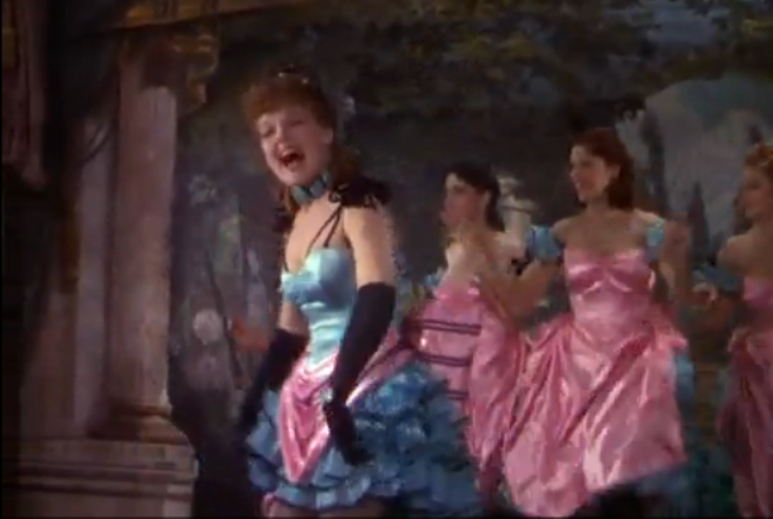
Of the two, this film, argues Prof. Slotkin, has a more pro-capitalistic outlook, as the railroad is presented as a herald of technological and societal progress.  As long as society has heroes like Flynn who will step up and make it safe for women and children, order and progress will win and benefit all.  There is a bit of tension in that *too* much domesticity is ridiculed in the figures of the older women of the "Pure Prairie League", in contrast to the fun women in the neighboring saloon as represented by singer Ann Sheridan, and all the drinking, partying men who raise hell in an extended barroom brawl sequence that is as fun as it is frenzied.

Ann Sheridan and her fellow saloon ladies in bright,
crisp pastels
Alan Hale reluctantly accepts a cup of tea
from the ladies in the 'Pure Prairie League'.  His
being inducted as a member is a wonderful comic touch.
I would agree that this film did capture a sense of optimism, of expansion, using 'right' along with 'might'.  I felt that, unlike JESSE JAMES, the point of view or message of the film was not overly heavy-handed.  Of course, the film stayed away from controversial topics such as the human cost of western expansion for the Native Americans.  For pure enjoyment and joyful tone this film is close to DESTRY RIDES AGAIN, another film from 1939 that I really enjoyed, and wrote about here.  I am not particularly a fan of Errol Flynn, and while he was fine here, I found myself taken with Alan Hale's portrayal of the loyal, and somewhat comic sidekick.  Olivia de Havilland was lovely and feisty, and while eventually succumbing to Flynn's wishes for domesticity, she did have an opportunity to earn a living at the local newspaper.

A very different, but equally enjoyable 1939 big budget western, is 20th Century Fox's  JESSE JAMES, starring Tyrone Power and Henry Fonda, with Henry King directing.  This one apparently started the 'cult of the outlaw' in popular culture, and there have been upwards of a dozen films on the subject of James.  Here, the railroad figures prominently again, but instead of a sign of progress, it's a sign of capitalist oppression, a sentiment that would be understood by a great number of Americans in the late 1930s.  James himself is initially portrayed somewhat fictionally as being driven to becoming an outlaw as a result of his family and farmer neighbors being illegally threatened by corrupt (railroad) businessmen.  He's someone we root for, and then he goes wrong as he finds he can't resist the criminal life even when better forces, namely the women in his life try to bring him back to the straight and narrow.

Unlike Olivia de Havilland's prominent role in DODGE CITY, the female lead here, Nancy Kelly, has not much to do other than moon and grieve over her man.  Nearly of the shots of the couple together feature Power over Kelly.  Power, obviously, was the big matinee idol, and was playing against type as the scruffy outlaw.  His acting chops were on display, as he was convincing and rather good in the role, as was Henry Fonda as his brother Frank James.  It's a well-paced western with action, pathos, and beautiful on-location vistas in and around Pineville, Missouri. (While the cast and crew were celebrated by residents of Pineville while on location, I was horrified to learn that at least one horse was killed by the stunt it was forced to do in a key scene). While punctuated by comic touches, especially from Henry Hull's blustering newspaperman, the tone of the film is darker than DODGE CITY.  Despite the fault of the opportunistic capitalists, the message that a life of crime doesn't pay, and ultimately can't be justified, is clear.

Power as James cannot be talked out of his next criminal venture.
It was a film that left me interested enough to consider watching the sequel.  Incidentally I recently watched a lesser western called KANSAS RAIDERS (1950) about James' early experiences with renegade confederate leader William Quantrill.  This film, starring Audie Murphy, was also greatly fictionalized but the portrayal of James as a 'misunderstood kid trying to do good but going wrong' is fully intact in this one as well.
The clear message would have been appreciated by 1930s audiences.
Next up in the lecture series:  STAGECOACH and OX-BOW INCIDENT.