Curt Siodmak, Screenwriter

The Wolf Man, 1941
Director: George Waggner
Writers: Curt Siodmak
Cinematographer: Joseph Valentine
Produced by: George Waggner and Jack J. Gross for Universal Studios
Starring: Claude Rains, Warren William, Evelyn Ankers, Maria Ouspenskaya, Lon Chaney Jr., Ralph Bellamy, Patric Knowles
Why I chose it
This blog series has made it through 20 years of cinema without a legitimate horror film...and there were plenty during those early years. Further, Universal Studios was lauded at that time for its output of classic 'monster' films, including Dracula, the Frankenstein series, The Invisible Man, and this one. I had not had the chance to see this one until now. Validating my choice were the voters in my Twitter poll, who chose it over It Started With Eve, Suspicion, and Swamp Water.
'No-spoiler' plot overview
Larry Talbot (Lon Chaney Jr.) returns to his family estate in England after growing up in the U.S., and finds his father, Sir John Talbot (Claude Rains), grieved over the death of his eldest son so he decides to stay on a while. Larry meets and quickly becomes enamored of Gwen, who works at the antique shop in the small town. Unfortunately, things go downhill quickly. A friendly visit to a small contingent of gypsies in the country bordering the town turns to disaster when Gwen's friend Jenny is pursued and killed by a werewolf, who only minutes before was the fortune teller Bela (Bela Lugosi). Larry jumps to the rescue and kills the wolf (and also Bela) with his special silver wolf-headed cane he had just bought. Having barely escaped this incident, and with a pentagon-shaped wolf bite to prove it, Larry becomes terrified by the idea of becoming a werewolf, which he indeed does. Struggling with trying to get appropriate help from the coterie of his father's friends, who are largely in denial about what is happening, he fears that his happily-ever-after with Gwen is in serious jeopardy.
Production Background
Classic film enthusiasts and scholars generally regard Universal Studios' monster films among the most compelling and trend-sitting in cinema. After a string of these in the 1930s, including the werewolf movie Werewolf of London (1935), output was spotty in the 1940s, with the production of lower-budget sequels and send-ups of the genre like Abbott and Costello Meet Frankenstein. Occasionally a seminal picture like The Wolf Man sneaked out of the studio with a top cast and production values.
English actor Claude Rains, so impactful in classics such as Now, Voyager and Mr. Smith Goes to Washington, was no stranger to horror films: he made The Invisible Man in 1933 and Phantom of the Opera in 1941, both for Universal. Apparently, he won the lead role over Lon Chaney, Jr. in Phantom, but here supports Chaney, the son of the famous 'Man of A Thousand Faces' (see my write-up on He Who Gets Slapped here). Chaney got his first role in horror with this but had a second one the same year with director George Waggner. Dracula star Bela Lugosi had also hoped to play the lead, but was relegated to the small role of the gypsy/werewolf.
According to TCM, Chaney was not the most popular man on set, as he complained about his heavy 'wolf' make-up, but also played practical jokes on co-star Evelyn Ankers, until she was completely fed up. The entire cast struggled with the noxious fog fumes in the outdoor scenes, and Ankers passed out at one point.
Some other notable film-related events in 1941 (from Filmsite.org):
- 24-year-old Orson Welles, called America's "boy wonder" or wunderkind, directed and acted in Citizen Kane (1941), a movie about a powerful newspaper publisher named Charles Foster Kane (modeled after William Randolph Hearst). "Boy genius" Welles was the first to ever receive simultaneous nominations in four categories: as producer, actor, director, and writer.
- Reclusive Swedish actress Greta Garbo retired early at age 36, after the release of her disastrous comedy, the box-office flop Two-Faced Woman (1941). She announced that she was quitting the film business, left Hollywood, and remained out of the spotlight until her death of natural causes in 1990.
- Approximately 500 animators and artists at the Walt Disney Studios conducted a five-week strike backed by the Screen Cartoonists' Guild, during the making of the animated film Dumbo (1941). The Disney workers demanded pay raises and the right to unionize, which they won when the strike was settled by federal mediation.
- The first, generally acknowledged film noir was released, John Huston's directorial debut film The Maltese Falcon (1941). It was the first detective film to use the shadowy, nihilistic noir style in a definitive way. The mystery classic was the pivotal work of novice director John Huston, and also starred former screen heavy Humphrey Bogart.
My Random Observations
- It's always a pleasure to learn that a film you plan to watch is, well, short. This one clocks in at 70 minutes and covers a lot of ground in that time. Kudos to Universal Studios and the production machine.
- The opening credits introduce all the main characters in short clips in pre-code Warner Bros. fashion! There is no mystery here about who is going to end up terrorizing the locals (see Screenshots section below). I have to remember, though, that in 80 years since this film was made, the general public has reaped the benefit of decades of 'Wolf Man' and 'Werewolf' movies and programs; I expect film-goers in 1941 found perhaps a bit more suspense in their experience watching this. For me, it was beautiful to watch but not the least bit suspenseful.
- I had to google "lycanthropy" -- the term introduced in the movie as related to Werewolfism (is that a word?). The Merriam-Webster dictionary defines it as follows:
- 1: a delusion that one has become a wolf
- 2: the assumption of the form and characteristics of a wolf held to be possible by witchcraft or magic.
- It seems that Lon Chaney, Jr. is not thought of as the film's best actor by reviewers. He loves to grin widely, as seen in the early part of the movie before his fate encroaches. I found him more convincing when he was distraught over his transformation into a killer. As the real tragedy of the story is a young man's life being torn from him and he having no power to take the necessary control, I felt Chaney conveyed this tragedy through his face and body.
- Of course, the fact that two innocents lost their lives bears mentioning here. I couldn't help but think of the infamous Star Trek "red shirts" - those peripheral characters that appeared in an episode only to serve the function of meeting a brutal end, after which our main characters would need to jump into action.
- The rest of the male cast is populated with A-listers: Claude Rains, of course, and the always interesting Warren William, to start. I had to read up on Evelyn Ankers, as she was new to me. Not surprising, because she made her primary career in 1940s Univeral horror films (a segment I haven't explored yet).
 |
| Meme from screenrant.com here. |
 |
| This is the friendliest-looking werewolf I've ever seen. |
 |
| The Talbot estate looks like nothing Larry had seen in the U.S.! |
 |
| Larry (Lon Chaney, Jr.) and Sir John Talbot (Claude Rains) negotiate the terms of their relationship. |
 |
| Larry inadvertently becomes a peeping Tom when he catches sight of Gwen (Evelyn Ankers) using his Dad's telescope. |
 |
| Larry is thrilled with his new silver-wolf-head cane he bought from Gwen. |
 |
| Gypsy fortune teller (Bela) prepares to entertain his client Jenny (Fay Helm), before he bites her. |
 |
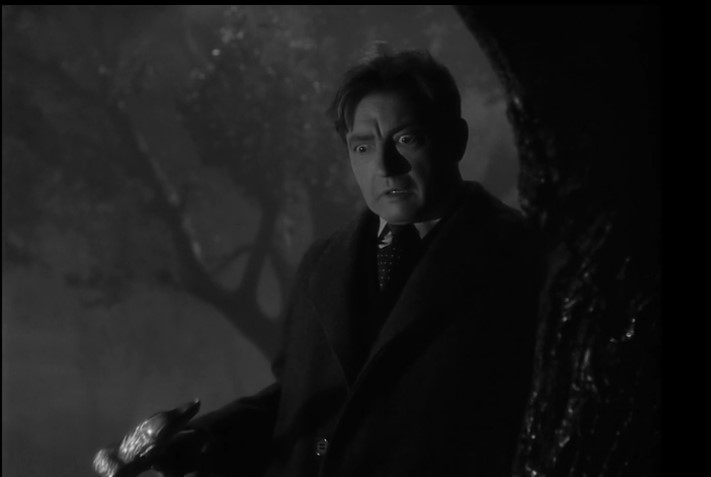
| If the English countryside is enshrouded in fog, beware! |
 |
| Dr. Lloyd (Warren William) and family lawyer Colonel Montford (Ralph Bellamy) discuss what to do about the problem that is Larry Talbot. |
 |
| A country show adds a bit of fun before the unrelenting doom to come. |
 |
| Gypsy Maleva (Maria Ouspenskaya) warns Larry he has a 99.9% chance of becoming a werewolf. |
 |
| Extra hair begins to grow on poor Larry's ankles -- and this is just the start! |
 |
| Werewolf seeks his prey in (where else?) the fog. |
 |
| Suspicious townspeople rotate their heads to watch Larry Talbot enter Sunday services. |
 |
| I swear there were wolf paws in this trap just a moment ago! |
 |
| Larry warns Gwen that both of them may be in serious trouble. |
 |
| Somehow I doubt that those straps will keep Wolf Man from escaping when he gets hungry. |

The film can be streamed from archive.org here, and also is available on DVD in several collections.