Search This Blog

Showing posts with label Myrna Loy. Show all posts

Friday, June 25, 2021

Fifty Years of Film in 50 Weeks, #19: The Rains Came, 1939

"Who is the pale copper Apollo?"
(Myrna Loy, meet Tyrone Power).

The Rains Came, 1939

Director: Clarence Brown
Writer: Phillip Dunne and Julien Josephson, from the novel by Louis Bromfield
Cinematographer: Arthur C. Miller
Produced by: Darryl F. Zanuck and Harry Joe Brown for 20th Century Fox Studios
Starring: Myrna Loy, Tyrone Power, George Brent, Brenda Joyce, Nigel Bruce, Maria Ouspenskaya, Joseph Schildkraut

Why I chose it
My Twitter polls have been slowly adding votes with every new poll, and this had a total of 15. This film won appxoimately 2:1 over the next two runners-up (Midnight and The Adventures of Sherlock Holmes). As I had no other criteria to choose this time, I was pleased to follow the wishes of my voters and watch this star-studded disaster/melodrama.

'No-spoiler' plot overview 
In a fictional small town in India called Ranchipur, a motley group of natives and foreigners, the latter being mostly English and Americans, get caught in a series of natural disasters that devastate the town: an earthquake followed by a tsunami and then a breakout of the plague. The main characters are Tom Ransome (George Brent), a cynical womanizer who is pursued by Fern (Brenda Joyce), the ingenue daughter of the local American missionaries; we learn Ransome has history with newly arrived Lady Edwina Esketh (Myrna Loy). Lady Esketh, for her part, married for money (we think?) to a much older Lord (Nigel Bruce) and continues her man-eating ways by pursuing the stoic, dedicated local 'high caste' doctor, Major Rama Safti (Tyrone Power). When she joins up to help the Major as a hospital volunteer working with the sick and dying plague patients, she's faced with a difficult decision when the Major can be appointed Maharaja only if he gives her up.

Production Background 
This film was Fox head Darryl Zanuck's moment in the sun. He bought the rights to the Louis Bromfield novel and went about putting his dream team together in 1939 style. He borrowed Myrna Loy and director Brown from MGM, and Brent from Warner Bros. Apparently no one was to his liking for the ingenue role, Fern, so he recruited a college student, Brenda Joyce (who went on to have a successful, if not exceptional, career in front of the camera). The fantastic scenes of torrential rains and flooding dominated the picture and the set. Credit special effects man Fred Sersen, who with his department won the first-ever special effects Oscar for his work. Apparently Brown loved his time at Fox, stating that the departments worked well together, unlike at MGM where feuds and one-upmanship were the norm. Upon release the film garnered lukewarm reviews, but it did well at the box office; however, the expenses were only recouped years later on re-release. 

Some other notable film-related events in 1939 (from Filmsite.org):

  • Swedish actress Ingrid Bergman made her American film debut (and English-speaking debut) as piano teacher/concert pianist Anita Hoffman in Intermezzo: A Love Story
  • The California Child Actor's Bill, better known as the Coogan Law, was enacted. The child labor reform act took place after 24-year-old Jackie Coogan, who had starred in The Kid (1921) opposite Charlie Chaplin, sued his parents (mother and stepfather) in 1938 for mismanaging and exploiting his career and spending his acquired fortune as a young star. 
  • The future rival to film -- television -- was formally introduced at the New York World's Fair in Queens. The Radio Corporation of America (RCA) unveiled a display of its first TV sets for sale to the American public.
  • British actor Basil Rathbone, as Sherlock Holmes - with an Inverness cape and curved-stem pipe, was accompanied by dull-witted, pipe-smoking Nigel Bruce as Dr. Watson, in their first appearance together as the crime-fighting duo, in 20th Century Fox's The Hound of the Baskervilles

My Random Observations

  • I must have reached the level of film fan who can instinctively associate stars and directors with particular studios; it's for that reason that the mixing of Brent, Loy, and Power had me doing double-takes at the screen watching this film. Sort of a patchwork quilt of a production!
  • While I absolutely adore black and white films, I feel this one may have been more impactful on viewers if in color, especially during the year that produced The Wizard of Oz and Gone With The Wind at competing studios. (Yes, I know other great pictures that year, like Stagecoach and Mr. Smith Goes To Washington, were filmed in B&W).
  • At times I felt that Alfred Newman's score was overbearing and distracted from the dialogue or action. I loved the Indian music interludes, but the European orchestral part of the score could have been dialed back (as I write this, I recognize a parallel between the use of music in this film and the Western influence in Indian culture especially during the colonial era).
  • I have a totally new appreciation for George Brent. Before, whenever he showed up in a movie, I would wince or sigh in resignation. I realize that is largely my prejudice. But here, he astonished me. His character may have been the best written, with the roguish and generous elements in his personality dueling at times, and Brent knew exactly how to play it. His performance was, in my opinion, the best of the entire cast. Even with Tyrone Power at his peak of handsomeness, I couldn't take my eyes off of him.
  • I was having a sense of deja vu and realized it was because of the similar themes and plot points of The Painted Veil, the Somerset Maugham novel that was filmed in 1934 and 2006. In that novel, a young wife, who is superficial and selfish, follows her physician husband to Hong Kong, takes up with a handsome colonial official, but ultimately finds purpose and true love by working alongside her husband to curb a deadly outbreak of cholera in China.

Screenshots
The opening titles appear to wash away, one after another.

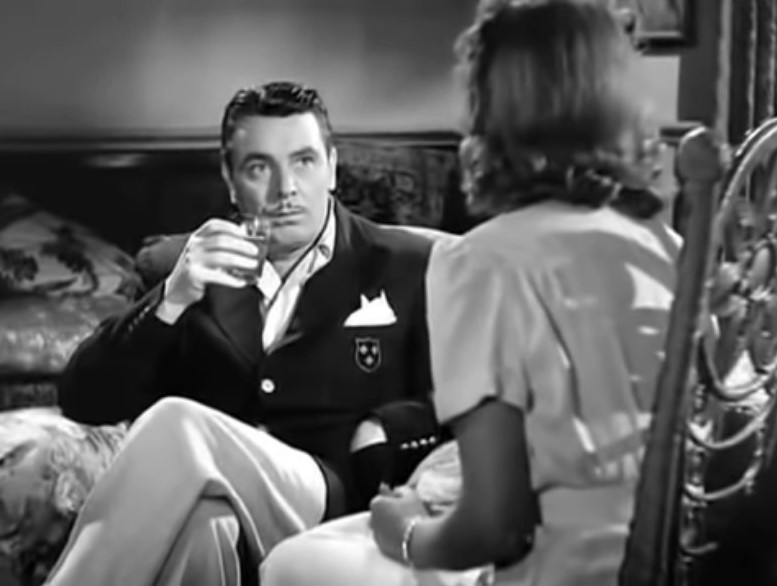
Ransome (George Brent) is content to sling pebbles at monkeys
outside his patio.

Elegant Tyrone Power dons brownface and a turban here
as Major Rama Safti.

Jane Darwell and Henry Travers run the American
Missionary School, and allow Ransome a respite from the
pretentious Mission owners next door.


Ransome not sure which part of his nature should win
when it comes to young Fern (Brenda Joyce).

H. B. Warner and Maria Ouspenskaya as Ranchipur's
Maharaja and Maharani.

Not a glimpse of a happy marriage (Loy and Bruce).

Ransome has his eye on the clouds as he takes a moment
to reflect on his past with Lady Esketh.

An unexpected romance begins to take root.

Lord Esketh's diary of his wife's dalliances.

During the floods, Fern comes to rescue Ransome and prepares
for a rest afterward.

Tom Ransome clings to the top of the statue of Queen 
Victoria, now mostly immersed in the rushing tsunami.
Symbolism, anyone?

Major Safti attends to the dying Maharajah.

Lady Esketh ponders her next move--in cards and in life.

Lady Esketh, masked against the plague, tends to a critically 
ill patient.

Major Safti's heart is pierced by the newly selfless Edwina.

Tom confronts Safti on his career choices.

Safti dressed for success, admired by the Maharani.

Where to Watch: I found a somewhat inferior print on YouTube here, and would instead recommend checking the DVD ("Studio Classics" line) out of your local library.

Further Reading
A major source for me was Mark Vieira's book Majestic Hollywood, The Greatest Films of 1939 (2013).
I also recommend Jeremy Arnold's article for TCM on the film with many juicy production tidbits, including Myrna Loy's relationships with others on the set and the tricks used by cinematographer Miller.

Monday, April 26, 2021

Fifty Years of Film in 50 weeks, #12: Love Me Tonight, 1932

"The son of a gun is nothing but a tailor!" "Isn't it romantic"? 

We are now into the height of the pre-Code era with this musical delight of a film.

Love Me Tonight, 1932

Director: Rouben Mamoulian
Writers: Samuel Hoffenstein, George Marion, Jr., and Waldemar Young, adapted from a play by Leopold Marchand and Paul Armont
Cinematographer: Victor Milner
Produced by: Rouben Mamoulian for Paramount Pictures
Starring: Maurice Chevalier, Jeanette MacDonald, Charles Ruggles, Charles Butterworth, Myrna Loy, C. Aubrey Smith
Music and lyrics by: Rodgers and Hart

Why I chose it
I love watching films from the early 1930s and have seen many of the big ones from 1932. Love Me Tonight was one of a handful of recommended new-to-me films; I chose it after it tied with Vampyr in my Twitter poll. The fact that I hadn't seen much of anything from classic film superstar Jeanette MacDonald gave the musical the edge. 

'No-spoiler' plot overview
Our hero, Parisian tailor Maurice (Chevalier), is duped by the penniless Viscount Gilbert de Varèze (Ruggles) into producing a boatload of suits for him on credit. Finally determined to collect what is owed to him, he ventures to the Chateau where the Viscount lives with his imperious Uncle (Smith), various elderly aunts, and cousins Countess Valentine (Loy) and Princess Jeanette (MacDonald). Coincidentally, Maurice had literally run into Jeanette on the road and fell instantly for her; his feelings were not immediately returned. 

To prevent his uncle from finding out about his debts, the Viscount introduces newly-arrived Maurice as a 'Baron'. Thus welcomed as an honored guest in the household, Maurice goes along with the ruse to get close to Jeanette. Ultimately she reciprocates his advances, but once his cover is blown, will they live happily ever after?

Production Background and 1931 in Film History
This film fits nicely into the style that early Paramount Pictures spun into cinema gold: sophisticated and 'continental' comedies and musicals. Russian-born director Mamoulian was a great fit there; he was hired at Paramount's Astoria (NY) studios after directing a number of stage musicals in the 1920s.

Mark Cousins, in his book The Story of Film, said Love Me Tonight is "so explosively innovative that it makes the majority of contemporaneous films look hopelessly dated." He cites Mamoulian's "major coup" as recording the musical and percussive score before the shoot started - unheard of in cinema at that point. In the scene where Maurice first arrives at the chateau, "he seems to dance and dart around the huge rooms" in time to the music. 

At the time the film was released it wasn't seen as a big hit, as 1932 was a down year for musicals before Warner Bros.' 42nd Street resurrected them, but ultimately notched #7 for box office proceeds in 1932. For its post-Production Code re-release (after 1934), this film was trimmed down to 96 minutes to remove more salacious lyrics and costuming. Those missing minutes have never been restored and are presumed lost.

Some other notable film-related events in 1932*:

  • Director George Cukor's A Bill of Divorcement marked the film debut of 24-year-old Katharine Hepburn as Sydney Fairfield (misspelled as Sidney and Katherine in the credits).
  • MGM's classic Best Picture-winning film masterpiece Grand Hotel was the first 'all-star' epic featuring many high-powered stars of the early 1930s, including John Barrymore, Wallace Beery, Joan Crawford, and Greta Garbo, etc. 
  • Welsh-born English actress Millicent Lillian "Peg" Entwistle gained notoriety by tragically committing suicide from atop the Hollywoodland sign  - she allegedly jumped from the giant "H". She had been in only one contracted Hollywood movie role (a bit part) since arriving in the LA area, RKO's Thirteen Women (1932), and it turned out to be the last for the 24-year-old discouraged actress. 
  • Paramount Pictures, founded in 1912, began to curtail activities in its East Coast studios in Astoria (Long Island, NY) and moved to Hollywood, once the conversion to "talkies" was complete.

*Thanks to Filmsite.org

My Random Observations
  • Talent overfloweth in this one: Chevalier and MacDonald, of course, and reliably excellent character actors Charles Ruggles, C. Aubrey Smith, Elizabeth Patterson, and Robert Grieg. That said, how underused was Myrna Loy in this one? I'm still really not sure what she was doing there (!). She had freshly graduated from playing exotic and sometimes villainess types in silents but had yet to advance to leading lady roles. Her day will come within a couple of years.
  • As this *may* be the only complete film I've seen with Jeanette MacDonald, my verdict: I like her. She was sassy, elegant, and at once innocent and worldly. Not sure I'm totally sold on her voice, though,although it fits the style of Rodgers and Hart's songs.
  • The opening scene, with the sun rising on Paris and numerous workers and craftspeople beginning their day, had me tapping my toes and snapping my fingers. The rhythmic blend of sounds crescendoed until the camera found Chevalier and he broke into song. You can't go wrong with a movie that starts like this. The opening scene can be viewed here: 

  • The musical numbers overall were tremendously memorable thanks to the genius of Rodgers and Hart. I had no idea that the classic 'Isn't it Romantic?' originates in this film. 
  • Maurice Chevalier seemed to always play the same charming French romantic rogue, but nobody did it better. While I loved this film, my favorite Chevalier remains The Smiling Lieutenant with Miriam Hopkins and Claudette Colbert.
Screenshots
Paris is bustling in the early morning.

Our first glimpse of our Maurice with his million-dollar smile.

Don't trust any man (Ruggles) who pretends to run a street race
because he doesn't have any outerwear!

Everyone joins in singing "Isn't it romantic?"

First glimpse of the lovely princess Jeanette - singing, of course.

Valentine (Myrna Loy) is enjoying this tiff between the Viscount
(Ruggles) and their uncle the Duke (Smith).

The doctor tells Jeanette's assorted relatives that her 
fainting spells will abate if she marries a young man(!)

Robert Grieg once again cast as butler, shows Maurice the way.

A hunting expedition results in a little accident for Maurice,
but brings him into the orbit of his love, Jeanette.

Jeanette finally acknowledges her feelings for Maurice,
but doesn't yet know that he's 'nothing but a tailor'.

Shot superimposition catches Jeanette watching Maurice 
walk down the winding path away from the Chateau

You better not mess with Jeanette - she's determined here
to stop a moving train on its tracks.

Where to Watch
The film is on DVD available through Kino Lorber. A few versions of the film are currently up on YouTube. 

Further Reading    
Richard Barrios's essay for the National Film Preservation Board here.
Fellow CMBA blogger and film historian Annette Bochenek from Hometowns to Hollywood film blog adds her thoughts and fills in some production details here.