Search This Blog

Showing posts with label Roger Livesey. Show all posts

Sunday, August 4, 2024

My 5 favorite Powell & Pressburger films

In honor of the recent release of Martin Scorcese's documentary Made in England: The Films of Powell and Pressburgerwhich I saw recently at the cinema, I present my five favorite (so far) films from this legendary filmmaking team, counting down from #5 to my #1.

First, for those not familiar with Michael Powell and Emeric Pressburger, they were a director/writer team who flourished as independent British filmmakers in the mid-20th century with a wide-ranging filmography and consistent innovation. They hired the best actors and crews working at the time, and thanks to the efforts of Scorcese's Film Foundation, many of their films have been restored to their original brilliance. Many are on DVD and streaming platforms, and some can be seen in your local independent cinema.

Michael Powell (left) and Emeric Pressburger in consultation (image
from Criterion.com)

#5: The Red Shoes (1948)Arguably the best-known of Powell & Pressburger collaborations, it has it all: music, dance, high drama, art vs. life, life imitating art, incredible technicolor, and gorgeous settings. A bonus is the film debut of the luminous dancer Moira Shearer. Watch the original trailer here: 

#4: A Matter of Life and Death (1946): I recently had the opportunity to see this on the big screen, and it was a blast. I had seen it earlier on the small screen, but the black and white scenes in the bureaucratic afterlife were so stunningly rendered, which only really "popped" in the cinema. I also found Roger Livesey to be a complete delight in his secondary but critical role as the doctor who defends our hero. And Marius Goring, who was the serious composer in love with Moira Shearer in The Red Shoes, here is fantastic as a petulant French 18th-century angel who failed to transport David Niven to the hereafter. Spoiler: It has a feel-good ending. 

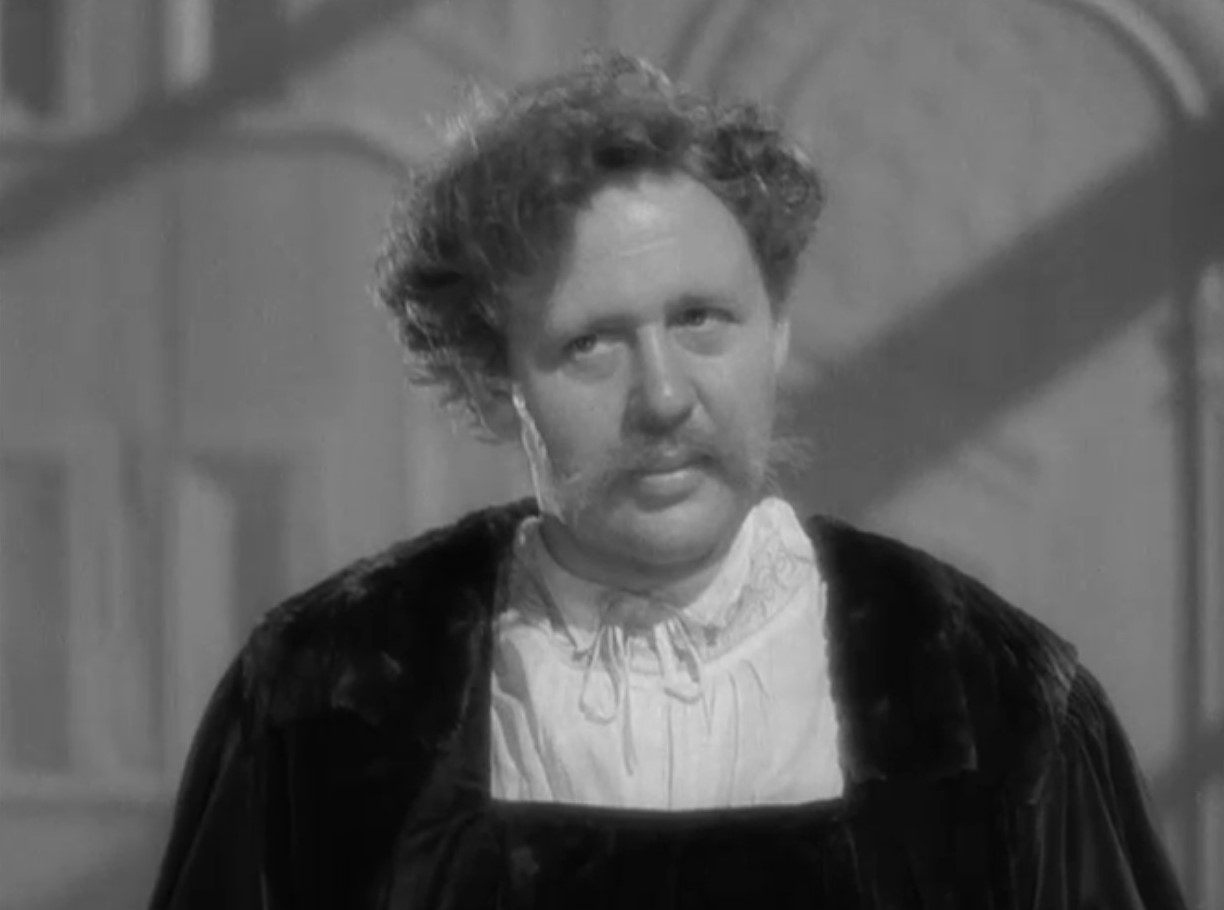
Residents of the afterlife are summoned to witness a trial.

Watch the trailer for the recent 4K restoration below.

#3: I Know Where I'm Going! (1945): This might be the most overtly romantic film in my list, with a love story unfolding against all odds. It's full of quirky characters, witty humor, and a forbidding Scottish highland coast, but the brilliance of leads Wendy Hiller and Roger Livesey make this so much more than your typical romantic drama. Seeing a restoration of this one last November at the British Film Institute was a highlight of my trip to the UK. A trailer is below.

#2: The Life and Death of Colonel Blimp (1943): Approaching this film, I asked, "Who is Colonel Blimp?" Turns out he was a famous cartoon character in England (created by cartoonist David Low) who represented a satirized "old-school" authoritarian British officer. The protagonist of the film is not named "Colonel Blimp" but was inspired by him. Yet as scripted by Pressburger and played by Roger Livesey, he is an imperfect but eminently likeable character who we accompany through 40+ years of his life and loves over the film's near 3-hour running time. Along the way we meet his one-time nemesis, and later friend, a German officer portrayed by Anton Walbrook, and three pivotal female characters all portrayed by Deborah Kerr. There could be so much said about this film, so I'll leave you with just two words: watch it.

Roger Livesey and Deborah Kerr in The Life and Death of Colonel Blimp

At the end of the movie I may or may not have exclaimed it was the best movie I'd ever seen, a true masterpiece. In that, Scorcese would agree with me. And then came...

#1: A Canterbury Tale (1944): My love for this film came as a complete surprise, as I hadn't even heard of it before I watched it for my "50 Years of Film in 50 Weeks" blog series. I delighted in the quirkiness, the wartime realism blended with overtones of medieval mysticism, yearnings that are partially satisfied but others left to the future...all with the trademark breathtaking shots and humanistic themes that run through most of the Powell & Pressburger oeuvre. Read my blog post here for a deeper dive into the film, its production, and my reflections. I cannot argue with writer Xan Brooks, who confessed in an article in The Guardian, "A Canterbury Tale may be the most loving and tender film about England ever made." 

Sheila Sim and Eric Portman in A Canterbury Tale

Which is your favorite of the Powell and Pressburger films? Please leave a comment.

Postscript: After I watched the Scorcese documentary, I realized that I have yet to see most of Powell & Pressburger's later work. Here are films that intrigue me and that I plan to see soon:

  • The Tales of Hoffman (1951): The complete opera by Offenbach on cinema, with Moira Shearer appearing as the famous dancing doll, Olympia. Of course, the actual singing was dubbed in by opera singers.
  • Gone to Earth (1950): Scorcese had good things to say about this one, a co-production with David Selznick, especially Jennifer Jones' (Mrs. Selznick's) performance, but the film was not a commercial success.
  • Peeping Tom (1960): This horror film was Michael Powell without Pressburger, and it was so controversial and almost universally panned at the time that Powell's career was over. The film has since been reappraised and is seen as Powell's last masterpiece.

Wednesday, June 2, 2021

Fifty Years of Film in 50 Weeks, #16: Rembrandt, 1936

When your film needs a big personality, Charles Laughton is always top of the list.

Rembrandt, 1936

Director: Alexander Korda
Writer: Carl Zuckmayer and June Head
Cinematographer:  Georges Périnal
Produced by: Alexander Korda for London Film Productions
Starring: Charles Laughton, Gertrude Lawrence, Elsa Lanchester, Edward Chapman, Walter Hudd, Roger Livesey

Why I chose it
I narrowed my initial list down to this one, recommended by a film friend, and Romeo and Juliet, and really was inclined to watch both. Ultimately, Rembrandt won because of my curiosity to see what Charles Laughton would do with the role, but also because producer/director Alexander Korda is a giant in early British cinema. 

'No-spoiler' plot overview
Rembrandt struggles to keep his seventeenth-century Amsterdam household afloat when his wife dies unexpectedly. He manages to derail his career when he paints an extremely unflattering commissioned portrait of civic guards in his famous "The Night Watch", and begins to drink. He's not sure whom to trust when everyone from his housekeeper to his best friend seems to want something from him, but he finds true love again with Hendrickje, a young maid with a pure heart. Will his life get back on track? Will his talent be appreciated again in his lifetime?

Production Background 
Alexander Korda was a towering figure in British cinema in the 1930s - he founded London films and produced and directed a series of hits, including The Private Life of Henry VIII (1933), which solidified his relationship with actor Laughton. Nabbing Laughton again for Rembrandt was a natural move; for his part Laughton threw himself into research, spending time living in Amsterdam, and even taking painting lessons to seem more comfortable in the studio scenes. However, not all time on the set was easy. Apparently Gertrude Lawrence, a renowned stage actor, wasn't enjoying the filming process and was rather disruptive. The lavish set design was contributed by Vincent Korda, the brother of Alexander. Ultimately, the film was a commercial failure but a critical success. According to a Hollywood Reporter news item, Rembrandt was the first film to have a trailer projected on an airplane by television transmission. The projection took place on a fourteen-passenger flight bound for London. 

Some other notable film-related events in 1936*:

  • The Screen Directors Guild was organized by a number of Hollywood filmmakers, choosing director King Vidor as its first president (he served from 1936-1938). The Guild was renamed the Director's Guild of America (DGA) in 1960.
  • American film producer Irving Thalberg died at the age of 37 - he had been dubbed the "Boy Wonder" for his brilliant ability to selectively choose successful film projects. As MGM's head of production, he was responsible for many MGM classics, including the aforementioned Romeo and Juliet that starred his wife Norma Shearer.
  • After a short one-year contract with MGM expired, 14-year-old starlet-singer Deanna Durbin signed with Universal Studios and made her first feature film, the successful musical comedy Three Smart Girls , reportedly saving the studio from bankruptcy. 
  • The first screen adventure for Flash Gordon, the comic strip character created by Alex Raymond in 1934, was Universal Pictures' 13 episode serial Flash Gordon (1936), starring Buster Crabbe.

*Thanks to Filmsite.org

My Random Observations

  • I expect that as a filmmaker focusing on the life of a great painter, you must be under pressure to produce as beautiful a film as possible, for obvious reasons. This film is stunning in its period imagery and costumes, and the cinematography of Georges Périnal ran the gamut from long shots to close-ups in glorious black and white (see Screenshots section below).
  • Charles Laughton's big personality works here. He's in almost every scene and the success of the film rides on his performance. I'm not sure whether writer Zuckmeyer or Korda insisted that this film feature more than one Laughton monologue because of his success reciting the entire Gettysburg Address in Ruggles of Red Gap the year before, but be warned, there are at least two of them here. They stop the action, and while excellently delivered, I fidgeted just a bit.
  • I admit to knowing nothing about Rembrandt's life. If the filmmakers were setting out to emphasize the lows of his life, they succeeded. Perhaps not as tragic as Van Gogh's, it wasn't an easy one. Once again, if there was any doubt, we are reminded that revered painters did not always have it easy in their day.
  • Roger Livesey is a favorite of mine for the films he made with Powell and Pressburger in the 1940s. He spent his entire film and stage career in Britain, and it's always a delight when he pops up in these earlier movies. He is completely unrecognizable as "Beggar Saul", but his voice gave him away for me! As a bit of trivia, his two brothers AND his father had small parts in this film.
Livesey in The Life and Death of Colonel Blimp
(1943).
  • Even though Elsa Lanchester (Laughton's wife) was not Korda's first choice for Hendrickje, I thought she was perfect here - she radiated beauty in a way I've never seen, not to mention her kindness and steeliness.
Screenshots
Here's a Rembrandt self-portrait opening the 
film credits, perhaps urging us to appreciate
how closely Laughton will resemble him.
 
In his early years, Rembrandt loved to spend money on
jewels for his wife Saskia. His friend is a bit concerned.

Rembrandt and villagers in Old Amsterdam.

Rembrandt's brutally honest "The Night Watch" is unveiled,
and doesn't get the reaction that would ensure
him career success.

Newly cynical Rembrandt is a bit perturbed at the 
criticism of his recent work. 

Rembrandt family housekeeper Geertje Dirx (Gertrude
Lawrence) plots to move in after the untimely death of 
Rembrandt's wife Saskia.

Roger Livesey as the beggar who becomes
King Saul in a sitting in Rembrandt's studio.

As King Saul

Rembrandt returns briefly to his humble birth home and
 village and eats supper with the fam.

In Rembrandt's birthplace, the villagers make merry.

Elsa Lanchester as Rembrandt's common-law
wife Hendrickje. Here she's getting ready
to sit for her portrait, what else?

This time, Rembrandt is not deluding himself
about the grave condition of someone he loves.

I think Laughton studied Rembrandt's self
portraits to put on this face.

The aged painter enjoying the attentions of a merry
young group enthralled with his wit.

Where to Watch
Criterion released a quartet of Korda films focusing on major figures ("Private Lives"); this one is in that set. I saw the film on Archive.org here.

Further Reading
As usual, TCM offers a nice essay about the film here. The AFI also has some interesting production tidbits, including from the recollections of Elsa Lanchester, here.