Search This Blog

Showing posts with label John Huston. Show all posts

Wednesday, May 18, 2022

Fifty Years of Film in 50 Weeks, #44: The Night of the Iguana, 1964

 "He that hath no rule over his own spirit is like a city that is broken down, and without walls."
Proverbs 25:28(KJV)
-from a sermon by the Rev. T. Lawrence Shannon in The Night of the Iguana


The Night of the Iguana, 1964

Director: John Huston
Writers: Anthony Veiller and John Huston from the play by Tennessee Williams
Cinematographer: Gabriel Figueroa
Music: Benjamin Frankel
Producer: Ray Stark for Seven Arts Productions, distributed by MGM
Starring: Richard Burton, Ava Gardner, Deborah Kerr, Sue Lyon, Skip Ward, Grayson Hall

Why I chose it
Life inserted itself with a vengeance over the past several weeks and my series went on hiatus. I needed to come back with a blockbuster, and this one fit the bill - a star-studded production with one of the centuries' best directors at the helm, based on a work by one of the centuries' most-celebrated playwrights. 

'No-spoiler' plot overview 
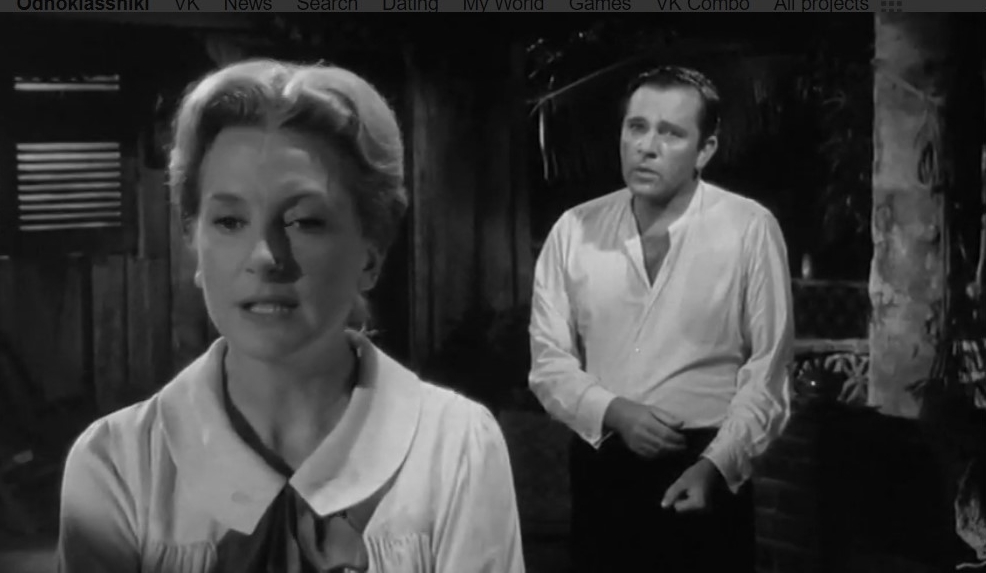
The Episcopal priest Rev. T. Lawrence Shannon (Burton) has a problem - he's been booted out of his congregation after a sex scandal and struggles to hold down his job as a tour guide employed to take a group of teachers from a Baptist college to see sights in Mexico. A combination of the temptations of a young seductress, Charlotte (Sue Lyon), and precarious mental health prompt him to take refuge at a remote inn in Puerta Vallarta with his unhappy tourists in tow. He's greeted warmly by earthy widow Maxine, who runs the inn. Shortly after, a prim but penniless single woman, Hannah Jelkes (Deborah Kerr), and her grandfather arrive looking for shelter. Over a single night, Maxine, Shannon, and Jelkes confront their life choices and bounce ideas off of one another. All three are changed by morning.

Charlotte (Sue Lyon in foreground) captures the attention of the Rev. 
Shannon (Burton) as her concerned chaperone Mrs. Fellowes (Grayson Hall) looks on.

Production Background

The production of The Night of the Iguana has entered the orbit of legend. First, without John Huston's decision to film in Puerta Vallarta, the remote town would most likely not have become the popular resort it is today. In fact, Huston, who favored on-location shoots, chose that location because of its remoteness, as the particular village was only accessible by boat. (Williams' play was set in Acapulco.) Williams himself apparently relished the opportunity to be an on-site advisor. Once the stars began arriving, the locals and the international press took notice. 

Of particular interest was Elizabeth Taylor, who accompanied her new boyfriend Burton to Mexico. The two stars were the talk of the universe after wrapping Cleopatra (1963), where their love story ignited. Ava Gardner was reported cavorting with local young men, similar to her character, Maxine. And Deborah Kerr was all too aware that her husband, writer Peter Viertel, was previously involved with Gardner. Yet by all accounts peace was maintained and everyone enjoyed the experience.

The film won one Oscar, for costume design (Dorothy Jeakins), but had been nominated for Best Supporting Actress (Grayson Hall), Best Cinematography, and Best Art Direction.

John Huston (back to camera) presents his cast
gold plated Derringer pistols on the set of 
The Night of the Iguana

Some other notable film-related events in 1964 (from Filmsite.org):

  • The mockumentary A Hard Day's Night (1964), the first Beatles film, premiered. The behind-the-scenes lives of the Fab Four were highlighted as Beatlemania erupted worldwide. The Beatles had made their first live TV appearance in the US on "The Ed Sullivan Show" on February 9, 1964.
  • To obtain film rights to the intellectual property My Fair Lady (1964), to be directed by George Cukor and starring Audrey Hepburn and Rex Harrison, Warners paid a record sum of $5.5 million in February 1962. (See Annie (1982) when the record was broken.)
  • Ronald Reagan's last feature film appearance before his retiring from the screen was in director Don Siegel's post-noir crime thriller The Killers (1964) in which he played 'heavy' or bad-guy crime boss Jack Browning - the first time he had ever played a villain. Two years later, he would be elected governor of California.
  • The first feature-length made-for-TV movie, an action film titled See How They Run (1964) and starring John Forsythe and Senta Berger, was broadcast on NBC-TV for its world premiere. It was the first broadcast of Project 120, an innovative deal between Universal and NBC.
My Random Observations
  • Wow, were most of the characters in this annoying or just plain odd! The film opened with a flashback to the moment that the Rev. Shannon lost his congregation, by having a breakdown on the pulpit and yelling angry nonsense. His agitated state persists for most of the movie. His nemesis, Mrs. Fellowes (the aunt of young sexpot Charlotte) is close behind him in the hysterics department. The eccentric Miss Jelkes and her grandfather are on the other side of the spectrum, poised, relaxed, and calm, despite their precarious circumstances. 
    Rev. Shannon loses it in the pulpit.
    Bus tour passengers wonder where their guide
    is taking them.
  • As I was watching this, I was getting distinct Mogambo vibes. That 1953 film shared so many elements with this one: an exotic setting (on safari in Kenya); a love triangle between a middle-aged man (Clark Gable), an earthy hostess (a very similar role for Ava Gardner), a prim newcomer (Grace Kelly), and life and career choices that must be made. Instead of iguanas, there were tigers in Mogambo. That story was based on the 1928 play Red Dust (also made into a movie) by Wilson Collison.
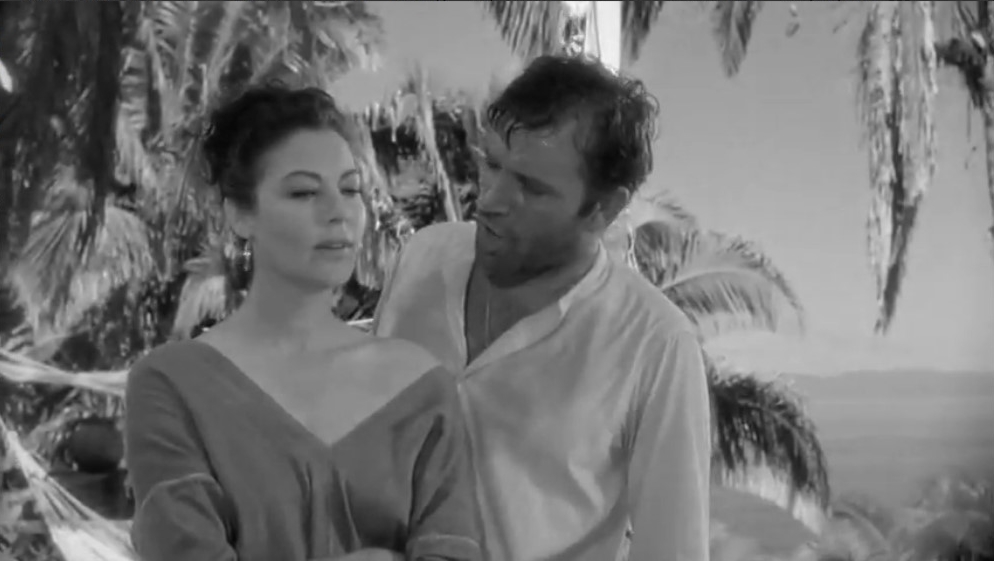
Maxine and Rev. Shannon negotiate the price of hospitality for his
tour group and the terms of their relationship.

Ava Gardner, Grace Kelly, and Clark Gable in Mogambo

  • There were so many visually interesting shots, thanks to director Huston and his cinematographer Figueroa. When I began to lose interest in the story or the characters because of the absurdity of the plot, I was pulled back in by the visually interesting shot compositions and beautiful lighting. Huston had argued to film in black and white and it is stunning, but even he thought later that color would have enhanced the emotional experience.
Maxine cavorts on the beach with her Mexican companions.

Miss Jelkes shares her life philosophy with Rev. Shannon.

  • Having been included in the title, the unnamed iguana only got a couple of brief scenes. I wanted more.
The iguana is not quite ready for its closeup.

Where to Watch
It's readily available on DVD and can be streamed for a small fee on most services.

Further Reading
While I haven't read the book, I listened to a fascinating interview with the author that convinced me that the book would be well worth reading: Johns, Howard: A Stolen Paradise, (The Making of The Night of the Iguana). For a deeper analysis of how the film adapted Williams' play, read this article.

Wednesday, July 18, 2018

Book review: The Life and Times of Sydney Greenstreet

Author Derek Sculthorpe continues to conduct exhaustive research leading to the biographies of classic screen actors whose names are less familiar to the casual movie fan, but beloved by cinephiles. The bio of British-born Sydney Greenstreet (1879-1954) is the latest of his for me to read and review, and this time I'm grateful to BearManor Media for providing me with my copy.  Check out my posts on the Van Heflin and Brian Donlevy bios, and my Q&A with author Sculthorpe included in the Donlevy post.

The thing about Greenstreet is this: while his film career was relatively short--he entered the industry in 1941 at age 61, but made his last film in 1949 due to his failing health--his appearances are so striking, his voice so resonant, and his characters' personalities loomed so large, that I'd wager that anyone would remember him after seeing a single of his films.  As his career arc differed so much from other classic film stars, I was particularly interested in learning about him as a way to illuminate some dusty corners in cinema history and early 20th-century cultural history. For this, the book does not disappoint.

Sculthorpe is a completist in his approach and offers everything that is known about Greenstreet, both professionally and personally, in a measured, chronological manner, starting with his family history. He drew from primary sources as well as books such as Ted Sennett's profile of Greenstreet and frequent co-actor Peter Lorre's professional collaboration, Masters of Menacebut his connection with Gail Greenstreet, the actor's granddaughter, was especially valuable, leading to insights and photos never before published. The book offers a complete catalog of Greenstreet's film, radio, and stage appearances, and 36 pages devoted to a bibliography and citations.

Young Greenstreet, ~1920.
From the book's Facebook page
"I seek to ... show that he had a full life before he became famous," Sculthorpe said in the book's introduction. As a result, over half of the book is devoted to his stage career, which actually encompassed most of Greenstreet's working life, but at first I wasn't sure that I would be as interested in that. However, as I continued reading I became fascinated by the new world of early 20th-century theater life was that opening up to me--the touring lifestyles, the larger-than-life theatrical impresarios, and changing tastes of the American public. Greenstreet, while a UK native, made the U.S. his adopted home early in his career, as he toured with a number of theatrical companies here.  Among those were Sir Philip "Ben" Greet of 'The Ben Greet Players',  Col. Henry Wilson Savage's company, which produced mostly musicals, Margaret Anglin, an actress and producer who produced a number of Shakespeare plays that Greenstreet sank his teeth into, and Minnie Fisk ("Mrs. Fiske") with whom Greenstreet excelled in Shakespeare's As You Like It.  Sculthorpe punctuates these histories with colorful stories of alfresco performances and audiences of suffragettes.


Greenstreet's star was considerably high at this point, and he never really actively sought to become a film star, but when John Huston gave him the opportunity with The Maltese Falcon after seeing him in a stage production of There Shall Be No Night by Robert Sherwood, Greenstreet's career was catapulted in a new direction. His success in the beloved noir led him to an Academy award nomination and a contract with Warner Bros., and he made Hollywood his home--this after he assumed The Maltese Falcon was going to be his one film, and did attempt to resume his stage career.
Greenstreet with Humphrey Bogart in The Maltese Falcon.
According to Sculthorpe, the two actors shared a warm relationship.
Sculthorpe examines Greenstreet's film career through the lens of the actor's theatrical experience. In plays, because of his large size (Greenstreet always loved food and was heavy from his early days) he wasn't cast as romantic leads in plays, but rather villains and often clowns or comic characters. [Of particular note to film fans was a 1931 production of Arisophanes' play Lysistrata in which Greenstreet shared the stage with Miriam Hopkins and Fay Bainter, and after he left, Hopkins' role was taken over by Jean Arthur.] In contrast, in films Greenstreet rarely had the opportunity to exercise his comic chops, as his most memorable screen roles were of imposing, albeit refined villains.  He did, apparently, complain to his studio bosses about the narrow nature of his roles, and eventually did receive parts in comedies, that were, for the most part, second rate. Perhaps the best known and loved today is Christmas in Connecticut, in which Greenstreet's relatively straight character had some comic moments--in particular, having a tumble in the snow.
Christmas in Connecticut proves to be less than hospitable
for poor Alexander Yardley (Greenstreet).
Unlike many Hollywood stars, Greenstreet's personal life seemed to be somewhat calm. He married New Jersey native Dorothy Ogden at age 38, and they had one son, John, who spent many years in boarding school in the U.S. while his father toured much of the time. Sadly, Dorothy fell victim to a mental illness and was institutionalized at age 41 for the remainder of her life.  While his wife's illness and absence was a considerable strain, Greenstreet was an outgoing person who formed relationships with his fellow actors and was generally appreciated for his professionalism and warmth.  He mentored up-and-coming stars including most notably Zachary Scott, who credited Greenstreet as his film 'teacher.' He apparently loved a good party and enjoyed regaling everyone around with jokes and stories.

Greenstreet as the trumpeter in a 1938/39 stage production
(with Lunt-Fontanne) of Amphitryon 38 (from the
book's Facebook page here)
Greenstreet succumbed in 1954 after years of battling ill health. Some may say that it's too bad he only acted for nine years and 24 films, but in reality I believe our memory of him is enhanced because his work was preserved in such a concentrated period of time.  I recommend the bio for dedicated film lovers looking to fill in many gaps in our understanding of the man behind the imposing, often frightening physique in many 1940s classics. As previously mentioned, his film work does not dominate the volume, and those picking up the book should know that equal time and analysis is devoted to his stage work.  For those, like me, for whom this part of history was unexplored, those parts of the book will greatly add to your appreciation of early 20th century cultural life.