"This is far and away the most dramatic and hair-raising picture yet made on the sinister subject of persecution in a totalitarian land, and the suspense which it manages to compress in its moments of greatest intensity would almost seem enough to blow sizable holes in the screen." (from the 1940 NY Times review by Bosley Crowther.)

Escape, 1940
Director: Mervyn LeRoy
Writers: Arch Oboler and Marguerite Roberts, from a novel by Grace Zaring Stone
Cinematographer: Robert H. Planck
Produced by: Mervyn LeRoy and Lawrence Weingarten for MGM
Starring: Norma Shearer, Robert Taylor, Conrad Veidt, Nazimova, Felix Bressart, Albert Bassermann, Philip Dorn, Bonita Granville
Why I chose it
This one was recommended by two film friends. It was a tough choice, but I was in the mood for an MGM film with one of the "Queens" of MGM, Norma Shearer. Considering WWII was underway in Europe and looming for the US in 1940, it seemed appropriate to pick a war-themed adventure.
'No-spoiler' plot overview
Mark Preysing (Robert Taylor) is an American who travels to Bavaria in 1936 to meet up with his actress mother Emmy Ritter (Nazimova), who as a German citizen had come back several years before to settle her husband's estate. What Mark learns, after considerable trouble, is that his mother has been captured by the Nazis and placed in a concentration camp because of perceived financial irregularities. He enlists the aid of a friendly doctor and local friends, along with the Countess von Treck, formerly an American, to navigate the hostile regime, personified by the Countess's boyfriend General von Kolb (Conrad Veidt), to get his mother out of Germany before she is executed for her "crimes." With the help of the doctor, they induce a death-like coma to try to smuggle Emmy out in a coffin. Complications ensue.
Production Background
This film was the second of the year MGM star Robert Taylor made with director LeRoy; the first was the fan favorite Waterloo Bridge, another war-themed drama, with the emphasis on the romance. His romantic partner here, MGM queen Norma Shearer, was looking to end her acting career and was just finishing out her contract. Filling out the cast were several actors who had recently fled Germany: Conrad Veidt, whom LeRoy had pursued vigorously for the role of the General; Albert Bassermann, who made his Hollywood debut in 1940 and was cast in six films, including Hitchcock's Foreign Correspondent also in 1940; Felix Bressart, a reliable character actor playing parts calling for a European; and Philip Dorn, who worked in Germany but was originally from the Netherlands. Hitler banned the movie for its antagonistic stance towards his regime, and later banned all MGM films.
Some other notable film-related events in 1940 (from Filmsite.org):
- Disney's groundbreaking Fantasia (1940), an outgrowth of the "Silly Symphony" series, was comprised of classical music pieces and matching animation. The film received a special certificate at the 1941 Academy Awards for its revolutionary Fantasound (early stereo or 'surround-sound').
- Vaudeville and radio stars Abbott and Costello made their big-screen film debut in One Night in the Tropics (1940). However, the two comics were not the major stars of the film, but just minor contract players (they reprised some of their famous stage acts, including a rudimentary "Who's on First").
- Actor/director/producer/writer/composer Charlie Chaplin released his first "all-talking, all-sound" feature film, The Great Dictator (1940). Charlie Chaplin was the first to ever receive three simultaneous nominations, as producer, actor, and screenwriter for the film.
- Walter Brennan became the first performer to win three Academy Awards for acting with his win in 1940. He won Best Supporting Actor for his performances in alternating years, for Come and Get It (1936), Kentucky (1938), and The Westerner (1940).
- The musical Down Argentine Way (1940) featured the first starring role for Betty Grable. It also featured Don Ameche and Carmen Miranda in her US film debut.
My Random Observations
- Escape grabbed my interest from the opening, in which we see Nazimova as Emmy Ritter prostrate in the hospital ward of a concentration camp. She's desperate but indignant and not afraid to mock her captors. Her heartreading emoting sets the tone for the film.
- Norma Shearer played her usual heroine combining elegance and pathos, but she seemed especially subtle here, especially when dealing with her Nazi lover (Veidt). I was delighted to find this tidbit: in his book The American Cinema, critic and writer Andrew Sarris briefly analyzes and categorizes the work of directors during the Golden Age, and places Mervyn LeRoy in the "lightly likeable" category. While he mostly points out his perceived flaws, Sarris singles out LeRoy's direction of Norma Shearer and Conrad Veidt's scenes together as a career high point.
- Is our hero Mark Preysing's naivete typical of the American public at the time? His mother is German, and yet he seems shocked everytime he faces examples of the totalitarianism and threats of the Nazi regime. I found it a stretch that it took him so long to realize he was facing tall odds to break his death-row Mom free. Of course, my twenty-first century perspective may warp my expectations of how characters behave in these situations.
- I need to see more of Philip Dorn's work; as the sympathetic doctor he was quietly charismatic. Despite his soft, friendly features, you never were sure he could be trusted.
- Overall, a compelling film, that despite some implausible plot developments and coincidences, captures the ominessness of the Nazi regime on the verge of the U.S. entry into WWII. I'm rather surprised it isn't better known. It's not a classic like Casablanca, but it's aided by innovative visuals and the committed performances of the leads and the European emigres.
 |
| The doctor (Philip Dorn) tells captured Emmy Ritter (Nazimova) that he may be able to help get a message to her son. |
 |
| Preysing (Robert Taylor) encounters his first unfriendly Nazi. |
 |
| Dr. Henning (Albert Bassermann) struggles to tell Preysing he needs to abandon the search for his mother. |
 |
| Preysing walks into a Nazi minefield looking for his mother. |
 |
| I love the position of the Nazi symbol here. |
 |
| A winter scene in small-town Bavaria: Preysing meets the Countess. |
 |
| The General holds his teenage girl audience captive with his charm and storytelling skills. |
 |
| The Countess and the General in a relationship reckoning. |
 |
| You know it's love when the Countess blows off the town parade to have tea with Mark Preysing in an empty cafe. |
 |
| An awkward situation at the opera when your American escort is under suspicion by the Gestapo and you have to introduce him around. |
 |
| The Doctor has an unusual interest in Preysing's business, but all can be settled over a couple of beers. |
 |
| Old friend Fritz Keller (Felix Bressart) tries to talk sense into Preysing. |
 |
| Preysing plays solitaire to calm his nerves when the Nazi guards at the next table decide he needs their company. |
 |
| Let's make sure that Emmy Ritter is really in that coffin! |
 |
| Bonita Granville (right) plays her usual venomous teen role while the Countess tries to be nonchalant. |
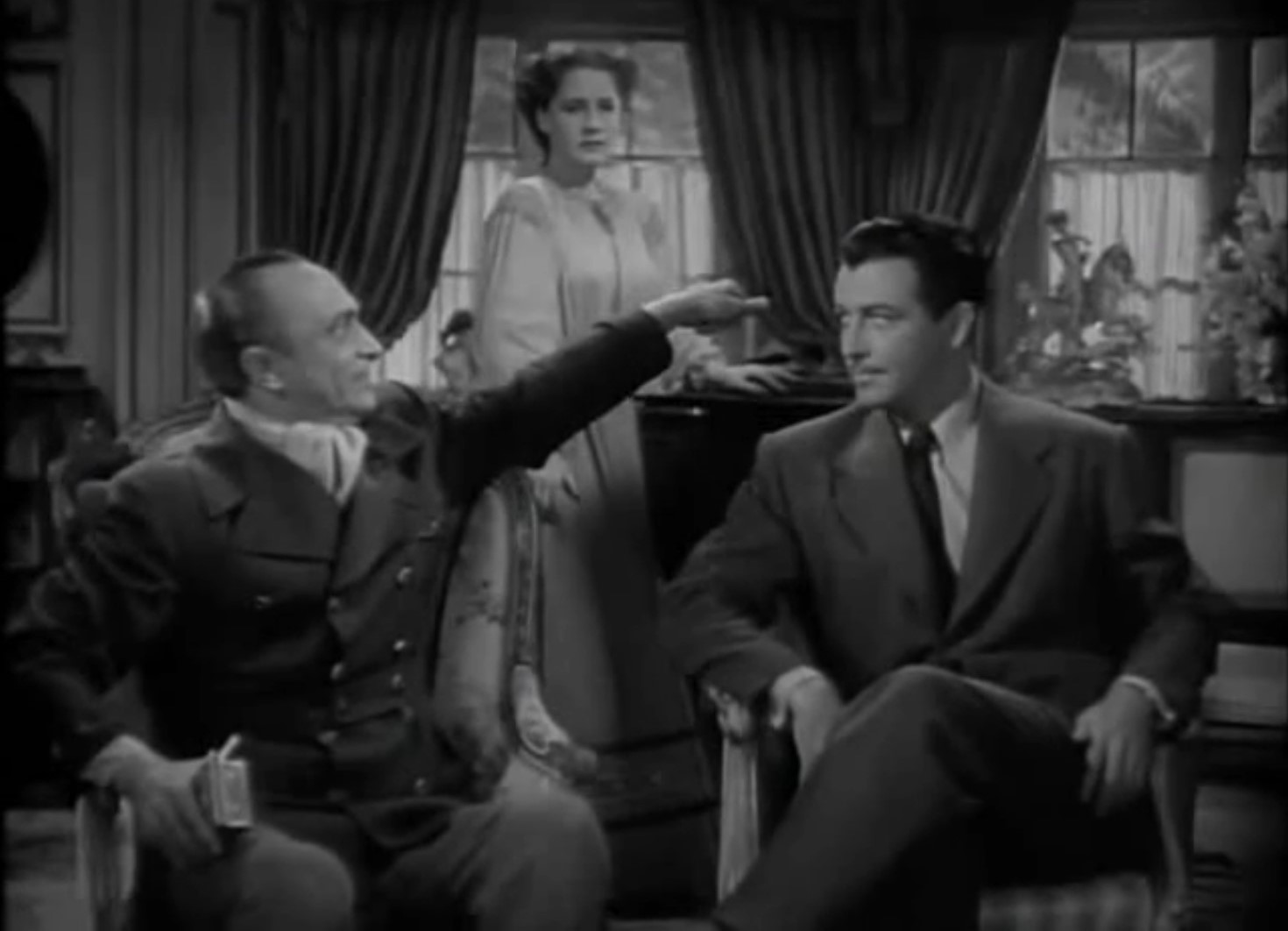 |
| The General grills Preysing while a concerned Countess contemplates how she'll get out of this jam. |
 |
| Mother and son together--things are looking up. |


