Search This Blog

Showing posts with label Charles Bickford. Show all posts

Monday, March 14, 2022

Fifty Years of Film in 50 Weeks, #42: The Days of Wine and Roses, 1962

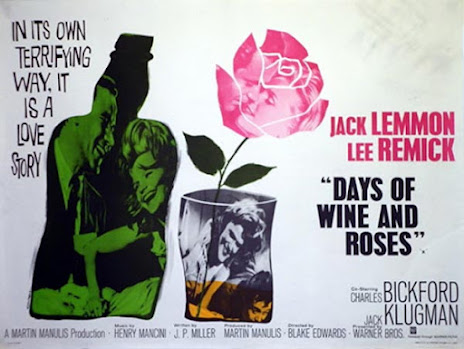
Days of Wine and Roses, 1962

Director: Blake Edwards
Writers: J. P. Miller
Cinematographer: Philip H. Lathrop
Music: Henry Mancini
Producer: Martin Manulis for Jalem Productions, distributed by Warner Bros.
Starring: Jack Lemmon, Lee Remick, Charles Bickford, Jack Klugman

Why I chose it
After last week's veering into farce, I decided to once again dip into hard-hitting drama. This film had been on my radar for years as it's been on TCM a number of times, and I was curious about how difficult it was going to be to watch. As difficult as Who's Afraid of Virginia Woolf? I decided to find out.

'No-spoiler' plot overview 
Joe Clay is a successful and somewhat smarmy public relations worker at a large ad firm in San Francisco. Among his important job duties is procuring women for visiting high-ranking clients and tossing back copious amounts of liquor. One evening he meets Kirsten, the teetotaling secretary in his firm and mistakenly assumes she is expected to be part of the "entertainment". Angry, she rejects his later advances, but then gives in to his courting and finds drinking may be fun after all. They get married, have a baby, but in the next few years, the drinking dominates and destroys, first Joe's career, then the marriage, and finally their mental and physical health. Joe finds AA, and Kirsten returns to her father's house, but they struggle through sobriety and relapse.

Production Background
Director Blake Edwards was a director on his way up, mostly working on TV series until the early 1960s. His first big hit was the ever-popular Breakfast at Tiffany's (1961), and after Days of Wine and Roses, he mostly helmed comedies like the blockbuster Pink Panther series. When he had the opportunity to direct this extremely serious feature film, which was originally presented in 1958 as a play on TV (teleplay) by J.P. Miller, he got megastar Lemmon to help boost the picture. (In the TV version, Cliff Robertson played Joe and Piper Laurie played Kirsten. Charles Bickford portrayed Kirsten's father in both the TV and theatrical film.)

According to the book Film: A World History by Borden, Duijsens, Gilbert, and Smith, Edwards and his two leads actually drank quite a lot during production. It's not clear if their drinking added verisimilitude to some of the most intense scenes! Both apparently also attended AA meetings and visited jails and hospitals that housed and treated drunks.

The film accrued 5 Oscar nominations, including Best Actor for Lemmon and Best Actress for Remick, but only took home Best Song for Johnny Mercer and Henry Mancini.

Some other notable film-related events in 1962 (from Filmsite.org):

  • The 7th and final "Road to..." film (starring Bing Crosby, Bob Hope, and Dorothy Lamour) was released -- The Road to Hong Kong (1962). It was the last of seven escapist 'Road pictures' (beginning in 1940 with The Road to Singapore). 
  • 36-year-old sex symbol Marilyn Monroe was discovered dead (August 5) in the Los Angeles area in her Mexican style bungalow of an apparent drug overdose, a death the coroner ruled as "a probable suicide." She was in the midst of filming with director George Cukor in Something's Got To Give (1962). 
  • The action/spy film Dr. No, which launched in the UK in 1962, inaugurated the successful, long-running, and highly profitable James Bond series of action films. Based upon Ian Fleming's works, this film cast as the series' first Agent 007, unknown actor Sean Connery. Ursula Andress also starred as Honey Ryder, the first iconic Bond girl. 
  • Patty Duke won the Best Supporting Actress Oscar for her performance as young Helen Keller in The Miracle Worker (1962). She was the first minor (under age 18) to win a competitive Oscar.
My Random Observations
*
Special thanks to my friend Vânia for her gif image files, which I've featured throughout this post. Check out her blog at aintthatakick.tumblr.com.

Camerawork can be striking.
  • Considering Joe's initial happy-go-lucky corporate persona, who is a willing conspirator  to sexist debauchery, the film rather struck me The Apartment (1960) meets The Lost Weekend (1945). The latter was a film from the 1940s showing one man's weekend battle with a serious alcohol problem, considered quite realistic and forward-thinking for the era. In some ways, the present film may be more painful because of the extended family devastation not really the focus of the earlier film.
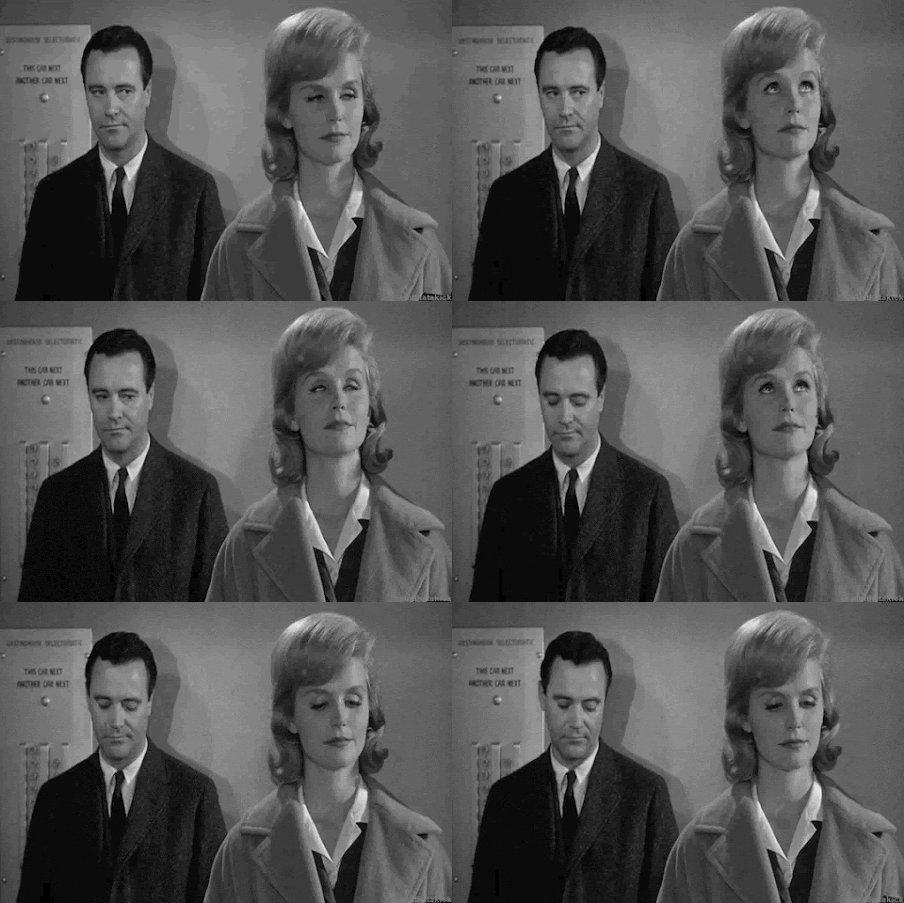
The Apartment, anyone?

Joe in the throes of a harrowing withdrawal.
  • The film is superb in letting us feel that all-consuming power of the bottle. Through the excellent performances, script, and cinematography we feel we are in the heads of our protagonists.
The lure of alcohol: one can have fun when drinking.

Kirsten realizes that the bottle makes for poor
company, when all is said and done.
  • This is my third film in this blog series featuring character actor (and one-time leading man) Charles Bickford. Last time we saw him was in the noir Fallen Angel (1945), and before that in Anna Christie (1930) opposite Greta Garbo. He's a good actor, and versatile, but it seems all his characters have one trait in common: they are strong and rugged. As Kirsten's father, he initially seems stern and to be feared, but we learn that he is an upstanding man who tries to help as his daughter's life spins out of control, and it's appropriate that the couple find him attractive to lean on.
  • So the verdict on if I find the film hard to watch: yes, but, not as difficult as I was expecting. There surely are painful scenes: when Joe is suffering withdrawal, when the couple's daughter suffers neglect or abuse, or when they confront how much love is able to overcome addition. The choice of black and white at once sets a somber tone and helps us keep slightly distant from the horror. Considering how these issues may be filmed in the modern era (Leaving Las Vegas comes to mind), I couldn't help but feel a bit spared from the worst.
    This can't be the life together that Joe and Kirsten
    had envisioned.
Where to Watch
The film can be rented to stream on a variety of the most popular streaming services, and can be purchased on DVD and Blu-Ray.

Further Reading
An excellent article on TCM.com provides interesting production tidbits, while this blogger posts a detailed comparison between the TV movie and the film.

Tuesday, August 31, 2021

Fifty Years of Film in 50 Weeks, #25: Fallen Angel, 1945

This post marks the halfway point in my journey through film history by watching approximately one film per week from successive years. Woo hoo!

Fallen Angel, 1945

Director: Otto Preminger
Writers: Harry Kleiner from a novel by Marty (Mary) Holland
Cinematographer: Joseph LaShelle
Producer: Otto Preminger for 20th Century Fox, Inc.
Starring: Dana Andrews, Alice Faye, Linda Darnell, Charles Bickford, Anne Revere, Bruce Cabot, John Carradine

Why I chose it
Although I loved British Powell & Pressburger's A Canterbury Tale, last week's film, I felt like returning to the Hollywood Studio System for a film that would represent the best things about the system during Hollywood's Golden Age. I was also in the mood for a film noir, a genre/style that was gaining major traction at this time in Hollywood. This film was recommended to me by two film friends whose opinion I trust.

'No-spoiler' plot overview 
Running out of bus fare, drifter and con-man Eric Stanton (Dana Andrews) disembarks from his Greyhound in a sleepy California coastal town, shy of his San Francisco destination. He take temporary refuge in "Pop's Eats" diner. 'Pop' (Percy Kilbride) is concerned about his favorite waitress, Stella (Linda Darnell), who has been missing for a few days. Stella reappears that evening, and Eric realizes the brunette bombshell has all the men in the town pining for her. Soon, Eric himself pursues Stella, who is also attracted to him, but demands that he earn enough money to support her.  Eric gets involved with a traveling fortune teller and medium (Carradine) and in that process meets sisters Clara and June Mills (Anne Revere and Alice Faye), the wealthy unmarried daughters of the town's former mayor. He sweeps the virginal June off her feet, but only intends to fleece her and skip town with Stella. Unfortunately, the same day he ties the knot with June, a key character is murdered and Eric becomes a prime suspect.

Production Background
Director/Producer Otto Preminger had a major hit for Fox, Laura, in 1944 with Dana Andrews and another brunette bombshell, Gene Tierney. So he was invited back the following year, along with many key crew members, including cinematographer LaSelle and composer Raksin, and leading actor Andrews, to helm Fallen Angel. In this melodrama propelled by a love triangle, the 'bad' love interest was cast with a star on the rise, sultry beauty Linda Darnell, who was romantically linked to Fox boss Darryl Zanuck. The 'good' girl went to a rather unusual choice: Alice Faye was known mostly from her musical films. But although Faye had begged to be cast in this to broaden her range, she apparently so disliked the finished film and her role, reduced to give Darnell more screentime, that she abruptly halted her career and didn't appear in a film again until 1962. 

While the film garnered generally good reviews, especially for the actors, it didn't make as much of an impression as Laura, and didn't earn any Oscar nominations. Preminger went on to work with Linda Darnell again in the romantic melodrama Forever Amber (1947), while Darnell and Andrews were paired as a married couple forced to fly a commercial airline flight in trouble due to incapacitation by the cockpit crew in Zero Hour! in 1957. Sadly, Darnell died in 1965 at age 41 in a house fire.

Some other notable film-related events in 1945 (from Filmsite.org):

  • Roberto Rossellini's influential landmark film Open City (1945, It.) formally introduced Italian Neo-Realism, marked by a gritty, authentic and realistic post-war film style. Characteristics included the use of on-location cinematography, grainy low-grade black-and-white film stock and untrained actors in improvised scenes. The socially-aware, documentary-style film captured the despair and confusion of post-World War II Europe.
  • Joan Crawford, who had developed a reputation for being mannered and difficult (and had been let go two years earlier by MGM for a slumping decline), pleasantly surprised everyone at Warners when she delivered one of the best performances of her career in Mildred Pierce (1945). In an astonishing comeback part (and debut role for Warners), Crawford won the film's sole Academy Award Oscar.
  • The Motion Picture Producers and Distributors of America (MPPDA), created by major US film studios in 1922 to police the industry, was renamed as the Motion Picture Association of America (MPAA). It was responsible for implementing the voluntary film rating system.
  • Pathe newsreel footage of the liberated German concentration camps was released - Radio City Music Hall declared it "too gruesome to be shown at a family theater."

My Random Observations

  • One of the things I learned from the TCM/Ball State U. course on film noir was that in a noir film, you're likely to see rooms with horizontal window blinds. This is a great piece of set design for the cinematographer, because they can use low lighting and shadow effects to cast what looks like jail bars across their subjects. Blinds show up early and often in Fallen Angel. In particular, in the diner Pop's Eats, where all the film's less savory characters meet. We're clued into the unhealthy relationships that play out at Pop's and will likely lead to serious problems.  Below are just a few of the shots featuring the prominent blinds.

    Stanton walks into "Pop's Eats"

    At "Pop's" counter is Pops (Kilbride, left), Stella, Mark Judd (Bickford)
    and Stanton. Blinds and their shadows dominate the screen.  

    Stanton and Stella get to know each other at "Pop's"

    Shadows galore as Prof. Hadley (Carradine, right) enters "Pop's"

  • On the other hand, the abode of the Mills sisters is Victorian -- we almost lose the two demure and secluded sisters in this shot at breakfast:
    June (Faye) and Clara (Revere) blend into their curtains
    while discussing their private lives while breakfasting.

  • Despite the near-identical production team, and the same leading actor, this film doesn't feel much like Laura. I attribute that first to the dominance of the musical score in the earlier film (courtesy of composer David Raksin), which sets an ethereal mood and gets stuck in your head pretty quickly. Second, Laura plays out in a mostly upper-class milieu, unlike the gritty, grimy feel of much of Fallen Angel. Yet, blinds show up in Laura, too!

    Laura (Gene Tierney) in her office.
  • In the reviews I've read, it's common to criticize Alice Faye's character's angelic, compliant, and loyal qualities that defy credulity. That didn't bother me, although I did find her June a bit of an enigma. For a character that started out as a spinster church organist, she took a huge leap to become a savvy, down-to-earth guardian angel who's willing to live with Eric Stanton's duplicitous misogynist. To make this transition she must have had a far more complex interior life than we see on screen. This was a miss for me, although I do appreciate that the film was primarily concerned with Stanton's character arc.
    June plans to play an organ recital at the church.

    June, the steely organist.

    June lets her hair down for Eric Stanton.

    And...June's costume neckline takes a major drop.
  • The best black and white films are just gorgeous to look at -- and this one should rank among those cited for the beauty of the shot composition. Here are just a few more screenshots highlighting the art of black-and-white cinematography in the studio era.


Where to Watch
A very nice print is streaming for free on YouTube at present. You can watch at this link. It's also available for free streaming on Archive.org, and can be purchased on Fox Home Entertainment DVD from the usual vendors.

Further Reading
Go to TCM's articles on the film, which served as one of my sources of production tidbits, for more detail. 

Sunday, April 11, 2021

Fifty Years of Film in 50 weeks, #10: Anna Christie, 1930

 I'm now 20% through my blog project, and entering a new decade. It's appropriate that since Greta Garbo was such a major star during this era, that I include one of her films. 

Anna Christie, 1930

Director: Clarence Brown
Writers: Frances Marion, adapted from the play by Eugene O'Neill
Cinematographer: William Daniels
Produced by Clarence Brown, Irving Thalberg, and Paul Bern for MGM 
Starring: Greta Garbo, Charles Bickford, George F. Marion, Marie Dressler

Why I chose it
This film rose to the top of my shortlist for Greta Garbo, but also for director Clarence Brown. Many years ago I was impressed with what he did with Valentino's Russian romp The Eagle, and vowed to explore more of his films. I learned of his vast impressive filmography, from the silent days to studio-era classics such as Intruder in the Dust, The Yearling, and National Velvet

That the film was recommended by a film friend and tied for first on my Twitter poll solidified my choice for 1930.

'No-spoiler' plot overview
After being separated from her father Chris (Marion) for most of her life, a young Swedish-American woman, Anna (Garbo), returns to seek shelter with him on the coal barge he captains. Unbeknownst to him and the young sailor she falls for (Bickford), her past is clouded with rape and prostitution. Eventually, she is forced to reveal these details to those she loves and risk their rejection.

Production Background and 1930 in Film History
In some ways, MGM was taking a risk with this film, with Garbo a silent film superstar but so many others becoming victim to the talkies because of their thick accents or other challenges adapting to the new medium. Fortuitously, the script, based on Eugene O'Neill's play, called for his protagonists to be Scandinavian-American, giving perfect screen to Garbo's accent. The film was marketed by MGM with the famous "Garbo Talks!" tagline. They had secured the services of veteran actor George F. Marion (he was born in 1860!), who had originated the role of Chris Christophersen in the Broadway run of the film as well as the 1923 film version. A version in German was also shot at the same time, starring Garbo but featuring a different supporting cast. 

Director Clarence Brown was nominated for two Oscars for films in 1930: this one, and Romance, also starring Garbo.

Some other notable film-related events in 1930*:

  • The first daily newspaper for the Hollywood film industry, The Hollywood Reporter, had its debut.
  • All Quiet on the Western Front (1930) was the first major anti-war film of the sound era, faithfully based upon the timeless, best-selling 1929 novel by Erich Maria Remarque. Although it won the Academy Award for Best Picture, it was criticized as being propagandistic and anti-militaristic. 
  • German stage revue actress Marlene Dietrich starred in her first Josef von Sternberg film, The Blue Angel (1930), playing the role of cabaret singer Lola-Lola and performing her signature song: "Falling in Love Again (Can't Help It)." Her performance in the first major German sound film led to a contract with Paramount in the US. 
  • The movie industry began to dub in the dialogue of films exported to foreign markets.

*Thanks to Filmsite.org

My Random Observations
  • Garbo is not a favorite of mine; while she is usually a glamorous, elegant, and sympathetic screen presence, her acting style brings a touch too much melodrama for my tastes. Yet here, I appreciated what Garbo did with the film's early version of Anna - the fallen, lower class, rough and cynical woman. She left her glamor in her dressing room and convinced as this character. Later, she transformed to a more poised, elegant version of Anna that better matched Garbo's type.
  • Not being from Ireland, I don't know if Charles Bickford's thick Irish accent was a good one, but it sure sounded like it! Bickford had a long Hollywood career and I love it when he shows up in a film. Bonus points if he gets to play a romantic lead.  Although his role here stretches the definition of romantic lead, considering his extreme roughness.
  • Garbo's and Dressler's characters are seen coming into the bar using the "Ladies' entrance"--I had no idea that such a thing existed. A little internet research set me right. According to Madelon Powers in her University of Chicago Press book called Faces along the Bar: Lore And Order In The Workingman's Saloon, 1870-1920,  a 'ladies entrance' served three purposes:  “First, it permitted women to enter inconspicuously and minimize public scrutiny of their comings and goings… Second, women’s entry through the side door eliminated the necessity of their running the gauntlet through the establishment front room . . . undisputed male territory.  . . .  Finally, the side door afforded women quick and convenient access both to the far end of the bar, where they could purchase carry-out alcohol and to a second chamber known as the ‘back room,’ where they could feast on free lunches or attend social events hosted there.” Who knew?
  • My second choice for 1930 film was Min and Bill, also a working-class drama starring Marie Dressler, who was the supporting character, Marthy, in this film. Like George Marion, Dressler was also born in the 1860s and was a theater veteran and considered today one of the greats in early cinema. It never gets old to witness performances of actors whose careers flourished over a century ago.
Screenshots
Christophersen (Marion) and his companion Marthy (Dressler)
meet up at their favorite watering hole.

Anna (Garbo) arrives at the bar and develops a bond
with Marthy, a kindred soul.

Anna's face and body language signal melancholy and
uncertainty in what she will find returning to her father.

High angle shot of the Anna's new environs.

Anna begins a life of dutiful domesticity aboard
her  father's barge.

Rugged sailor Matt Burke (Bickford) checks 
Anna out in the fog.

Anna and Matt getting to know one another.

A fun 'date' in the city.

Lovely shot of Anna with Brooklyn Bridge

Christophersen and Burke have competing
designs on Anna.

High melodrama: Anna and her father during
a moment of reckoning.

Is a happy ending possible for these three?
Where to Watch
The film can be streamed for a small fee on many streaming platforms, including Amazon, Hulu, and YouTube.

Further Reading
Danny of Pre-code.com discusses the film here, highlighting how it conforms to conventions of pre-Code cinema, and like me, admit to not being a huge Garbo fan. As usual, TCM has an excellent essay on the film here.

Tuesday, September 3, 2019

Alan Ladd blazes down the (Western) trail with 'Branded' (1950)

September 3rd marks the birthday of one of my favorite old Hollywood stars, Alan Ladd. To celebrate, I'm pleased to contribute this post to 'The Man Who Would Be Shane: The Alan Ladd Blogathon," hosted by Gabriela at Pale Writer. Check out all the great posts this week HERE.

By 1950 when Branded came around, Alan Ladd was already a superstar. After tooling around in bit parts, he'd burst forth in 1942 in This Gun For Hire, in a noir anti-hero role, and his on-screen spark with co-star Veronica Lake prompted Paramount to pair them in multiple noir/adventure tales over the next few years. During this time though, Paramount was casting about for more properties to feature their cash cow, and Westerns seemed like a good match for Ladd's stoic tough-guy-with-a-sensitive-soul persona. His natural athleticism and comfort with horses (he owned his own ranch) could be put to good use. The first Western Ladd made was Whispering Smith (1948) and when it succeeded the next one wasn't far behind.

In Branded, Ladd embraces the Western with renewed gusto, and blazed open the Western trail that was to lead to many film successes in the 1950s. While nobody would put this one above his most iconic film, Shane, which would come in 1953, it's an altogether worthwhile piece of cinematic entertainment and in my personal top-five Ladd films. As in Shane, Ladd's character is a gunfighter with a murky past, also with a single, meaning-packed name: Choya (derived from cholla--a prickly cactus native to Mexico and the southwest U.S.).
Don't mess with me: Alan Ladd in Branded's opening scene
The novel Montana Rides by Evan Evans was adapted for the screen by Sydney Boehm and Cyril Hume, and Rudolph Maté was assigned to direct. Maté, who had been a renowned cinematographer, had recently made his limited foray into directing, but all his previous films were black and white dramas. Though the photography credit goes to Charles B. Lang, Jr., I imagine Maté had a lot to say about shot composition. Regardless, the breathtaking Technicolor views of the Arizona canyon country grounded the film in the rugged West, even if the narrative action pla in Texas near the Mexican border.

The time period is never specifically stated in the film, but seems to be consistent with a mid-late 19th century when the West was still a rough place for the white newcomers to the territory. Unscrupulous fortune seekers roamed around threatening ranchers and gunfighters challenged the establishment of an orderly society in small towns. It's this environment that we're thrown into after the opening credits have rolled -- we meet Choya, who's been holed up in a store trying to evade a posse, and with guns blazing makes a daring escape with his only friends (his guns) and kin (his horse). He's tracked down in the rugged country side by Leffingwell (Robert Keith) and convinced to go in with him on a con--for the promise of a fortune, Choya's to impersonate the long lost son of wealthy rancher Lavery (Charles Bickford). He's even tatooed with a birthmark to match that of the son, who was kidnapped at five years old.
Choya getting a tattoo on his right shoulder by "Tattoo" (John
Berkes). Leffingwell (Robert Keith) makes sure the design is right.
Choya shows up at the ranch, and by acting the tough but hard-working cynic, he earns a job as a ranch hand and when the moment is right, he lets himself be discovered as missing Richard Lavery. There are complications, of course, including the fact that Choya can't help but be attracted to his new "sister," Ruth (Mona Freeman). Additionally, the sleazy Leffingwell has been revealed to be the kidnapper, having apparently concocted this plot over 25 years earlier and sold the real Richard Lavery to a Mexican jefe, Rubriz (Joseph Calleia). Richard has no recollection of his birth family, and is now living as Tonio Rubriz (Peter Hansen). Of course these dilemmas are all solved in a tidy 104 minutes, but only after an extended chase sequence through the streams, canyons and caves along the border, and nail-biting confrontations and 'come-to-Jesus' moments.
Choya meets Rubriz (Joseph Calleia).
Watching this, it seemed to me that Ladd was comfortable being that tough guy spitting nails at his antagonists, and showing off his strong lithe body wrestling or attempting to break a young colt, while also enjoying being stretched to act in more subtle ways. In the scene in which he watches his new 'mother' (an excellent Selena Royle) get emotional after it dawns on her she's looking at her lost son, his discomfort at his deception is evident in his expression and body language. In the Alan Ladd documentary The Real Quiet Man, co-star Mona Freeman commented on Ladd's sensitivity. "He didn't always realize it himself...he was sensitive, and there was a great gentleness about him."
Does Choya want to go through with his mistaken identity deception?
While overall Ladd isn't allowed to stray too far from his handsome leading man presence, I particularly liked those scenes in which he's sporting facial scruff, been dunked in a river, or dragged through the canyon dust. It's a way he's liberated from the confining image that dogged him much of his career, even while it made him box office gold for many years. It's evident he's having a blast making this film. According to Freeman, he was full of gags and fun on set, relaxed and enjoying himself. He did, however, show tremendous deference to the veteran Charles Bickford, even relentlessly trying to beg off a crucial fisticuffs scene until Paramount execs forced the shoot.
Ladd seems to be double-fisted with the guns in this movie.
Another plus for the film is a strong supporting cast, especially Bickford and Freeman, who has just the right blend of sweetness and spunk. Joseph Calleia hams it up a bit, but I can still buy him as a Mexican bandit chief. Robert Keith is perfection as the scheming, murderous Leffingwell who keeps appearing at all the wrong times determined to get what he wants. Peter Hansen made his film debut here, before becoming a reliable TV star. He and Ladd became good friends making the film, and Ladd cast him in a few of his later pictures he produced for Warner Bros.
Ruth Lavery (Mona Freeman) and Choya negotiate their relationship
Unlike other Westerns in which the history and politics of time and place are dominant themes, here the story is a melodrama, and could have easily been adapted for a different setting. What's really being explored here is the process of personal discovery -- and the meaning of family. The film illuminates many angles on this theme without bludgeoning the audience with it. Every character is alone with their struggles, in many ways, and the rugged landscape both reflects and intensifies those struggles. We know that at the film's end when most characters attain a bit of respite and the understanding they're looking for, it's probably only temporary as the next journey of survival is around a future corner.

Don't forget to read more great blog posts about Alan Ladd and his films here!

Saturday, March 30, 2019

Planning my schedule--sort of--at the 10th Annual TCM Film Festival


Well, it's that time again and the annual Turner Classic Movies Film Festival will explode in Hollywood bigger than ever in under two weeks now. (It's the 10th anniversary of the Festival and the 25th anniversary of the TV channel, and all passes have sold out for the first time.) While I'm excited to be attending, I so far haven't succeeded in building my complete schedule ahead of time, because with up to five different films showing in every time slot, and great guests appearing, my decision-making abilities have vanished--I need help, people!

In any case, I've captured my thoughts here as my festival planning is still very much a work in progress. Perhaps it's good not to get too committed, as it's inevitable that things change at the last minute. So, here goes:

Thursday, April 11
So for opening night, I can eliminate a few films pretty quickly: When Harry Met Sally (1989) (only for higher-level passholders), Dark Passage (1947), (seen it recently), The Umbrellas of Cherbourg (1964) (seen it recently on the big screen), Mogambo (1953) (sorry, no interest). The remaining films are all up for grabs.

Marilyn Monroe & Jane Russell
Option 1: I'll admit my first instinct was to head to the Egyptian Theater for Gentleman Prefer Blondes (1953) because it would certainly be fun to get the festival started with a rousing, fun musical with Marilyn Monroe and Jane Russell--that, plus I've not seen the entire thing. If I did that, I could stick around and see another fun film, or at least I believe it's fun as I haven't watched the entire thing ever -- The Bachelor and the Bobby Soxer (1947). (Cary Grant, Myrna Loy, and an adolescent Shirley Temple star).

Option 2: I'm also tempted to hang out by the pool for the outdoor screening of Ocean's 11 (1960). Angie Dickinson will be there, and outdoor screenings are usually a blast -- unless it's uncomfortably cold. In which case, it's best to be inside a warm cinema. This one ends late, so if I choose it, there will be no time to get to any other.

Gary Cooper as Sergeant York
Option 3: Sergeant York (1941) is screening at the Legion Theater (a new venue for the festival) and here's another Gary Cooper classic I haven't seen. In addition, members of the York family will be there to provide perspective to film-goers. What an amazing opportunity! If I choose this one, though, the timing is such that it will be my only film for the evening.

Friday, April 12
Morning Schedule: The first film of the day was an easy one for me: Merrily We Go To Hell (1932): it's a pre-code and who can resist a title like that? Fredric March plays a drunk and I'll be interested to see how it compares to his Norman Maine in A Star is Born (1937). After that, I may do something I've never done before: go to the Grauman's Chinese Hand & Footprint Ceremony for Billy Crystal, one of my favorite entertainers who so deserves this honor. For the second slot of the morning, my inner film geek will likely take over as I head over to the Legion Theater for What's Not To Love About Republic Serials? which promises film clips showcasing behind the scenes of the low-budget sci-fi/action short films from Republic pictures.

Afternoon schedule:  For the early slot, for me it's a choice between My Favorite Wife (1940),  (another Cary Grant classic) and the seminal silent film Sunrise (1927). I absolutely LOVE Sunrise, and it was one of the films that awakened my classic film obsession. However, my first view of this one was on the big screen with a new score performed live by the Berklee Silent Film Orchestra, so this screening wouldn't be a novelty for me. My Favorite Wife is a film new to me, and Jennifer Grant, Cary's daughter will be on hand to share her insights about her famous dad. It's a tough choice. Also, tugging at me will be the Hollywood Black Backlot meetup at 3:30, with a chance to meet author and film historian Donald Bogle, and get a free copy of his book.

Evening Schedule: For the later afternoon/early evening slot, I'm tempted to hang out near the Chinese cinema #6 for Vanity Street (1932) and Open Secret (1948). These are low-budget "discoveries" and are new to me. The former stars one of my favorites, Charles Bickford, in a rare leading man part. I'd be tempted to attend Steel Magnolias (1989) with the original playwright, Robert Harling, and star Shirley MacLaine in attendance (Wow!). The only thing is, this film will come to a local cinema later this year as part of the TCM/Fathom Big Screen Classics Series, and I will no doubt catch it then with our newly-minted TCM Boston Backlot chapter. The final and best option for me may be to head to Day For Night, a 1973 Truffaut film starring Jacqueline Bisset, with Ms. Bisset in attendance to offer her thoughts. I've not even heard of this one, (!) so a pleasant surprise may be in store for me here.

Late evening: Here it's a toss up between Road House (1948) and Winchester '73 (1950). The former, a film noir starring Richard Widmark and Ida Lupino, has been on my watch list for a while. And, it'll be shown in gorgeous black-and-white on nitrate. If I'm in a Western sort of mood, I'll head over to the Jimmy Stewart classic, to check another one off my watch list. And oh by the way, no midnight movie for me -- just can't do it!

Saturday, April 13
Barbara Rush in
When Worlds Collide
Morning schedule: It doesn't get much easier on Saturday. My first choice will be between All Through the Night, a comedy-thriller starring Humphrey Bogart from 1942, and When Worlds Collide (1951), a sci-fi "discovery" in which star Barbara Rush will be at the screening. The morning's dark horse is The Little Colonel (1935), a classic Shirley Temple film. Since I've not seen any of her films from her golden age--childhood that is--this is an opportunity to rectify that. For the second slot, I'm pretty much decided to see the classic British comedy Kind Hearts and Coronets (1949); it's new to me, plus young Alec Guinness, people!

Afternoon Schedule: For the early slot, I'm tempted by A Raisin In the Sun (1961), which is universally acclaimed and stars the great Sidney Poitier. Alternatively, there is a double feature starring silent cowboy star Tom Mix -- with live piano accompaniment from Ben Model. I could be very happy there! For the second slot, it will come down to one of these two: 1) Nashville (1975) -- this one is considered a Robert Altman classic and I've yet to see it. And as far as special guests--there is huge list for this one, including Jeff Goldblum, Keith Carradine, and (gulp!) Lily Tomlin! 2) The other option is It Happened Here (1964) a documentary-styled war drama from film historian and preservationist Kevin Brownlow. Mr. Brownlow will be there also to receive the 2nd annual Robert Osborne Award, and I would love to see him be honored that way.
Acclaimed Western star of the
early cinema, Tom Mix
Late evening Schedule:  If there is time after Nashville lets out, I'll plan Indiscreet (1958) with Cary Grant and Ingrid Bergman. It's directed by recently-deceased Stanley Donen. If I've decided I've had my fill of Cary Grant already, (I know, right?!) If I don't make it to that and still feel like continuing my film-watching, I'll probably go for Samson & Delilah (1949), shown in nitrate with Victoria Mature, daughter of star Victor Mature, there for the screening. Hmm...on second thought...maybe that should be my #1 selection!

Sunday, April 15
Morning Schedule: The last day of the festival is always bittersweet, but still full. There is also the issue of all the 'TBA' slots -- these get announced the day before when festival planners assess how many popular films from earlier in the weekend had to turn away attendees, and thus deserve another shot on the big screen. Assuming none of the TBAs is a huge draw for me, the day still starts out with a really difficult choice: Mad Love (1935), Peter Lorre's first U.S. film, The Defiant Ones (1958), which earned Sidney Poitier his first Oscar nod, or Holiday (1938), the Cary Grant/Katharine Hepburn romp? I've not seen any of them, and all will be great, so...dear reader, any suggestions?? It may all depend on how many of these stars' other films I've seen so far at the festival.

After this, I'll likely take a little break before the TCM Backlot Members' Meetup starting at 1:30. Since our Boston chapter just formed, with yours truly as co-chair, I want to meet other members and get ideas from established chapters.

Evening Schedule: Before the closing night party, I'll need to make at least one more choice for a late afternoon/early evening film. I expect I'll be strongly tempted by The Dolly Sisters (1945) starring Betty Grable and June Haver. It's a technicolor musical to be screened on nitrate, so I expect it'll be a fun way to close out the festival. No epics (Gone with the Wind, Godfather II) for me!

And that will be a wrap, folks! I'd love to hear your thoughts. The full schedule can be found here. Check back for my summary of my actual experiences!