Search This Blog

Showing posts with label Angela Lansbury. Show all posts

Saturday, May 16, 2020

Six favorite films from the '60s

I'm pleased to participate in the annual 'Classic Movie Day' Blogathon hosted by Rick at the Classic Film and TV Cafe. If you love lists, head to his site by clicking the image below, to get your fill of cinephiles' recommendations for this fabulous decade.

Similar to last year when I posted 5 favorites from the 1950s, my list spans genres and countries of origin. I selected what some may see as 'obvious' picks and then others that are lesser-known in hopes of raising their profile and getting some folks to check them out. Here they are, in chronological order of release date as reported in IMdB.com

These offspring don't seem like normal children to Mr. Sanders
Village of the Damned (1960) Kicking off my list is a quaint British sci-fi/horror/thriller set in a small town in England and made by MGM's British Studios and directed by Wolf Rilla. One of my all-time favorites, George Sanders, is the lead, a middle-aged schoolteacher about to become a father for the first time. Sanders usually played suave, cynical cads, but here is the hero and plays it completely straight. That's right--he may convince you he has a broader acting range than you may have thought.

It's the first of series of films that build from society's paranoia about a nuclear catastrophe that pervaded the fifties and reached into the early 1960s. In this fable, a supernatural phenomenon causes a new species of killer blonde children to come into the world all at the same time. Only some clever planning and quick acting can save the village -- but at what cost? With children being both victim and perpetrator, will society ever recover? It's filmed in glorious black-and-white and captures mid-century small town British life charmingly, while the menace is growing first in the background, and then the foreground. It will only consume 77 minutes of your time.

The Manchurian Candidate (1962)
Angela Lansbury and screen son Laurence Harvey
I came to this film rather late--but what an introduction. At the 2016 Turner Classic Movies Film Festival in Hollywood Angela Lansbury was there for this late-night screening. I nabbed one of the last seats in the sold-out Chinese Theater and I'll never forget the experience. (It was my second time seeing Dame Angela in person, and she is an inspiration.)

The communist menace is still front and center in this lauded surreal political thriller directed by John Frankenheimer. There is a deep malaise and cynicism in the USA of this film, which adds to its timeliness even if the circumstances are different. No one can be trusted, and our protagonists, played by Laurence Harvey and Frank Sinatra, seem at least a little complicit in their misadventures. Angela Lansbury is great as a Lady Macbeth-like character, and her husband is expertly played by James Gregory. Janet Leigh, a big star at the time, has a supporting role as a cipher who inserts herself into Frank Sinatra's character arc. At the end of the film, some issues are resolved, but the ending is far from a happy one. It's a trippy and enjoyable ride.

Dr. Strangelove (1964)
The "War Room" in Stanley Kubrick's satire
"Gentlemen! You can't fight in here! It's the war room."

What a biting piece of satire this film is, while being about as hilarious as any movie ever made. The irreverent take on diplomatic and military authority ushers in the transition from a simply cynical view of the post-nuclear societal order to a fully anti-establishment one that characterized much of the decade of the 60s. Renowned director Stanley Kubrick chooses, once again, a B&W palette to illuminate his bleak world.

Peter Sellers is at the top of his comic game playing multiple roles, from an ever-optimistic U.S. president trying to sweet-talk the Soviet ambassador to the title role of a truly mad scientist.  The parade of stars is impressive -- all of them terrific, from Sterling Hayden to George C. Scott and Keenan Wynn.

A match made in heaven?
The Sound of Music (1965) Now for something completely different...The 1960s saw a number of great classic musicals put on film, with long running times and huge budgets intended to bring TV-struck patrons back to cinemas. This film won the Best Picture Oscar in 1966, and I was a tad surprised to learn that it isn't universally appreciated among classic movie fans or even critics at the time (Pauline Kael had some harsh things to say about it). For me, though, it's really wonderful, and probably because I had two very different experiences of it separated by decades. My first experience was when I was taken to the theater in the 1970s to see it in a theatrical release. I was in grade-school at the time, and my recollection was having witnessed a children's adventure story with great music and scenery. As a 30-something adult I caught it on TV and found it wasn't that at all - it was a romance! Everything else was secondary.

And Christopher Plummer was extraordinarily dreamy. But the film has so much else going for it - Julie Andrews is just terrific, and, after all, we are talking Rodgers and Hammerstein here. Despite the nearly three hour running time, director Robert Wise keeps the pace swift and the production values are superb. Who wouldn't want to make a pilgrimage to old Salzburg after watching the film? And the 'true story' angle adds to the poignancy of what's on screen, even if details have been adjusted. Just put aside your skepticism and enjoy the spectacle of mid-century family-friendly Hollywood at its best.
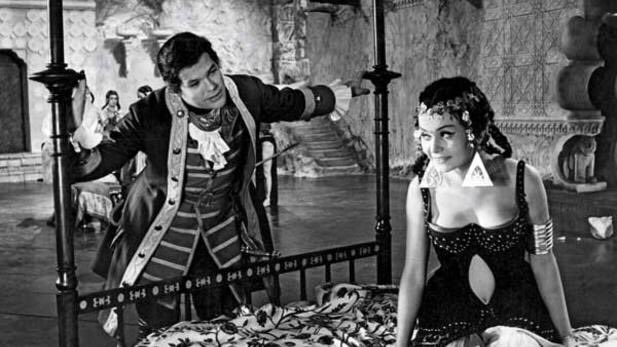

Zbigniew Cybulski (left) and Iga Cembrzynska in an early
erotic adventure.
The Saragossa Manuscript (1965) Another bit of whiplash here - a film that couldn't be more different from The Sound of Music is this Polish cult classic. I saw this film at the Harvard Film Archive a few years ago as part of a retrospective of director Wojciech Has. I was blown away. It's a pseudo-historical surrealist epic starring Zbigniew Cybulski, that some may know from the 1950s films of Andrzej Wajda. He was in the top tier of Polish stars during that era.

Based on the 1847 novel by Polish author Jan Potocki, it's set in the middle ages and describes the adventures of a Spanish officer as written in an old manuscript found by the officer's grandson in Zaragoza many years later. And the adventures are told in 'frame-tale' style, with story embedded in story like the Russian nesting dolls. It's a fascinating and challenging narrative, but Has unfurls it onscreen with a heavy dose of surrealism. Into the various narratives come gypsies, thieves, Moorish princesses, and of course, soldiers of the Spanish Inquisition. Using black and white cinematography and outdoor locations, it's a visual treat but also an aural one, with a haunting, 'electroacoustic' soundtrack by Krzysztof Penderecki. The film has captivated new audiences from the restoration work started by the Grateful Dead's Jerry Garcia and finished by Martin Scorcese. Scorcese included this film in his traveling exhibition 21 Masterpieces of Polish Cinema. Watch, and don't try to understand it, just experience it.

Le Samourai (1967) On a film podcast a few years back I heard the host say that in his opinion Jean-Pierre Melville is the best director ever. "Who??" I thought. I'd obviously missed something. Over the past few years I've been able to learn a bit more about this French director (who adopted his last name as a homage to the American author of Moby Dick)  through a few of his films. Known now as a precursor to the lauded 'French new wave' of film-making, his output was relatively small -- only 14 director credits from the late 1940s through the early 1970s. There isn't a better place to start exploring his work than through his neo-noir Le Samourai. It's rather a French This Gun for Hire, starring France's biggest, or at least handsomest, star, Alain Delon, who is still with us at the time of this writing. He radiates a coolness rather like Alan Ladd in his breakout role in TGFH. Melville films in color, though, and every shot is interesting, a window into mid-century French style that makes one wish to stop time in a series of freeze-frames that could be admired.

Honorable Mention: The Hustler, A Hard Day's Night

Sunday, January 10, 2016

Rarely Screened Treasures at the Harvard Film Archive

Last night I had the pleasure to attend a special 'Members' Weekend' screening of two rarely shown classic Hollywood romps in 35mm:  DESTRY RIDES AGAIN (1939), and HOLLYWOOD OR BUST (1956) at one of our best local arthouse cinemas, the Harvard Film Archive.  Not a bad way to spend a Saturday evening with friends, old and new alike.

The Harvard Film Archive (HFA) houses over 25,000 items in its collection supporting film research and education in partnership with Harvard University.  They have regular public screenings of films in their collection in their 200-seat no-frills auditorium, and often program director retrospectives, sometimes with the director in attendance.  Guy Maddin was a recent guest speaker, although I missed him. In late 2014 I was privileged to attend Dame Angela Lansbury's fascinating in-person remarks after a screening of one of her lesser-known films with Warren Beatty, ALL FALL DOWN.  Among other things, she described what it was like to work with George Sanders in two films she made with him:  "George loved beautiful women.  He never made a pass at me."  And "George was often bored because he was so much brighter than everyone else around."  She was beyond lovely, and an inspiration, still working hard to entertain us at 90 years young.  And last spring I was introduced to the films of Polish auteur Wojciech Has at a multiple film retrospective. His surrealist epic THE SARAGOSSA MANUSCRIPT is not to be missed. Net, the HFA is a great place to indulge a budding film buff's thirst for discovery.  As a member, I received a special invitation to attend their 'Members' Weekend' screenings yesterday, which offered not only the films, but a reception to meet HFA staff and other members.  The event did not disappoint.

DESTRY RIDES AGAIN
The satirical western DESTRY was made in that famous "best" of Hollywood years, 1939, but it is rarely publicly screened and it doesn't enjoy the fame of others made that year, or even of other Westerns.  Directed by George Marshall, it's fantastic.  It's rather a western-screwball comedy, starring a young James Stewart, and Marlene Dietrich in a comeback role for her after being named 'box office poison.'  Brian Donlevy, who I had seen in some Paramount films with Alan Ladd, gained new respect from me as the villain of this one.  He has such swagger, menace, and yet a large helping of likability that keeps your eyes on him.  This film contained Non. Stop. Action in ensemble scenes that were breathtakingly gorgeous and witty.  Well-known character actors of the 30s such as Mischa Auer, Allen Jenkins, and Una Merkel, all played important roles with gusto.

As an Old Hollywood fan, I have never appreciated the popular Stewart as much as some other fans, and often find him too strident and harsh for the leading roles he played (e.g. in IT'S A WONDERFUL LIFE, or THE SHOP AROUND THE CORNER even).  Here, his characteristic 'edge' is pitch perfect in his role as the new town sheriff's deputy, who is viewed initially as a man not up to the task, but who knows that he is smarter than everyone and makes this clear at his own pace, in his own way.  He even steals the loyalty of Marlene Dietrich, as cabaret singer Frenchy, away from blustery Donlevy.  Dietrich is a force, as she usually is, and going in to the film I was skeptical of her chemistry with Stewart, even knowing that supposedly they had an affair during film.  Well, believe it -- it's there.  Anyway, the film, with plentiful witty inside jokes, raucous musical numbers, and just enough tone variation from humor to pathos, to keep you interested, is a must-see for any Old Hollywood fan.
Opening scenes of hard partying at the Bottleneck Saloon
Marlene and Brian Donlevy plot during an upstairs game of poker
Initial confrontation between Donlevy and Stewart

First encounter between Stewart and Dietrich. 
Close up of Stewart during an emotional moment
Women of the town aim to break up the shootout with various rolling pins and other household weapons

HOLLYWOOD OR BUST


The second film of the double feature, directed by Frank Tashlin, was the last major film ever to star Dean Martin and Jerry Lewis as partners, and featured Anita Ekberg as herself in an extended cameo. Pat Crowley was the ingenue love interest of Martin's.  Essentially the two men meet under somewhat suspicious circumstances surrounding a raffle ticket racket for a new convertible.  They both capture the convertible in NYC and head out on a cross-country road trip to Hollywood and their dreams.   The ride was a lot of fun, but it's a film I won't be rushing out to add to my DVD collection. I must admit, I've not been a devoted fan of this team, in fact to date have seen none of their other pairings so obviously don't have much to compare.  I will say that a little bit of Jerry Lewis goes a long way.  Also, the film is considered a 'musical', but I don't enjoy musical numbers that prominently feature bad or purposely distorted singing voices (Lewis).  On the positive side, the team had a unique chemistry and seemed to anticipate each other's actions just enough to keep the pace of the film fast.  That they supposedly were at great odds and did not speak off-screen wasn't evident in the film at least to me.  The film benefited from some recurring visual jokes and ridiculous situations that did elicit quite a few laughs from the appreciative audience.

Dean Martin opens the film by welcoming fans of Hollywood all over the world (followed by Lewis's non-PC parodies of film fans in various countries)
Dean and Jerry hit the road with Jerry's great dane "Mr. Bascomb"
The sights one apparently sees when driving through the country
An enticing Ekberg as seen by Lewis

Thanks, HFA!