
The Rains Came, 1939
Director: Clarence Brown
Writer: Phillip Dunne and Julien Josephson, from the novel by Louis Bromfield
Cinematographer: Arthur C. Miller
Produced by: Darryl F. Zanuck and Harry Joe Brown for 20th Century Fox Studios
Starring: Myrna Loy, Tyrone Power, George Brent, Brenda Joyce, Nigel Bruce, Maria Ouspenskaya, Joseph Schildkraut
Why I chose it
My Twitter polls have been slowly adding votes with every new poll, and this had a total of 15. This film won appxoimately 2:1 over the next two runners-up (Midnight and The Adventures of Sherlock Holmes). As I had no other criteria to choose this time, I was pleased to follow the wishes of my voters and watch this star-studded disaster/melodrama.
'No-spoiler' plot overview
In a fictional small town in India called Ranchipur, a motley group of natives and foreigners, the latter being mostly English and Americans, get caught in a series of natural disasters that devastate the town: an earthquake followed by a tsunami and then a breakout of the plague. The main characters are Tom Ransome (George Brent), a cynical womanizer who is pursued by Fern (Brenda Joyce), the ingenue daughter of the local American missionaries; we learn Ransome has history with newly arrived Lady Edwina Esketh (Myrna Loy). Lady Esketh, for her part, married for money (we think?) to a much older Lord (Nigel Bruce) and continues her man-eating ways by pursuing the stoic, dedicated local 'high caste' doctor, Major Rama Safti (Tyrone Power). When she joins up to help the Major as a hospital volunteer working with the sick and dying plague patients, she's faced with a difficult decision when the Major can be appointed Maharaja only if he gives her up.
Production Background
This film was Fox head Darryl Zanuck's moment in the sun. He bought the rights to the Louis Bromfield novel and went about putting his dream team together in 1939 style. He borrowed Myrna Loy and director Brown from MGM, and Brent from Warner Bros. Apparently no one was to his liking for the ingenue role, Fern, so he recruited a college student, Brenda Joyce (who went on to have a successful, if not exceptional, career in front of the camera). The fantastic scenes of torrential rains and flooding dominated the picture and the set. Credit special effects man Fred Sersen, who with his department won the first-ever special effects Oscar for his work. Apparently Brown loved his time at Fox, stating that the departments worked well together, unlike at MGM where feuds and one-upmanship were the norm. Upon release the film garnered lukewarm reviews, but it did well at the box office; however, the expenses were only recouped years later on re-release.
Some other notable film-related events in 1939 (from Filmsite.org):
- Swedish actress Ingrid Bergman made her American film debut (and English-speaking debut) as piano teacher/concert pianist Anita Hoffman in Intermezzo: A Love Story.
- The California Child Actor's Bill, better known as the Coogan Law, was enacted. The child labor reform act took place after 24-year-old Jackie Coogan, who had starred in The Kid (1921) opposite Charlie Chaplin, sued his parents (mother and stepfather) in 1938 for mismanaging and exploiting his career and spending his acquired fortune as a young star.
- The future rival to film -- television -- was formally introduced at the New York World's Fair in Queens. The Radio Corporation of America (RCA) unveiled a display of its first TV sets for sale to the American public.
- British actor Basil Rathbone, as Sherlock Holmes - with an Inverness cape and curved-stem pipe, was accompanied by dull-witted, pipe-smoking Nigel Bruce as Dr. Watson, in their first appearance together as the crime-fighting duo, in 20th Century Fox's The Hound of the Baskervilles.
My Random Observations
- I must have reached the level of film fan who can instinctively associate stars and directors with particular studios; it's for that reason that the mixing of Brent, Loy, and Power had me doing double-takes at the screen watching this film. Sort of a patchwork quilt of a production!
- While I absolutely adore black and white films, I feel this one may have been more impactful on viewers if in color, especially during the year that produced The Wizard of Oz and Gone With The Wind at competing studios. (Yes, I know other great pictures that year, like Stagecoach and Mr. Smith Goes To Washington, were filmed in B&W).
- At times I felt that Alfred Newman's score was overbearing and distracted from the dialogue or action. I loved the Indian music interludes, but the European orchestral part of the score could have been dialed back (as I write this, I recognize a parallel between the use of music in this film and the Western influence in Indian culture especially during the colonial era).
- I have a totally new appreciation for George Brent. Before, whenever he showed up in a movie, I would wince or sigh in resignation. I realize that is largely my prejudice. But here, he astonished me. His character may have been the best written, with the roguish and generous elements in his personality dueling at times, and Brent knew exactly how to play it. His performance was, in my opinion, the best of the entire cast. Even with Tyrone Power at his peak of handsomeness, I couldn't take my eyes off of him.
- I was having a sense of deja vu and realized it was because of the similar themes and plot points of The Painted Veil, the Somerset Maugham novel that was filmed in 1934 and 2006. In that novel, a young wife, who is superficial and selfish, follows her physician husband to Hong Kong, takes up with a handsome colonial official, but ultimately finds purpose and true love by working alongside her husband to curb a deadly outbreak of cholera in China.
 |
| The opening titles appear to wash away, one after another. |
 |
| Ransome (George Brent) is content to sling pebbles at monkeys outside his patio. |
 |
| Elegant Tyrone Power dons brownface and a turban here as Major Rama Safti. |
 |
| Jane Darwell and Henry Travers run the American Missionary School, and allow Ransome a respite from the pretentious Mission owners next door. |
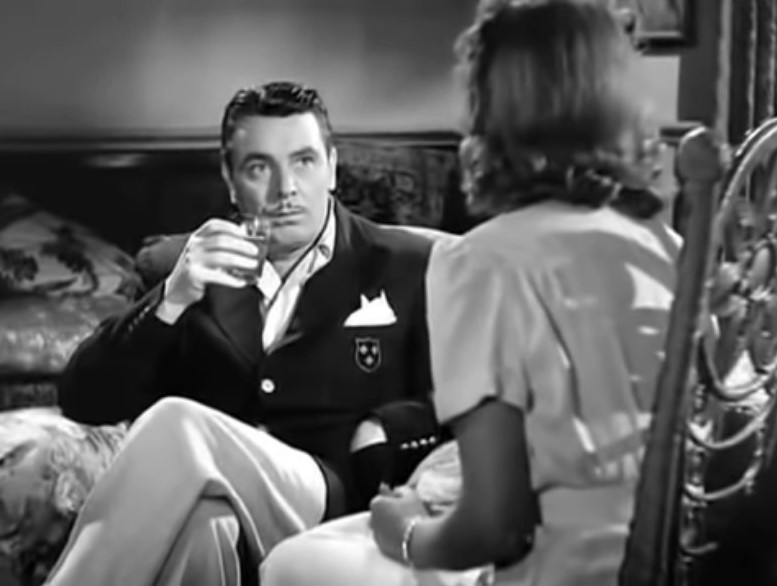 |
| Ransome not sure which part of his nature should win when it comes to young Fern (Brenda Joyce). |
 |
| H. B. Warner and Maria Ouspenskaya as Ranchipur's Maharaja and Maharani. |
 |
| Not a glimpse of a happy marriage (Loy and Bruce). |
 |
| Ransome has his eye on the clouds as he takes a moment to reflect on his past with Lady Esketh. |
 |
| An unexpected romance begins to take root. |
 |
| Lord Esketh's diary of his wife's dalliances. |
 |
| During the floods, Fern comes to rescue Ransome and prepares for a rest afterward. |
 |
| Tom Ransome clings to the top of the statue of Queen Victoria, now mostly immersed in the rushing tsunami. Symbolism, anyone? |
 |
| Major Safti attends to the dying Maharajah. |
 |
| Lady Esketh ponders her next move--in cards and in life. |
 |
| Lady Esketh, masked against the plague, tends to a critically ill patient. |
 |
| Major Safti's heart is pierced by the newly selfless Edwina. |
 |
| Tom confronts Safti on his career choices. |
 |
| Safti dressed for success, admired by the Maharani. |
Further Reading
A major source for me was Mark Vieira's book Majestic Hollywood, The Greatest Films of 1939 (2013).


