Another month and another feast of offerings for the classic film fan in Greater Boston. Two very special silent film screening events are coming up, and some fun flicks to enhance your summer's entertainment quotient. Check them out and support your local cinemas!
July 6 & 7: Silent film fans should consider coming out to see the Fritz Lang sci-fi classic METROPOLIS (1927) with live musical accompaniment from our own Cambridge-based Alloy Orchestra. In what is a first in the 'The Sounds of Silents' program, there will be two screenings on back-to-back days Weds & Thurs July 6 & 7 at 7:00. The Alloy Orchestra was launched at the Coolidge in 1991 with this same film, so these screenings represent a special 25th anniversary celebration for the group. The film is the newest "complete" version of the film, which premiered in 2010. The Alloy Orchestra has a unique percussive and electronic sound to their specially-composed scores. For those new to the film, it's a visual feast - the first full length sci-film ever made.
A video clip of the Alloy Orchestra rehearsing their METROPOLIS score can be seen here:
July 18, 7 PM: THE HUSTLER (1961) is next up in the Big Screen Classics series. I've never seen this Robert Rossen film starring Paul Newman, Jackie Gleason, Piper Laurie, and George C. Scott, but all indications are that it's a tremendously-written and compelling drama. All the stars were nominated for Oscars in the main categories, as was director Rossen and the film for Best Picture. The only Oscars it DID win were in the cinematography and art direction, which tells me it does need to be seen on the big screen!
Somerville Theater July 10, 2 PM. The Somerville has a special silent film screening event of its own in July as part of the 'Silents Please' series -- a double feature of W.C. Fields' rarely screened silent comedies in 35 mm: SO'S YOUR OLD MAN (1926), directed by Gregory La Cava, and IT'S THE OLD ARMY GAME (1926, also with silent screen goddess Louise Brooks). A special guest will be Dr. Harriet Fields, granddaughter of the actor. (!) I've not seen much W.C. Fields, and none of his silents, and this represents a terrific opportunity. Both films are shown in 35mm with live piano accompaniment by Somerville regular Jeff Rapsis.
July 28 7:30 PM: The Somerville will need seatbelts for patrons on this day as Steve McQueen rides in in BULLITT (1968), THE GETAWAY (1972). Both are 35 mm prints from Warner Archive. For those who haven't experienced the phenomenon that was McQueen in the second half of the 20th century, this is a way to correct that.
Brattle Theatre July 4:, 12:00 PM & 8:00 PM On the holiday, The Brattle will screen the summer classic JAWS (1975), one of the first in the emerging blockbuster category of films and director Steven Spielberg's first huge hit. It will also screen at the Somerville in August. I wonder if our proximity to the ocean here makes this such a popular one year after year? Regardless, if you've never seen it on the big screen you shouldn't miss it.
Jane Greer & Kirk Douglas in OUT OF THE PAST
MORE NOIR!! The theatre just announced that the 75 Years of Film Noir festival continues with another installment with a focus on the 'femme fatale'. Here is the list of femmes fatale along with the film and the screening date:
Harvard Film Archive
The programming at the HFA is always exciting. In July, the complete Robert Aldrich retrospective (...All the Marbles) continues. What's particularly cool about the program is that it features films that are not only directed by Aldrich, but those in which he served as an assistant or in another capacity. In addition the HFA has included episodes of the TV series 'Four Star Playhouse' that Aldrich directed, which included several major stars. In total, the list is too long to completely reproduce here, but check the link above for the full list. I'm particularly excited about seeing:
July 9, 7:00 PM: AUTUMN LEAVES (1957), in 35 mm, starring Joan Crawford,Vera Miles, and Lorne Greene. It's a "late Hollywood melodrama, lurid, strange and overheated," and said to be Aldrich's first foray into the 'women's picture', which would culminate with WHATEVER HAPPENED TO BABY JANE?" Whew!
July 31 4:30 PM: THE SOUTHERNER (1945), in 35 mm. This one was directed by the great French director Jean Renoir, but Aldrich served as assistant director. It's starring Zachary Scott and Betty Field, and is totally new to me. There is a chance I'll be at Woods Hole for their annual Film Festival, but if not, I will be here!
This installment of #WesternMovieSummer finds me in the early 1940s for two contrasting films, one considered a classic and the other not so much. The two pictures are filmed in black and white and that's about where the similarities end. I've already had a moment or two this past week of feeling overwhelmed as the vastness of this genre has been driven home to me -- apparently 30% of movies made in the Hollywood studio era were westerns -- but, undeterred, I'm soldiering on, watching and enjoying a fascinating sampling of the genre.
This is the "classic" of the two, directed by William Wellman, and starring Henry Fonda, by then a major star of 20th Century Fox, and with Dana Andrews in a small but critical role. It's entirely fiction, based on the 1940 novel by Walter Van Tilburg Clark, of the same name, and packs a depressing and spare story into 81 minutes. It twists our guts as an entirely unromanticized tale of brutality, making the viewing experience more educational than entertaining. Fonda is nothing like his noble 'YOUNG MR. LINCOLN' character or even his Frank James in JESSE JAMES. For those who like their Westerns tackling head-on the ugly reality of much of society who pushed forward into lawless unsettled territories, this one won't disappoint. As discussed by Prof. Slotkin in his Western Movie course, the film's key subject, lynching of a small band of settlers accused of cattle rustling and murder, would have been understood by contemporary audiences as a parable for the rampant practice of lynching of African Americans, still prevalent at the time.
Anthony Quinn, Dana Andrews, and Francis Ford as the victims, Frank Conroy at right as Major Tetley
Further driving this point home, the most heroic character of the film, the one most willing to stand up in opposition to the lynching, is an African American character, Sparks. Ironically, and sadly, the actor Leigh Whipper, went uncredited in the film. His career was quite long and eventful, and he is cited as having been the first African-American actor to join the Actor's Equity Association.
Leigh Whipper as "Sparks." Image from diva-harrington.com
Despite the bleak tone, the story and characters are well drawn, the direction is tense, and the message is timeless. I especially appreciated Andrews here, as a desperate man caught in the web of hate. Secondary character Harry Davenport is excellent, as is young Harry Morgan and Anthony Quinn, who's oily but attractive. The film does not waste time setting the atmosphere -- in the very first scene, as Fonda and friend Morgan ride into town, the view of the town shows very little life:
Also early on, we understand the nature of Fonda's character as a man who, while not necessarily criminal, is not someone we'd admire. Within the first few minutes Fonda downs several whiskeys, gets into a fistfight as a result of a minor insult, gets knocked out cold, and when coming to has to rush out of the bar to throw up. The close-ups and medium shots do not flatter him. Because he's Henry Fonda we expect him to act the hero, but he lets us down a few times during the film. He does emerge at the end, however, as a somewhat changed man.
Henry Fonda not looking his best.
Those familiar with the novel or the film will surely point to the many societal lessons and psychological depths embedded in it. For me, it was a potent reminder that even in the relatively early years of Hollywood, Westerns were not all romanticized visions or rousing action melodramas, and that the studio system could buck the expected societal values and critique them.
WHEN THE DALTONS RODE (1940)
In sharp contrast is this minor but entertaining western, made in 1940 for Universal Studios. At the helm was George Marshall, a talented director who scored brilliantly with DESTRY RIDES AGAIN (1939) and is also known for the Alan Ladd/Veronica Lake noir THE BLUE DAHLIA. The film chronicles the heyday of the real-life 'Dalton gang' of brothers, who, in the James & Younger gang mode, terrorized stagecoaches, trains and banks in the early 1890s in and around Kansas until they met their end, not unlike many other outlaws of the era, in a grand shoot-out. The film, of course, greatly fictionalizes the story, and in the tradition of the JESSE JAMES movie, tries hard to keep our sympathies on the side of this gang of murderers by giving them a sympathetic, loving matriarch, a law-abiding hero/friend in protagonist Randolph Scott, and a justification for their turning outlaw in the greedy, unscrupulous land-grubbing capitalists who make life tough for them.
I found a sharp contrast between the subject matter and the tone of the film, set up from the beginning in the onscreen narration which does not mince words about the lawless and brutal nature of the Daltons, but is accompanied by the most upbeat and jaunty music imaginable. Introduced early on the brothers, portrayed by Broderick Crawford, Brian Donlevy, Frank Albertson & Stuart Erwin, are shown to be a rowdy bunch of good-hearted pranksters who are out to have a good time and celebrate their Ma's birthday. Crawford as 'Bob' Dalton, is even the local sheriff and is engaged to the lovely telegraph operator Kay Francis. Even when it's made clear that the gang has succumbed to the life of crime, and the body count rises, the film seems to want to make it clear that they are just a short redemptive act away from returning to the right side of the law. The men of the town are shown to be largely a group of buffoons, in which the Daltons are clearly part. Andy Devine plays his usual dupe for comic effect on many occasions. The only smart characters are Scott's Tod Jackson, Francis, and George Bancroft as the businessman/villain. And very unlike THE OX-BOW INCIDENT, this town is filled with folk:
The last fifteen minutes of the film, though, are somewhat grim, as the brothers find themselves ambushed, and there is a prolonged shoot-out in which there is little music, only shots fired repeatedly in an intense sequence, until every last gang member is dead (this would not be a spoiler considering the real-life end for this gang, captured in some morbid photos that can be found online). Ironically the youngest of the brothers, Emmett Dalton, is shown as being killed, but in real life he lived to write an autobiography on which the film is supposedly based.
The brothers being photographed with their Ma (played by Mary Gordon) .
While there are no social critiques of note here, and the film exists primarily to entertain those looking for a pseudo-historical romp, it is a fun watch, with daring stunts and colorful characters. The cast seems to be having a grand time. Kay Francis, on the way down from her career high as elegant pre-code 'woman of the world' roles, is still stunning and compelling as the love interest. As a film capitalizing on the success of JESSE JAMES and the depression-era audiences who would expect to root for the common man against evil capitalists, it's an example of studio-era Hollywood fare very much of its time.
Kay Francis and Randolph Scott "meet cute" at the cow pen
I had such a fantastic experience with last year's "Summer of Darkness"--studying film noir with TCM, Ball State University, and several thousand other eager 'students'--that I found a big hole this summer in my film-studying agenda. To address that, I've decided to learn about the western genre with the help of a course recorded in 2008 by Richard Slotkin at Wesleyan University and now available in podcast form from "iTunes University." The course is "Western Movies: Myth, Ideology, and Genre." The western is a film genre that I wouldn't call my favorite, but one that I've come to appreciate more lately.
Professor Slotkin is an English professor, author, and American cultural historian. Understanding the historical context of film is one of the many reasons I love the classics, and this series offers the opportunity to focus on this aspect of the films. The course recordings include 18 separate lectures featuring that many films, and proceed roughly chronologically. While it seems unfortunately that some lectures featuring westerns in the silent era were not recorded, the earliest lectures available start with some classics from 1939. Approximately every other day during my work week I'll listen to a lecture on my morning commute, and in the same week I'll view the films.
As shared by Prof. Slotkin, the Western was starting to make a resurgence in the late 30s, as standard depression-themed films or pure escapism in screwball comedy was starting to run its course. Westerns now presented an opportunity to reclaim an optimistic past while still commenting on the pros and cons of capitalism, of which 1930s audiences were all too aware. The course starts with two films made in 1939 that are new to me: DODGE CITY and JESSE JAMES. These two films present a view of the west through two very different philosophical lenses, according to Prof. Slotkin. I enjoyed both of them.
DODGE CITY
This Warner Bros. film, starring Errol Flynn and Olivia de Havilland, and directed by Michael Curtiz, is not dissimilar to the swash-buckling adventure films that catapulted Flynn to stardom, often alongside de Havilland. It has a light-hearted tone through most of it. Flynn plays an opportunistic cattle trader who helps the railroad establish a foothold in west by making Dodge City, KS, a booming cattle town and prominent new railroad stop, safe from those Western-style gangsters that are extorting citizens for their own gain and benefiting by ensuring lawlessness and violence prevail.
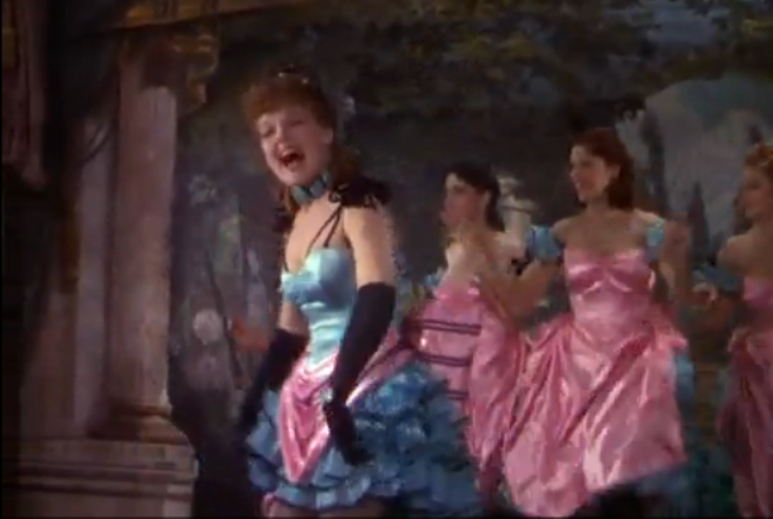
Of the two, this film, argues Prof. Slotkin, has a more pro-capitalistic outlook, as the railroad is presented as a herald of technological and societal progress. As long as society has heroes like Flynn who will step up and make it safe for women and children, order and progress will win and benefit all. There is a bit of tension in that *too* much domesticity is ridiculed in the figures of the older women of the "Pure Prairie League", in contrast to the fun women in the neighboring saloon as represented by singer Ann Sheridan, and all the drinking, partying men who raise hell in an extended barroom brawl sequence that is as fun as it is frenzied.
Ann Sheridan and her fellow saloon ladies in bright,
crisp pastels
Alan Hale reluctantly accepts a cup of tea
from the ladies in the 'Pure Prairie League'. His
being inducted as a member is a wonderful comic touch.
I would agree that this film did capture a sense of optimism, of expansion, using 'right' along with 'might'. I felt that, unlike JESSE JAMES, the point of view or message of the film was not overly heavy-handed. Of course, the film stayed away from controversial topics such as the human cost of western expansion for the Native Americans. For pure enjoyment and joyful tone this film is close to DESTRY RIDES AGAIN, another film from 1939 that I really enjoyed, and wrote about here. I am not particularly a fan of Errol Flynn, and while he was fine here, I found myself taken with Alan Hale's portrayal of the loyal, and somewhat comic sidekick. Olivia de Havilland was lovely and feisty, and while eventually succumbing to Flynn's wishes for domesticity, she did have an opportunity to earn a living at the local newspaper.
A very different, but equally enjoyable 1939 big budget western, is 20th Century Fox's JESSE JAMES, starring Tyrone Power and Henry Fonda, with Henry King directing. This one apparently started the 'cult of the outlaw' in popular culture, and there have been upwards of a dozen films on the subject of James. Here, the railroad figures prominently again, but instead of a sign of progress, it's a sign of capitalist oppression, a sentiment that would be understood by a great number of Americans in the late 1930s. James himself is initially portrayed somewhat fictionally as being driven to becoming an outlaw as a result of his family and farmer neighbors being illegally threatened by corrupt (railroad) businessmen. He's someone we root for, and then he goes wrong as he finds he can't resist the criminal life even when better forces, namely the women in his life try to bring him back to the straight and narrow.
Unlike Olivia de Havilland's prominent role in DODGE CITY, the female lead here, Nancy Kelly, has not much to do other than moon and grieve over her man. Nearly of the shots of the couple together feature Power over Kelly. Power, obviously, was the big matinee idol, and was playing against type as the scruffy outlaw. His acting chops were on display, as he was convincing and rather good in the role, as was Henry Fonda as his brother Frank James. It's a well-paced western with action, pathos, and beautiful on-location vistas in and around Pineville, Missouri. (While the cast and crew were celebrated by residents of Pineville while on location, I was horrified to learn that at least one horse was killed by the stunt it was forced to do in a key scene). While punctuated by comic touches, especially from Henry Hull's blustering newspaperman, the tone of the film is darker than DODGE CITY. Despite the fault of the opportunistic capitalists, the message that a life of crime doesn't pay, and ultimately can't be justified, is clear.
Power as James cannot be talked out of his next criminal venture.
It was a film that left me interested enough to consider watching the sequel. Incidentally I recently watched a lesser western called KANSAS RAIDERS (1950) about James' early experiences with renegade confederate leader William Quantrill. This film, starring Audie Murphy, was also greatly fictionalized but the portrayal of James as a 'misunderstood kid trying to do good but going wrong' is fully intact in this one as well.
The clear message would have been appreciated by 1930s audiences.
Next up in the lecture series: STAGECOACH and OX-BOW INCIDENT.
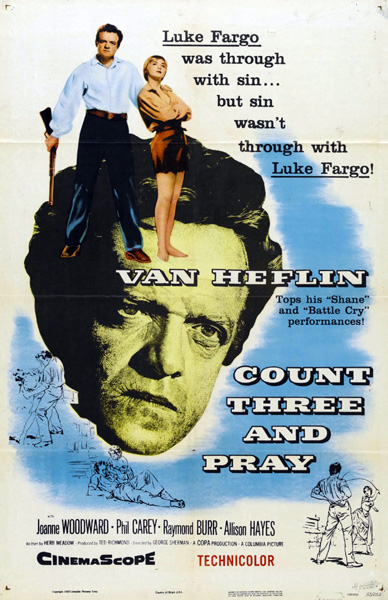
It's a role that arguably no other actor would suit the way Van Heflin suited it -- the Civil War veteran and former bad boy who finds God and returns to his southern town to take over as preacher. The character is Luke Fargo and the movie is COUNT THREE AND PRAY (Columbia, 1955). The film plays to all of Heflin's many strengths. The film is also notable for the debut of Joanne Woodward, in a completely non-glamorous but fabulously fun role. For those reasons alone, although there are more, it's worth a look. It doesn't appear to be available on DVD. A copy is on YouTube at the moment and I took the opportunity to view it before it disappears.
Original Film Poster (Wikipedia.com) with the tag
line "Luke Fargo was through with sin....
but sin wasn't through with Luke Fargo!"
The director, George Sherman, is known most commonly as a workhorse director of "B" Westerns, although his prolific career spanned the late 30s through the mid 70s. In the 40s and 50s he primarily worked for Columbia and then Universal Pictures. The first picture Van Heflin made after leaving MGM was for Universal under Sherman: TOMAHAWK (1951) (more on this one below). I highly recommend this post at the Movie Morlocks blog for a re-assessment of Sherman's work.
IMDb calls this film a Western but that doesn't seem 100% accurate. It's more a period post-Civil War comic melodrama, with some good guy/bad guy dynamics typical in Westerns, along with some gorgeous outdoor scenery. Adapted by Herb Meadow from his own short story "Calico Pony", the film adopts an overall joyful and lighthearted tone, punctuated with some more serious moments. It begins with Heflin's character, Luke Fargo, dressed in Union blue uniform, outdoors with two other men who are dressed in Confederate gray. It becomes clear they are heading home from the Civil War. A series of visual clues and short scenes establish that the townsfolk have a great distaste for union soldiers, and Fargo in particular. His own place having been burnt down, Fargo shows up at the place belonging to the former parson, who was killed in the war. There he encounters a wild young teenage girl, Lissy (Woodward), who is orphaned and has been living there. After clumsily pulling a rifle on Fargo, Lissy settles in to a tentative peace with him, and the two decide to share quarters. Then, attempts to prove he's a changed man to the local suspicious townsfolk, and to set up a new church and take over as pastor, meet with resistance from local boss Raymond Burr, and two women who were involved with him before he got religion. The townsfolk goad him into fistfights, gambling, and other sins that he swore he'd given up. Will he become a successful pastor and gain the respect of his flock? Will he end up with one of the women carrying a torch for him? Will Lissy ever be tamed and become a productive member of the community? These are the questions the narrative hangs on.
Civil War soldiers on their way home (Heflin is at right).
Heflin (right) confronts town boss Burr (left)
Struggling to find words in his first
attempt at preaching.
Van Heflin nailed this portrayal - perhaps because as a multi-faceted character, Fargo required Heflin to draw on his experience as both a serious and comic actor. Able to display conflicted emotions and motivations so well as showcased in many films noir, Heflin easily convinced as a rabble-rouser turned preacher. He could also be earnest without cloying, and scenes in which he attempted to justify his conversion were utterly believable. In two scenes he made me very nervous with him as he struggled with serious stage fright when trying to preach. The monologue he delivers after the failed church dedication, where he is wrestling with his self worth and his future, is brilliantly delivered. His subtle comic talents and timing, on display in earlier films such as PRESENTING LILY MARS and THE FEMININE TOUCH, were essential to his banter with Joanne Woodward's character. Pay special attention to the scene where he's just taken a bite of chicken when Lissy tells him she stole the bird from the neighbor's henhouse.
Don't mess with Joanne!
In this, Joanne Woodward's debut, she was 25 years old, and delightfully impish and funny in her attempts to be tough, and convince Fargo she was going to be in charge. With dirt smeared on her face most of the time and a pageboy haircut, she only showed glimpses of the beauty she displayed in later films. Her southern accent and roots were used to enhance this comic character, and she had a comfortable chemistry with Heflin. She delivers an hilarious moment during the first preaching scene outdoors, when Fargo was unable to get started with his sermon. After a pregnant pause, Lissy shouts from a her perch in a tree top, "Why don't you preach about hell, you oughta know about that, you raised enough around here!" The "congregation" broke out in laughter while Fargo's embarrassment deepened. Woodward enjoyed her experience in this film (Derek Sculthorpe, Van Heflin, A Life in Film, cited from a contemporary Hedda Hopper piece). She also apparently nicknamed her second daughter "Lissy" after her character (IMDb),
It's not a perfect film, and while Sherman does a great job at the pacing, and deftly balancing the serious and comic elements, it seemed that Raymond Burr's character didn't have enough to do as a villain, and the characters of Georgina and Selma (the local madam) were unfortunately primarily one-dimensional and cliched. In a minor quibble, today's sci-fi fans will likely be distracted, as I was, by a musical theme that starts identically to that of Star Trek original series (!)
Georgina (Allison Hayes) confronts Luke (Heflin) as the Bishop (Robert Burton) contemplates his next move.
Yancey (Raymond Burr) and Georgina prepare to start a new life.
MAJOR SPOILER BELOW -- SKIP THIS PARAGRAPH IF THAT MATTERS TO YOU!
The dynamic between Fargo and Lissy throughout the film is one of a kindly uncle taking care of a wild teenage girl who, not surprisingly, develops a crush on him. That the two might take their relationship in an adult direction seemed remote, and there were only minor hints that Fargo ever felt an interest in her beyond paternal, and those perhaps were seen that way only in hindsight. Additionally, the audience, throughout the entire film, believed that Lissy was about 15 and only near the end is it revealed she is actually 18. At that time Fargo's restored as a rightful pastor by the bishop, who knows something needs to be done about the 18-year-old girl and the pastor sharing quarters--he decides that the two need to be married right away. Lissy is thrilled with the idea and hands the bishop her rifle in case of any trouble. After a brief and half-hearted protest, Fargo seems to acquiesce to this turn of events and the film ends with them walking toward the chapel arm in arm. Initially I wasn't sure if I felt comfortable with this -- considering Fargo is old enough to be Lissy's father, and played that kind of role through the film. Then I reflected that in the 1800s, marriages of convenience, and between men and women of vastly different ages, would not have been seen as unusual. I came to terms with the end of this film; despite that I would have been fine if Lissy had just gone off to boarding school or the like, with her life bettered thanks to Fargo.
END SPOILERS
Eager to see another Sherman film, I picked TOMAHAWK (1951) -- on DVD as part of a 10 Movie western collection from Universal-- because it also starred Heflin. This one is a more traditional western, with a screenplay (Silvia Richards & Maurice Geraghty) that revolves around, although takes liberties with, the real-life fateful encounters between the U.S. Cavalry and the Sioux tribes in the Black Hills in the 1860s. The main character is Jim Bridger (Heflin) who was a real explorer and scout, and famed for the "Bridger Pass". He was a character in two other films in made in the classic era.
Heflin giving the U.S. Army officers an earful about
their treatment of Native Americans
The film is shot almost entirely on location outdoors in the windswept plains and hills of South Dakota. The color looks gorgeous. Like BROKEN ARROW, the story portrays the plight of the Native Americans sympathetically, with Heflin taking their side as the peace broker during an intense time. If anything, that intensity is reflected almost a bit too much in Heflin's performance, who commands the screen but comes across early as a bit self-righteous, which may have been a flaw in the script. He does a fine job in the role but I suspect it didn't stretch him the way Luke Fargo did. Jack Oakie in a supporting role brings a bit of levity, if not outright comedy, to the film, and is splendid. Yvonne De Carlo is beautiful and spirited as a young woman trapped in the Cavalry fort and torn in her affections between evil cavalry officer Alex Nicol, and Heflin. The Native American cast was headed by John War Eagle as Chief Red Cloud, and many Native Americans filled the ranks of the cast in minor roles. Unfortunately the part of the young native girl, Monahseetah, is played by white Susan Cabot. (In a parallel to COUNT THREE AND PRAY, here there is key relationship between Heflin's character and a young girl/woman, which in this film is left undefined for about 2/3 of the film).
Warriors on both sides line up in anticipation of a key
peace conference
The script did a good job of revealing key backstories and relationships little by little, to enlighten the underlying motivations of the characters and build tension. While not a character study, per se, there was a degree of development, and not always predictable. The action sequences were not extensive but were well done.
Heflin enhanced his local celebrity as a result of this film, as recounted in his biography (Van Heflin, A Life in Film (2016) by Derek Sculthorpe). He was fascinated with the history of the local Native Americans, and even went so far as to learn the Sioux language, which he periodically speaks in the film. Honored by the local Sioux tribe, he was adopted by the chief as an honorary grandson, and given the name 'Looking Horse'. He spoke at various civic gatherings in Rapid City as well during his time on location. The conviction he felt for the cause of the Native Americans was no doubt reflected in the intensity his performance.
There was an emotional heft to this film, with credit to Sherman and the actors. I felt immensely sad at the bloodshed that accompanied this time in history. While it's not a classic, and occasionally falls victim to cliches, I do recommend it highly for all western film fans. For further reading, check out this perspective (by Colin at Livius1 blog). Some parting images below.
Alex Nicol romances the beautiful Yvonne De Carlo
Jack Oakie (right) and friendly cavalry office Russ Conway
As stated by R. Emmett Sweeney for the Movie Morlocks blog post on George Sherman, "The final shootout is more like a Holocaust, Van Heflin’s severe face colored with nausea." Shown here with Preston Foster as the Colonel.
John War Eagle as Chief Red Cloud is overcome with emotion as he witnesses the slaughter of his warriors.
Summer is officially here, and many New Englanders will be heading to the beach, mountains, Tanglewood, etc to enjoy the short outdoor season. For indoor activities, there are no shortage of classic film screenings in the area in June to cool us off from all the outdoor exertions (!)
The Brattle It's hard to believe that we'll be a full year removed from last year's "Summer of Darkness" with Ball State University and TCM, but the learning continues with the year-long film noir repertory series screening at the Brattle. This fun series continues with "Prime Noir of the 1950s" from Weds June 8 through Thurs. June 16. Click the link above for the full schedule of films, most of which are 35 mm screenings. I'm particularly excited about IN A LONELY PLACE (1950), which, while I saw during "Summer of Darkness", I believe might have been the most emotionally impactful noir I've seen, with a powerhouse performance from Humphrey Bogart. Leading lady Gloria Grahame is especially poignant; in real life she was apparently going through a divorce from director/husband Nicholas Ray. This is screening on Fri June 10 and I have plans to attend.
The Brattle staff's 'pick' is SWEET SMELL OF SUCCESS (1957) with Tony Curtis and Burt Lancaster, screening in 35 mm on Thursday June 9 at 8:30 PM and Sunday June 12 at 1 PM. I'm eager to see this one as well, as I've not seen it, and it's later noir. Finally, I'm eager to see Richard Widmark and Gene Tierney in Jules Dassin's NIGHT AND THE CITY (1950). This one is a digital screening on Thursday, June 16 at 7:30 PM.
SWEET SMELL OF SUCCESS
Tony Curtis and Burt Lancaster
There are some other interesting offerings in the second half of the month. In the "not sure it's considered a classic film but this sure sounds like a cool event" category -- for fans of RAIDERS OF THE LOST ARK, a double feature on Monday June 20 of a fan-made "remake" of the film and a 2016 "making of" documentary by Jeremy Coon and Tim Skousen (RAIDERS! THE STORY OF THE GREATEST FAN FILM EVER MADE) will be presented. In both cases the filmmakers will be on hand to discuss their projects. Watch the trailer here:
An intriguing-sounding series called "Man Meets Wilderness" is presented the last week in June and will feature the classic Chaplin comedy THE GOLD RUSH (1925) at noon on Sunday June 26th, and Robert Altman's western MCCABE AND MRS. MILLER (1971) at 2 PM and 7 PM also on the 26th.
The HFA seems to have an great summer ahead for cinephiles--they will feature two summer long 'complete works' retrospectives; the first, that from director Robert Aldrich, starts in June. (Rouben Mamoulian is promised later this summer!) Aldrich's career started in the early 40s and lasted through the early 80s. As of this writing the HFA hasn't published the detailed summer schedule, but June screenings are lining up like this:
Friday June 3, 7 PM KISS ME DEADLY (Aldrich 1955) - a great cold-war style late noir that was featured in last year's 'noir summer'. Sunday June 5, 5 PM10 SECONDS TO HELL (Aldrich 1959) -- a WWII drama starring Jack Palance.
A sports double-feature is tempting on Friday June 10, 7 PMTHE LONGEST YARD (Aldrich 1974) and 9:30 PMBIG LEAGUER (Aldrich 1953) Saturday June 11 it's an Aldrich Western double-feature, both films featuring Burt Lancaster: 7 PMULZANA'S RAID, and APACHE (1954) at 9 PM. Sunday June 12 at 5, it's THE FLIGHT OF THE PHOENIX (Aldrich 1965) with James Stewart. Friday June 17, at 7 PM it's THE LAST SUNSET, and at 9:15 it's THE CHOIRBOYS (1977) Saturday June 18 at 7 PMTHE DIRTY DOZEN, (Aldrich 1967) followed at 9 PM by the noir THE PROWLER (Joseph Losey, 1951) -- a fave of mine. Sunday June 19, 5 PM William Wellman's THE STORY OF G.I. JOE (1945) with Burgess Meredith and Robert Mitchum starts the evening, followed by SODOM AND GOMORRAH (Aldrich,1962) at 7 PM
The weekend of June 24-26 will be a 'Members Weekend' and while no screening announcements have yet been made, I'll be planning to attend at least one evening as I greatly enjoyed this event last winter.
Coolidge Corner Theatre The Coolidge's "Big Screen Classics" continues on full steam through the summer. In June, they will be screening classic screwball comedy THE PHILADELPHIA STORY (1940) with Cary Grant, Katharine Hepburn, and Jimmy Stewart (how's that for a trifecta of top-tier stars?) on Monday June 6th at 7:00, Two special guests, documentary filmmakers Joan Kramer and David Heeley, who knew Stewart and Hepburn, will be on hand for a Q&A. Then on the following Monday (13th) will be the epic LAWRENCE OF ARABIA (1962), which is just a bit too long at 3.5 hours for a work night for me.
Two all-time great early screen stars Greta Garbo and John Gilbert will throw romantic sparks on the big screen in their 1926 silent melodrama FLESH AND THE DEVIL in 35 mm. This continues the 'Silents, Please' series on Sunday June 25th at 2 PM, with live music by pianist Jeff Rapsis. I greatly enjoyed the screening of the funny caper PATHS TO PARADISE earlier this month, also with Rapsis, who is a local who does a tremendous job accompanying films with piano or organ. More about him on his website here.
I'm pleased to share this post on Tommy Udo for the Great Villain Blogathon 2016, brought to you by Kristina at Speakeasy, Ruth at Shadows and Satin, and Karen at Silver Screenings. Check out their pages for the complete list of great posts for the characters we love to hate. NOTE: POSSIBLE SPOILERS AHEAD!
Imagine you never heard of Richard Widmark, didn't know he garnered an Oscar nomination for his first ever film, KISS OF DEATH, and certainly aren't aware of any infamous scene involving a middle-aged woman and a wheelchair. Audiences in 1947, coming to see KISS OF DEATH for the first time, would fit this description. In 1947 you would have likely paid your money to see Victor Mature, a reliable, good-looking leading man, or perhaps wanted to check out new leading lady Coleen Gray. Maybe you had heard of and admired the work of director Henry Hathaway, who had a respectable resume with films starting from 1930, and in fact continued his career through the mid 1970s with directing credits on classics as TRUE GRIT, NEVADA SMITH, and AIRPORT. Or maybe you were attracted by the movie's provocative title and wanted to be scared, seduced, or both. Coming out of the movie, though, you would most likely be talking most about one thing: the villain in this piece, Tommy Udo. This post examines how skillfully Widmark, Hathaway, and the film's writers and crew, created this inimitable character.
Immediately after the opening credits
The film itself is a respectable but not outstanding noir, with hallmarks of the genre including voice-over narration at the beginning and end (however, this time coming from a woman (!)), and on-location settings in NYC claiming to be the real locations. Both features were common to the 'docu-noir' style of the time, which is a nice touch and adds to the grittiness of the action.
Victor Mature as Bianco trying to
make a quiet getaway from the crime scene
After the credits roll Victor Mature makes his appearance, a tall, dark and handsome man named Bianco, who looks too straight to be staging a jewelry store robbery in the middle of a crowded commercial high rise during prime shopping time. He is clumsy in how he handles the robbery, and bungles every attempt to escape. He gets caught and, it turns out, he has an extensive record of various similar crimes and has done time. Considering this is Victor Mature, and he looks as if he could have just given a sermon at his local Presbyterian church--that's how earnest he comes across--you might have trouble buying him as a criminal. Nonetheless he would likely succeed in winning your sympathy as the protagonist who needs another chance to redeem himself.
About 13 minutes into the film you'll encounter the character Tommy Udo (pronounced "YOO-doe"), not as a live human but as words on a page, declaring him worthy of a prison sentence. You probably take little notice or meaning to those words, and certainly don't appreciate the foreshadowing of the future link between the two men. He certainly wasn't part of the jewelry store robbery that got our hero in trouble.
The protagonist, Bianco, and villain Udo, to be sentenced on the same day.
Widmark as Udo keeping an eye
on the guards outside his cell
However, when you first *see* him in the flesh -- he makes an immediate impression as a thin blond man behind bars, sitting to the right of Mature. Your hair will likely rise on the back of your neck. Why? He speaks with an ugly street-cultivated New York accent, spitting his words and sneering while goading both the prison guard, "that cheap squirt passing up and down", and Mature's Bianco. And then he switches from spitting insults to laughing -- and what a laugh. He curls his lips and emits a nasal chuckle that borders just on the hysterical. (Ironically, the laugh originated from a nervous habit that Widmark had when originally reading for the role -- Kim R. Holston, Richard Widmark, a Bio-Bibliography.) Still, rather than assigning any real importance to this character, and not knowing anything about his past, you're thinking, oh, this is just the type of uncomfortable company our hero is going to have to deal with during his time in Sing-Sing. (Bianco gets a full sentence by refusing a deal from Assistant District Attorney D'Angelo (Brian Donlevy) to get less time by squealing on his crime partners.)
The next scene has Bianco and Udo in a train on their way to Sing-Sing, and they are handcuffed together. Again a foreshadowing of the characters' fateful connection that, as a viewer in 1947, you would not have appreciated, but it certainly is a clever touch by writers Ben Hecht and Charles Lederer.
Bianco (Mature) enjoys a fun moment
with Nettie (Gray), now married.
Udo will disappear from your mind as he disappears from the plot of the film for some 30 more minutes. We see how young, innocent Coleen Gray as Nettie comes to the emotional aid of Bianco, and how Bianco changes his mind about not squealing after learning one of his partners ("Rizzo" - never seen on screen) was involved with his wife, leading to her suicide, and wants to take revenge and get his life back. He is paroled under the watchful eye of D'Angelo, reunites with his daughters, and marries Nettie. But the price is high. The deal Bianco makes with D'Angelo is to use his scheister of an attorney, Earl Howser, wonderfully played by Taylor Holmes, to get to Rizzo--the associate at whom Bianco throws suspicion as a squealer in an earlier crime. Howser hires, you guessed it, hit man Udo, also freshly out of prison, to get to Rizzo. But Udo doesn't 'get' Rizzo, just his wheelchair bound mother (Mildred Dunnock) who he encounters in the famous wheelchair scene.
Widmark and Mildred Dunnock
This scene is where we see Widmark pull out all the stops. As a 1947 viewer of course you know this guy is trouble, but unlike scary tough characters portrayed by the likes of Edward G. Robinson or James Cagney in gangster films, this guy looks like a strong wind would take care of him. He's hunched over, swaying slightly back and forth, his normal posture demanding his shoulders are uneven, and stomps what remains of his cigarette on the apartment floor. When he discovers Rizzo has made a hasty exit and his mother is lying to cover up, he approaches her first with that deranged laughter, then rapidly switches to rage. His habit of wiping his mouth during the emotional transition is a tic that appears later in the film -- a nice touch Widmark adds to give us the feeling this guy is unhinged. He says "You know what I do to squealers? I let 'em have it in the belly, so they can roll around for a long time thinkin' it over."
Then, he jumps into action, rips out the electric cord from a lamp, wraps it tight around Dunnock, and hurls her, wheelchair and all, down the stairs, while she screams before crashing to her most certain death. You, the viewer, might lose your lunch at this point. This animal, with not the slightest hesitation, kills with pleasure, and he doesn't even care that it's messy -- he's panther on the loose.
Watch the entire infamous wheelchair scene here:
You'll barely have a chance to recover from the shock of this scene before it becomes clear that Bianco's association with Udo is not done -- he's been told he has to get in Udo's confidence to pull critical damning information that D'Angelo can use to get Udo put away. Now the two men are back in the same scene, both of their fates hanging on what the other will do. You're likely scared at the thought that Bianco has to deal with this guy -- if he slips only slightly, the consequences will be severe. Your fear is only enhanced by the contrast between the two men -- Mature is tall, dark, large-boned and, Widmark is blond and slight. Widmark has a frantic energy, while Mature is calm, solemn, and quiet. The scene plays out with Udo believing ex-con Bianco is his "paaaal", and takes him to various night clubs, putting on displays of ill-treating everyone around, but eventually gives Bianco critical info. that he needs.
Bianco (Mature) looks on as Udo makes threats towards his girl--just look at her face.
But this isn't all. Bianco is going to have to testify at Udo's trial, which D'Angelo says is a sure conviction. You breathe a sigh of relief that that may be it for Udo--but no. The prosecution's case wasn't strong enough, and Udo was let free--free to hunt down Bianco. The tension is ratcheted up when Bianco, on his own terms, decides to entice Udo into a late-night meeting with the purpose of sacrificing himself so Udo can be caught in the act of murder. This scene is terrifying, and with Widmark's portrayal of Udo as a madman, you wonder if he will behave in the rational ways Bianco is expecting. I'm not going to spoil the ending of the film, although I realize many readers know it.
I've mentioned how Widmark uses his voice, mannerisms, and body to portray an unhinged psychopath. But beyond that, 20th Century-Fox's costume and wardrobe team made excellent choices to enhance this impression on the viewer. At first I knew there was something about the way this guy dressed...sure, perhaps it was the unusual dark suit and light tie combination. But then I realized, only on second viewing--the HAT!! The hat initially seems like a typical 1940s fedora. But Udo's hat is out of proportion--the brim is too wide and too flat, dwarfing Widmark's head and face. The effect is somewhat clown-like. It's the clown-like effect that makes Widmark's Udo just that much crazier and scarier. Have a look:
After his turn in this film in 1947, Widmark was no longer unknown. In an interview with the Telegraph UK's Michael Shelden, he stated he felt like he "overdid" his portrayal of Udo, and was self-conscious, knowing he wasn't Darryl Zanuck's original choice for the role. His career off and running, he got teased by fellow actors about his crazy laugh, but he had attained his goal--to be in the movies. For a while he was typecast him into playing very similar characters in films such as ROAD HOUSE. Luckily for film lovers and for Widmark, and unlike other talents who were typecast early (Laird Cregar, for one), he was able to exercise his acting range in different roles and is remembered not just for this film, but for portrayals in westerns, and as solemn, morally-grounded characters such as Col. Tad Lawson in JUDGMENT AT NUREMBERG (1962).
Frank Gorshin as 'The Riddler'
from www.denofgeek.com
Yet, it may be his first role that is his most iconic. Some have pointed out the character similarities between Udo and 'The Riddler' or even 'The Joker' in Batman franchise. In fact Frank Gorshin, who portrayed The Riddler in the 1966 film and the TV series, cited Widmark's Udo as an inspiration. You may also see a bit of Udo in Heath Ledger's acclaimed portrayal of The Joker as all kinetic energy and malevolent insanity in THE DARK KNIGHT (2008). Regardless, Widmark's accomplishment with this character ensures that Udo, once experienced, will likely never be too far from our nightmares.


 July 10, 2 PM. The Somerville has a special silent film screening event of its own in July as part of the 'Silents Please' series -- a double feature of W.C. Fields' rarely screened silent comedies in 35 mm: SO'S YOUR OLD MAN (1926), directed by Gregory La Cava, and IT'S THE OLD ARMY GAME (1926, also with silent screen goddess Louise Brooks). A special guest will be Dr. Harriet Fields, granddaughter of the actor. (!) I've not seen much W.C. Fields, and none of his silents, and this represents a terrific opportunity. Both films are shown in 35mm with live piano accompaniment by Somerville regular Jeff Rapsis.