Search This Blog

Wednesday, June 2, 2021

Fifty Years of Film in 50 Weeks, #16: Rembrandt, 1936

When your film needs a big personality, Charles Laughton is always top of the list.

Rembrandt, 1936

Director: Alexander Korda
Writer: Carl Zuckmayer and June Head
Cinematographer:  Georges Périnal
Produced by: Alexander Korda for London Film Productions
Starring: Charles Laughton, Gertrude Lawrence, Elsa Lanchester, Edward Chapman, Walter Hudd, Roger Livesey

Why I chose it
I narrowed my initial list down to this one, recommended by a film friend, and Romeo and Juliet, and really was inclined to watch both. Ultimately, Rembrandt won because of my curiosity to see what Charles Laughton would do with the role, but also because producer/director Alexander Korda is a giant in early British cinema. 

'No-spoiler' plot overview
Rembrandt struggles to keep his seventeenth-century Amsterdam household afloat when his wife dies unexpectedly. He manages to derail his career when he paints an extremely unflattering commissioned portrait of civic guards in his famous "The Night Watch", and begins to drink. He's not sure whom to trust when everyone from his housekeeper to his best friend seems to want something from him, but he finds true love again with Hendrickje, a young maid with a pure heart. Will his life get back on track? Will his talent be appreciated again in his lifetime?

Production Background 
Alexander Korda was a towering figure in British cinema in the 1930s - he founded London films and produced and directed a series of hits, including The Private Life of Henry VIII (1933), which solidified his relationship with actor Laughton. Nabbing Laughton again for Rembrandt was a natural move; for his part Laughton threw himself into research, spending time living in Amsterdam, and even taking painting lessons to seem more comfortable in the studio scenes. However, not all time on the set was easy. Apparently Gertrude Lawrence, a renowned stage actor, wasn't enjoying the filming process and was rather disruptive. The lavish set design was contributed by Vincent Korda, the brother of Alexander. Ultimately, the film was a commercial failure but a critical success. According to a Hollywood Reporter news item, Rembrandt was the first film to have a trailer projected on an airplane by television transmission. The projection took place on a fourteen-passenger flight bound for London. 

Some other notable film-related events in 1936*:

  • The Screen Directors Guild was organized by a number of Hollywood filmmakers, choosing director King Vidor as its first president (he served from 1936-1938). The Guild was renamed the Director's Guild of America (DGA) in 1960.
  • American film producer Irving Thalberg died at the age of 37 - he had been dubbed the "Boy Wonder" for his brilliant ability to selectively choose successful film projects. As MGM's head of production, he was responsible for many MGM classics, including the aforementioned Romeo and Juliet that starred his wife Norma Shearer.
  • After a short one-year contract with MGM expired, 14-year-old starlet-singer Deanna Durbin signed with Universal Studios and made her first feature film, the successful musical comedy Three Smart Girls , reportedly saving the studio from bankruptcy. 
  • The first screen adventure for Flash Gordon, the comic strip character created by Alex Raymond in 1934, was Universal Pictures' 13 episode serial Flash Gordon (1936), starring Buster Crabbe.

*Thanks to Filmsite.org

My Random Observations

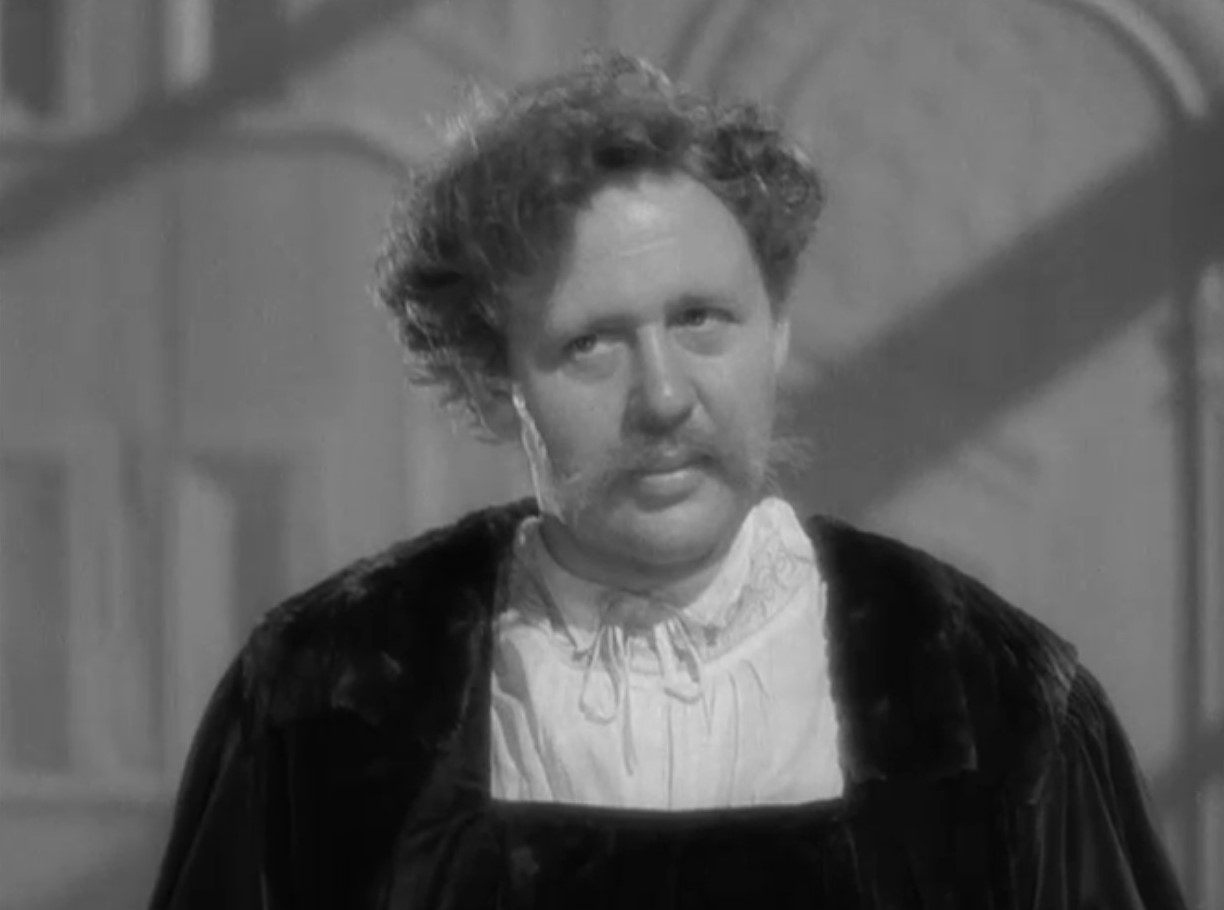
  • I expect that as a filmmaker focusing on the life of a great painter, you must be under pressure to produce as beautiful a film as possible, for obvious reasons. This film is stunning in its period imagery and costumes, and the cinematography of Georges Périnal ran the gamut from long shots to close-ups in glorious black and white (see Screenshots section below).
  • Charles Laughton's big personality works here. He's in almost every scene and the success of the film rides on his performance. I'm not sure whether writer Zuckmeyer or Korda insisted that this film feature more than one Laughton monologue because of his success reciting the entire Gettysburg Address in Ruggles of Red Gap the year before, but be warned, there are at least two of them here. They stop the action, and while excellently delivered, I fidgeted just a bit.
  • I admit to knowing nothing about Rembrandt's life. If the filmmakers were setting out to emphasize the lows of his life, they succeeded. Perhaps not as tragic as Van Gogh's, it wasn't an easy one. Once again, if there was any doubt, we are reminded that revered painters did not always have it easy in their day.
  • Roger Livesey is a favorite of mine for the films he made with Powell and Pressburger in the 1940s. He spent his entire film and stage career in Britain, and it's always a delight when he pops up in these earlier movies. He is completely unrecognizable as "Beggar Saul", but his voice gave him away for me! As a bit of trivia, his two brothers AND his father had small parts in this film.
Livesey in The Life and Death of Colonel Blimp
(1943).
  • Even though Elsa Lanchester (Laughton's wife) was not Korda's first choice for Hendrickje, I thought she was perfect here - she radiated beauty in a way I've never seen, not to mention her kindness and steeliness.
Screenshots
Here's a Rembrandt self-portrait opening the 
film credits, perhaps urging us to appreciate
how closely Laughton will resemble him.
 
In his early years, Rembrandt loved to spend money on
jewels for his wife Saskia. His friend is a bit concerned.

Rembrandt and villagers in Old Amsterdam.

Rembrandt's brutally honest "The Night Watch" is unveiled,
and doesn't get the reaction that would ensure
him career success.

Newly cynical Rembrandt is a bit perturbed at the 
criticism of his recent work. 

Rembrandt family housekeeper Geertje Dirx (Gertrude
Lawrence) plots to move in after the untimely death of 
Rembrandt's wife Saskia.

Roger Livesey as the beggar who becomes
King Saul in a sitting in Rembrandt's studio.

As King Saul

Rembrandt returns briefly to his humble birth home and
 village and eats supper with the fam.

In Rembrandt's birthplace, the villagers make merry.

Elsa Lanchester as Rembrandt's common-law
wife Hendrickje. Here she's getting ready
to sit for her portrait, what else?

This time, Rembrandt is not deluding himself
about the grave condition of someone he loves.

I think Laughton studied Rembrandt's self
portraits to put on this face.

The aged painter enjoying the attentions of a merry
young group enthralled with his wit.

Where to Watch
Criterion released a quartet of Korda films focusing on major figures ("Private Lives"); this one is in that set. I saw the film on Archive.org here.

Further Reading
As usual, TCM offers a nice essay about the film here. The AFI also has some interesting production tidbits, including from the recollections of Elsa Lanchester, here.

Tuesday, May 25, 2021

Fifty Years of Film in 50 Weeks, #15: The Informer, 1935

"Then Judas repented himself - and cast down the thirty pieces of silver - and departed." 

The Informer, 1935

Director: John Ford
Writer: Dudley Nichols, from the novel by Liam O'Flaherty
Cinematographer:  Joseph H. August 
Produced by: John Ford for RKO Radio Pictures.
Starring: Victor McLaglen, Heather Angel, Preston Foster, Margot Grahame, Wallace Ford, Una O'Connor, Donald Meek
Music: Max Steiner

Why I chose it
This tied for first in my Twitter poll, but the Oscars the film won, especially the score by Steiner and Best Actor for Victor McLaglen, convinced me I needed to see this early John Ford talkie, which won him his first Best Director Oscar.

'No-spoiler' plot overview
In one Dublin evening during the Irish Civil War of 1922, a brutish, desperate, recently court-martialed ex-member of the IRA Gypo Nolan (McLaglen), informs on a fellow rebel (Wallace Ford) to the British 'Black and Tan' authorities and comes to regret this act, as the rebel is killed and Nolan quickly wastes the 20 pounds he gained for his informing.

Production Background 
John Ford was a successful director during the silent era and made a grudging transition to sound, employed by Fox. There he made epics and bucolic "Griffithian" dramas according to his biographer, Scott Eyman. When he switched to RKO, his style changed, and he indulged his love of German expressionistic technique, which was infused into the dark night settings and dramatic lighting of The Informer. McLaglen and Ford were collaborators for decades, both hard-drinking Celtic souls who somehow found great humanity in their films' characters. Tales told that McLaglen was actually drunk during his scenes of inebriation were debunked much later by Ford himself. 

Ford specifically requested composer Max Steiner for the movie based on his score for The Lost Patrol made with Ford the previous year. Previews were lukewarm, making the production team nervous, but critics were rapturous and surprising most, it earned a hefty profit. Based on this reception and the resulting Oscars, Ford was now a bona fide star director, coveted by the industry despite his being difficult to work with. As for Steiner, he won his first Oscar, and much praise for his score. Director Frank Capra even sent him a telegram exclaiming the score was the best he'd ever heard (Music by Max Steiner, by Steven C. Smith, 2020).

Some other notable film-related events in 1935*:

  • RKO's and Rouben Mamoulian's Becky Sharp (1935) was the first feature-length Technicolor film to be shot entirely in 3-strip color - a milestone film dramatizing William Makepeace Thackeray's novel Vanity Fair with Miriam Hopkins in the title role.
  • British director Alfred Hitchcock became an internationally famous figure for his thriller The 39 Steps.
  • Twentieth Century Pictures (founded in 1933 by Darryl F. Zanuck and Joseph Schenck) and the Fox Film Corporation (founded by William Fox in 1915) merged to form 20th Century-Fox, overseen by Schenck and Zanuck.
  • Selznick International Pictures, a major Hollywood motion picture studio, was founded in 1935 by David O. Selznick, who had left MGM. As an independent producer, David O. Selznick served as a "one-man" film industry with tremendous authority and power over the selection of stars and decisions of directors.
  • Olivia de Havilland debuted in film with A Midsummer's Night Dream

*Thanks to Filmsite.org

My Random Observations

  • For the first quarter of the film, this feels like a silent. There are long dialogue-free stretches, with dramatic music, expressionistic lighting and close-ups of faces overcome with emotion.  This isn't surprising, as Ford, experienced in directing silent film, was emerging from that era to the new 'talking picture' era that he would master as well. As a fan of the late silent period, I loved this "throw-back" feeling, considering much of the early 1930s were pre-Code dialogue-rich offerings.
  • Despite its minimalist sets, unsubtle symbolism and expressionistic filming technique, the film feels authentic. Ford, a son of Irish immigrants, had a knack for getting the culture down. It truly felt like you were looking at real events in war-torn Dublin through perhaps a distorted lens. Credit should go, of course, to McLaglen, whose towering central performance is believable if heavily dramatic.
  • Someone should write an opera from this story. Having not read the novel, I'm not sure if the outlines of the plot are more complex than in the film, but the simple story, filled with high-pitched emotion and stirring action, and its short time frame would be perfect set to music. Perhaps some of Steiner's score could inspire the composer, along with popular Irish tunes inflected with appropriate dissonance, of course.
  • Once again, I'm taking a moment to laud one of my favorite character actors: this time, Wallace Ford. No relation to director John, Ford had a difficult early life but emerged in movies with his raw talent in the early 1930s to take on flawed leading men or secondary parts that put his boyish enthusiasm and bluster with a natural vulnerability bordering on weakness of character to good use. The part of the doomed Frankie McPhillip is perfect for him. If his Irish accent isn't consistent, well, it's not uncommon for actors to not quite nail difficult accents (although Ford was born in England so... hmmm.). Ford was handsome and likeable as a young actor, and aged, as many do, with a few extra pounds, continuing his career through the early 1960s. His last role was of the brow-beaten grandfather in A Patch of Blue with Sidney Poitier, Shelley Winters, and Elizabeth Hartman.
    Wallace Ford in middle age (Wikipedia)

Screenshots

Our first glimpse of conflicted, downtrodden Gypo.

Gypo considers the reward offered for the capture of his compatriot.

A street tenor (Denis O'Dea) sings 'The Rose of Tralee'

A side of character actor Donald Meek that we rarely see. 
Here he's sizing up streetwalker Katie.

Katie and Gypo pine to escape war-torn Dublin. If they 
only had the cash.

Frankie McPhillip (Wallace Ford) wanted and hiding.

Gypo and Frankie share confidences at an IRA hangout.

Gypo in the act of informing.

Frankie beset by the Black and Tans.

Frankie's mother collapses in grief.

Gypo with Frankie's mother and sister, trying to hide his guilt.

Gypo, buying everyone a meal, is very popular for a few minutes.

 A biblical denouement as Gypo repents his guilt before 
a life-sized crucifix and Frankie's mother.

Frankie tries to negotiate with IRA leaders Gallagher and 
Mulholland (Preston Foster & Joe Sawyer).

Desperate lovers Gypo and Katie (Margot Grahame) have a tender moment.

Where to Watch
The film is available on DVD (Warner Bros. Archive) and currently streaming on Amazon Prime Video, where I watched, and other streaming platforms.

Further Reading
I enjoyed the Self-Styled Siren's essay looking at the evolution of film criticism centered on the film, and also this SUNY-Albany article with production tidbits.

Tuesday, May 18, 2021

Fifty Years of Film in 50 weeks, #14, a 'Hidden Classic': Death Takes a Holiday, 1934

Bad News: Due to a confluence of events I am now officially one week behind in my film-watching and blog updates for this series. I hope I can make up the difference to end the year on goal!

Good News: I'm thrilled to be submitting this post as part of the Classic Movie Blog Association's Spring Blogathon on 'Hidden Classics'. Click on the image below to access everyone's choices of films that you may not have heard of but definitely should watch.

My 'hidden classic' is: Death Takes a Holiday, from 1934.

Director: Mitchell Leisen
Writers: Maxwell Anderson and Gladys Lehman, adapted from the play by Alberto Casella
Cinematographer: Charles Lang
Visual Effects (not minor here): Gordon Jennings

Produced by: Emanuel Cohen and E. Lloyd Sheldon for Paramount Pictures
Starring: Fredric March, Evelyn Venable, Guy Standing, Katherine Alexander, Henry Travers, Gail Patrick, Kent Taylor, Kathleen Howard

Why I chose it
Once again, I reached out to a film friend for some recommendations of 1934 films I hadn't seen; this one was on her list and then it won my Twitter poll ( the other options: Lady By Choice, Crime Without Passion, and Cleopatra).

'No-spoiler' plot overview
A small group of wealthy, fun-loving families plans to enjoy some time together in an Italian villa, but challenges ensue when they are visited for three days by mysterious Prince Sirki, who seems to know little of common courtesies. Unknown to all but Duke Lambert, the owner of the villa, Prince Sirki is the earthly disguise for none other than the Grim Reaper, or Death himself, who has decided to take a few days off from whisking mortals to the afterlife. His objective? To better understand why humans fear him. He lives it up with fun and games, and enjoys the attentions of several women in the party. He's particularly enthralled with young Grazia, who is engaged to Corrado, son of the Duke. He's a quick learner and realizes love is the transcendent driver of the human experience.

Production Background 

  • This film was director Leisen's second feature; his first was Cradle Song, also starring Evelyn Venable and putting her ethereal beauty to good use. (I saw Cradle Song at the Capitolfest Film Festival a few years back). 
  • The play was translated into English by Walter Ferris, and this was the version adapted for the film. Ferris, for his part, went on to become a screenwriter himself. 
  • According to an account by Leisen, the film succeeded for Paramount, and he received mail from fans saying they no longer feared death!
  • A remake called Meet Joe Black was released 53 years later starring Brad Pitt. I'd feel better about death, too, if I knew it took the shape of a handsome leading man!

Some other notable film-related events in 1934*:

  • The pre-Code Era comes to an end: An amendment to the Production Code established the Production Code Administration (PCA), which required all films to acquire a certificate of approval before release or face a penalty of $25,000. The members of the MPPDA agreed not to release or distribute any film that didn't carry the seal. The MPPDA appointed Joseph Breen as the director of the PCA to enforce the Production Code. The era of "separate beds" was inaugurated.
  • The Catholic Church formed the Legion of Decency to boycott any film that didn't use the Production Code as a guideline.
  • Louis de Rochemont began the documentary newsreel film series, The March of Time.
  • The Thin Man was the first installment of a popular series of six MGM films casting a sophisticated, glamorous, pleasure-seeking, and urbane husband-wife detective team (William Powell and Myrna Loy as Nick and Nora Charles). The story was taken from Dashiell Hammett's 1934 detective novel of the same name. Eventually, Powell and Loy appeared in 14 feature films together (from 1934 to 1947).
  • Famed child star Shirley Temple made her feature film debut in 1934, producing several films that year for Fox and Paramount. In 1935, Shirley won the Juvenile Academy Award for her film work encompassing 1934, and became the first female to receive a "special" Oscar.

My Random Observations

  • Some movies blow you away when you first see them; others that leave you flat on first viewing come to life on the second. I'm glad I watched this twice as it fell in the latter of those two categories. At first, the film seemed a bit too mannered for me. But once you accept some of the conceits that are built into the script, and realize those conceits are part of the point, the film really comes to life. The characters are all well-drawn, even if the film doesn't reach 90 minutes, which is a delight in itself. I particularly enjoyed Guy Standing as the nervous Duke, who must keep the dreadful secret about his mysterious houseguest. 
  • I smiled when I counted the various fairy tales and legends that seemed to find their way into this script; in particular, it seemed a mash-up of Cinderella, The Flying Dutchman, and Jekyll and Hyde (the latter aided by the presence of Fredric March, who had portrayed Stephenson's protagonist(s) two years earlier).
  • Fredric March sure looked good at this stage in his career. That said, the accent he adopted here, made to sound 'foreign' no doubt, reminded me of Dracula. It didn't help that he had dark make-up around his eyes that hinted at his supernatural origin.
  • Evelyn Venable had some amazing gowns in this film (yay, Edith Head & Travis Banton). And despite her beauty and attire, she totally convinced as the spiritual young woman not interested in the pleasures of earthly life. Maybe that is because she already had them (!).
  • I love when Gail Patrick appears in a film - she is a willowy beauty from the early Hollywood days who had enough of a haughty air to prevent her from *ever* getting a lead role in a film and was always relegated to the part of romantic rival (Love Crazy), nasty sister (My Man Godfrey), or the like. She played these roles to perfection, and I suppose was grateful to have a long, fruitful career in Hollywood nonetheless. After her acting career, she got into producing, and was apparently named 'Los Angeles Woman of the Year' twice!
Screenshots

Just one of several times that Grazia (Venable) gives Corrado
(Taylor) a weary look when he presses her to marry him, again.

Cruising down a twisty road at night - the light on Venable
vs. the shadows on her friends was striking.

What kind of villa is this? Gothic-Greek-shabby-chic?

The shadowy figure of Death approaches at Midnight.

Duke Lambert tries to keep it together in a conversation with Death.

The guests are stunned to see the arrival of Prince Sirki...

...a vision in white, looking like Fredric March.

Gail Patrick's and Katharine Alexanders' characters are 
forced into a rivalry trying to be the first to get the attention
of the handsome Prince.

The Prince grins as his holiday has the effect of keeping 
people from the death that would have been inevitable had
he been on the job.

Cesaria (Travers) lectures the Prince on life and love.

Now this is scary -- when provoked, the Prince shows his dark side.

The Prince looks on after giving Alda (Alexander) the scare of
her life.

The Prince and Grazia have a dance before midnight.

Where to Watch
I watched the film on Archive.org here, but it is also available on DVD. 

Further Reading
A bit of production history and discussion of the special effects are shared in TCM's film article here.

I love reading snarky contemporaneous reviews, and this one by Helen Brown Norden for Vanity Fair fits the bill (you will have to scroll down the page a bit to find it). She made an observation that I also did above: "Fredric March plays Death as if he thought he might possibly be Dracula; and he intones all his words with an awesome, old-Shakespearian-actor solemnity." 

Don't forget to check out all the posts highlighting 'hidden classics' here, and have fun!

Sunday, May 16, 2021

Six decades of film Jameses

Yahoo! Today is  "National Classic Movie Day", and I'm celebrating virtually with my fellow classic film bloggers. This year, bloggers are writing about one favorite film from each of six decades of film history as part of a blogathon hosted by Rick of Classic Movie and TV Cafe. Check out all the posts by going to Rick's site here - there really is no better way to build up your watch list of great classics than through recommendations of this group of bloggers!

In addition to being "National Classic Movie Day", May 16th will always be a special day for me - my dad's birthday. So, for my entry in this year's blogathon, I'm taking a cue from Turner Classic Movies - during May their 'star' of the month is "Movie Roberts"-- and building my list of favorites around "Movie Jameses" in honor of my own favorite James. 

1920s: James Murray (1901-1936) The Crowd (1928)

Sadly, James Murray is known for the leading part in this movie and very little else. Originally from New York, Murray's big dream was to have a career in Hollywood, and his dream came true when famed director King Vidor found him in a casting office and, impressed with his skills, cast him in The Crowd. He did go on to make a few more films before falling victim to depression, substance abuse, and homelessness. He ultimately died at only 35 years old after drowning in what may have been a suicide. 

James Murray

Watch The Crowd because...it represents the best of the art of the silent film. It's at once visually stunning and biting in its social commentary ... a story of a young couple struggling to make it in the big city. Opposite James Murray was cast Eleanor Boardman, director Vidor's second wife. Ironically, it was made a couple of years before the stock market crash that launched the Great Depression. Director King Vidor was one of the most prolific directors in Hollywood, and his career spanned the birth of pictures through to the early 1960s. 


1930s: James Cagney,  (1899-1986), Footlight Parade (1933)

Diminutive Irish-American actor James Cagney is, of course, a titan of Classic Hollywood cinema, and a personal favorite. His talents were made for the screen, whether he's singing and dancing (for example, Yankee Doodle Dandy), or rubbing out foes that ran afoul of any number of gangster characters he portrayed (The Public Enemy). Cagney's career really took off in the 1930s, and even though he had many terrific parts in later decades, his pre-Code films are my favorites.

James Cagney (from Wikipedia)

I chose to highlight Footlight Parade, first because Cagney isn't a gangster here, he's an eternally optimistic theatrical producer who can (shock!) sing and dance. And who doesn't like watching him dance? The backstage plot revolves around Cagney's efforts to corral assorted players and sell theatrical "prologues", live showpieces that precede feature films at big-city movie houses. Almost everyone in the Warner Bros. stable is there, with Joan Blondell toning it down a bit but making a wonderful partner for Cagney, Dick Powell, Rudy Keeler (the two of them reprising their romance from 42nd Street), Guy Kibbee, Ruth Donnelly, Hugh Herbert, Frank McHugh, and more. And then there are the fabulous musical extravaganza numbers choreographed by Busby Berkeley. Be aware of some unfortunate dated elements; otherwise, this is a fabulous romp. Directed by Lloyd Bacon.


1940s: James Stewart, (1908-1997), 
The Philadelphia Story (1940)

James Stewart has little in common with Cagney, but he shares the versatility and screen legend status. Just a bit younger than Cagney, his career really took off starting in the 1940s, and The Philadelphia Story was one of his first major leading man breaks (would you believe he played the villain in the second 'Thin Man' film in 1936?) Stewart was a WWII hero, and upon returning home after the war, found he could channel some of the darkness in his personality into his later roles. He became, like one of his Philadelphia Story co-stars Cary Grant, a favorite of Alfred Hitchcock. 

James Stewart (Wikipedia)

The first time I saw The Philadephia Story I didn't like it. It seemed overly stagy and contrived. Then I had the opportunity to watch a special screening at my local cinema and was completely entranced as the subtleties that make the movie were so much more apparent. Stewart and Cary Grant orbit around society damsel Katharine Hepburn on the eve of her marriage to staid bachelor George Kittridge. All kinds of shenanigans ensue. The witty script and pitch-perfect portrayals by the leads and supporting players alike make this one a must-see. I especially love British actor Roland Young as Uncle Willie. Directed by George Cukor, this was just one of four films Stewart made in 1940. 


1950s:  James Dean (1931-1955), East of Eden (1955)
Here is another titan of film. But unlike Cagney & Stewart, his titan status is based on his potential, as seen in a total of three films he made in 1955, and that wasn't fully realized as he tragically died later that year in a car accident at age 24. (It's really hard to imagine that Dean would be 90 this year). But Dean in many ways emblemizes the 1950s, not least because of the teenage rebellion issue that seemed to capture the public imagination then, so this actor of eternal youth is my choice for this decade.

James Dean (Wikipedia)

East of Eden
 was actually Dean's first of his three feature films - and it's a meaty role in the film version of Steinbeck's novel which had come out only three years before. And it's not set in the 1950s, but right after WWI, focusing on the generational struggles of a family in the Salinas Valley of California, and the uncovering of secrets. Directed by Elia Kazan, it has an epic feel. Dean was able to showcase the range of attitudes he brought to a character: defiance, vulnerability, sweetness, and roughness. Julie Harris is wonderful as the love interest of both brothers in the Trask family, and Raymond Massey brings life to the difficult character of the father, a role he said was the best in his career.

1960s: James Coburn (1928-2002), The Magnificent Seven (1960)
The Magnificent Seven was a career-launching film for James Coburn, an actor who had toiled in minor parts. Here, director John Sturges cast him as Britt, a knife-thrower and sharpshooter who talks only with his weapons. Coburn has a classic scene in this film in which his wiry body and taciturn nature belies his deadliness when provoked. Coburn went on to a long career in film and television, playing rough-and-tumble types in action or Western flicks. 

James Coburn (IMDb)

I watched The Magnificent Seven for the first time last year. I was afraid that it might be one of those films that didn't live up to its classic reputation. Thankfully, I was wrong. In the hands of director John Sturges, who loved the source material, Kurosawa's The Seven Samuraiit is a compact, beautifully shot piece of Western entertainment. And I readily bought Russian-born Yul Brynner as the mercurial but tough leader of the gang who tries to protect a Mexican village from a group of marauders led by the great Eli Wallach. Steve McQueen is a second lead here and almost succeeds in taking the picture from Brynner. The film is also known for its evocative score by Elmer Bernstein

1970s: James Caan (1940-), The Godfather (1972)

And now for the young-un in the bunch: James Caan, who is still with us. A New York native who got his start on the stage, Caan cemented his star status as the lead in the TV movie Brian's Song in 1971. He then won the role of Sonny Corleone in The Godfather over Robert De Niro. His manic, explosive energy was put to good use -- he even had one of the most memorable death scenes in the movies. He garnered a nod for the Best Supporting Actor Oscar along with co-stars Robert Duvall and Al Pacino. He continued as a leading man and supporting actor over the subsequent decades, overcoming substance abuse issues and a rocky personal life. He also dabbled in directing and lived out his tough-guy persona as a Master of Gosoku Ryu Karate.

James Caan (IMDb)

The Godfather ranks as #3 in the American Film Institute of best films, and it set the standard for modern mob dramas. It's character-driven, and epic, running nearly three hours. There are several storylines that criss-cross in mostly tragic ways. In the end, The Godfather is dead, from natural causes, and the reluctant son is stepping into those shoes, poised to become even more of a monster. Despite that, you rather root for these Corleone mobsters, while despising them more for the way they treat the women in their lives than the way they dispatch their enemies. Directed by Francis Ford Coppola, and followed up by a sequel many consider the original's superior.


For more recommendations of classics through the decades, head over to Rick's Classic Film and TV Cafe for the master list of bloggers sharing their favorites.