Search This Blog

Saturday, February 26, 2022

Fifty Years of Film in 50 Weeks, #41: Lover Come Back, 1961

"Okay, so I've sewn a few wild oats.:
- Jerry Webster
"A few? You could qualify for a farm loan!"
- Carol Templeton

Lover Come Back, 1961

Director: Delbert Mann
Writers: Stanley Shapiro and Paul Henning
Cinematographer: Arthur E. Arling
Producer: Robert Arthur, Stanley Shapiro, and Martin Melcher for 7 Pictures Corporation-Nob Hill Productions, Inc.-Arwin Productions, Inc. Production
Starring: Rock Hudson, Doris Day, Tony Randall, Edie Adams, Jack Oakie

Why I chose it
After a few ultra-serious films, I was in the mood for a frothy comedy. When this one popped up on my list, I was especially attracted to it as a way to start filling in the gaping hole in the Rock Hudson-Doris Day films. When I saw Jack Oakie was in the cast, that sealed the deal for this secret Oakie enthusiast!

'No-spoiler' plot overview 
Carol Templeton (Day) and Jerry Webster work for rival ad agencies on Madison Avenue. Even though they haven't met, they often fight to win the same potential client, which engenders a bit of an (un)friendly 'in name only' rivalry. Womanizer Jerry doesn't hesitate to go to extreme lengths to win a client, much to the consternation of his neurotic boss and company owner, Pete Ramsey (Tony Randall). A major ruse is unleashed when in the midst of trying to keep one of his girlfriends (Edie Adams) from walking out, he makes up a product name (Vip) and promises she can be the "Vip Girl". Jerry then has to actually get Vip to materialize and enlists the help of brilliant chemist Linus Tyler (Jack Kruschen) to come up with something (anything). Hot on the trail of Vip, and not knowing there is no such product, Carol is introduced to Jerry who pretends to be Tyler to access to some of her business secrets. Of course, the two begin a relationship. Viewers must stay tuned to see what Vip will really turn out to be, and how long Jerry can keep his real identity hidden from Carol!

Carol (Day) tries to console Linus (Jerry in disguise) when
he just doesn't know what to do with his feelings for her (!).

Production Background
The first film pairing of the dynamic Rock Hudson and Doris Day in Pillow Talk (1959) was a huge success with late 1950s audiences, and co-producer Stanley Shapiro, who also wrote Pillow Talk, looked to pair them again in a similar tale of mistaken (or unknown) identities, and personality mismatches. 

Lover Come Back was also a hit, and oft-grumpy NY Times critic Bosley Crowther even loved it. He said, "Pillow Talk was but a warm-up for this springy and spirited surprise, which is one of the brightest, most delightful satiric comedies since It Happened One Night."

Despite the lauds it received from critics, Lover Come Back only garnered one Oscar nomination, for Best Writing, Screenplay.

Some other notable film-related events in 1961 (from Filmsite.org):

  • The action war film The Guns of Navarone (1961) starring Gregory Peck, had one of the most expensive budgets of films at the time, at $6 million, and was one of the top-grossing films of 1961, along with Disney's animated 101 Dalmatians (1961).
  • Method actor and maverick auteur John Cassavetes' low-budget film Shadows (1961) was his first directorial effort - deliberately created as a contrast to Hollywood's studio system. The self-financed, self-distributed cinema verite film was a story set in New York about an inter-racial couple. Shot on 16-mm film and using a non-professional cast and crew, the film symbolized the emergence of the New American Cinema movement, and inspired the growth of underground films and other independent ("indie") and personal works.
  • A search commenced for the first James Bond actor, after UA announced it would produce seven films based upon Ian Fleming's 007 British super-spy, to be produced by Albert R. Broccoli and Harry Saltzman. Cary Grant, James Mason, Patrick McGoohan, and David Niven, were considered for the role, ultimately given to 30 year-old actor Sean Connery.
  • Marilyn Monroe's last completed film, before her death in 1962, was director John Huston's anti-western The Misfits (1961) -- it was also the last film of screen icon Clark Gable.
My Random Observations
  • ANOTHER film in which a chemist is portrayed as a socially-awkward misfit? Oh my. So it's especially hard to imagine that Doris Day is supposed to believe gorgeous Rock Hudson is a chemist, even if he wears a beard, along with an ill-fitting suit and bowtie, and acts ultra naive. That's OK, I suppose we are supposed to believe that Doris as Carol is a bit naive herself, even if she is a savvy marketing executive.
    The chemist vs. the leading man - which do you choose?

    Hudson as Jerry as Linus (!) feigns shock watching a strip show
    with Carol. Carol either doesn't like the show or is embarrassed by 
    Rock's wardrobe.

  • With the prevalence of social media, business sites like LinkedIn, etc., it did strike this modern viewer as quaint that the main plot revolved around Carol having no idea what her well-known but hated rival Jerry actually looked like!
  • Jack Oakie's role was much too small. This comedy star of early talkie cinema had a unique slapstick style and loved to put on accents (think 'Napaloni' in The Great Dictator (1940)). Here he is a rich Virginia gentleman who plays into the hands of Jerry and Carol who duke it out to win his account. As a mere tool to set up the characters and scenario for the film, he disappeared after the first ten minutes, much to my chagrin. This film was the last Oakie made.
    Jack Oakie (right) being treated to a good time by
    Rock Hudson as a prelude to a deal.

    The good time was just a bit too good. Carol 
    (Day, left) looks at the aftermath in horror.

  • How much inspiration did Matthew Weiner, the creator of TV's smash hit Mad Men, get from this movie, set in precisely the same era, with the focus on sexual politics interfering with work politics? For fans of the series, I would strongly recommend this film, even if the romantic comedy angle is not the main theme of the series. I really enjoyed the film and felt that the pacing, performances, script were perfect, and the set and costume design were scrumptious.
    Jon Hamm (left) and John Slattery in a scene from Mad Men

  • Tony Randall is wonderful. He underplays a comic role that could tempt most actors to slice the ham a bit too thick, but his interactions with Hudson are believable enough to be downright hysterical.
Tony Randall (left) as the boss uses a horn to beckon moose as 
the clearly unamused Jerry wishes here were anywhere else.
  • For Bit player bingo this time, I present Ann B. Davis, well known as the smart-aleck but loveable maid Alice in The Brady Bunch, here playing Day's assistant.
    Ann B. Davis (right) looks uncannily like Alice when she helps
    Doris Day with her outfit.
Where to Watch
It's available on DVD and can be streamed for a small fee on many standard streaming services.

Further Reading
Check out this piece in Vanity Fair detailing the lives of Doris Day and Rock Hudson, and how they intersected inside and outside the movies they made together.

Thursday, February 17, 2022

Fifty Years of Film in 50 Weeks, #40: Elmer Gantry, 1960

Jim Lefferts: You look like a man who could use a drink.
Elmer Gantry: You know somethin', Jim? There oughta be a law against drinkin'.
Jim Lefferts: There is. Prohibition.
Elmer Gantry: That's against sellin', not drinkin'.
Jim Lefferts: Amen.
Elmer Gantry, 1960

Director: Richard Brooks
Writer: Richard Brooks, from the novel by Sinclair Lewis
Cinematographer: John Alton
Producer: Bernard Smith for Elmer Gantry Productions (Richard Brooks' company)
Starring: Burt Lancaster, Jean Simmons, Arthur Kennedy, Dean Jagger, Shirley Jones

Why I chose it
As an Academy Award nominee from 1960, and an adaptation of one the  early 20th century's most provocative novels, this one just grabbed more of my attention than any other potential films. 

'No-spoiler' plot overview 
Elmer Gantry (Burt Lancaster) is a small-time con man during the Prohibition era, who as an itinerant salesman finds he can win sell anyone almost anything, even religion, with his speaking abilities and charisma. He wanders into a traveling Revivalist show headlined by "sister" Sharon Falconer (Jean Simmons), a lovely, sincere preacher who has the gift of connecting with rural folk and converting them to an active, evangelical Christianity. At first resistant to Elmer's charms, Sharon recognizes his gift for preaching even if he crosses boundaries of propriety, but then begins to fall for him. Their burgeoning relationship is threatened by both his past involving another woman (Shirley Jones) and his ambition, which also threatens the existence of their troupe.

Elmer Gantry (Lancaster) wows a rural crowd of the faithful with his
fiery preaching.

Production Background
The success of Elmer Gantry owes much to producer/director/writer Richard Brooks. He was intrigued by the 1927 Sinclair Lewis novel, and decided to adapt the first half of it to the big screen, although with reportedly significant alterations to some of the main characters. Burt Lancaster was cast after it was originally reported that Brooks had considered Montgomery Clift for the lead role. Brooks had already worked with Lancaster, having written two of his earliest films: The Killers (1946) and Brute Force (1947) Lancaster made the character of Gantry his own, even incorporating the "slide" moves of baseball player-turned evangelist Billy Sunday. As for Brooks, he married his leading lady, Jean Simmons, shortly after production wrapped.

The film did well upon release, earning over three times its $3 million production budget at the box office. The film also won three Academy Awards: Best Actor for Burt Lancaster (his sole Oscar win), Shirley Jones for Best Supporting Actress, and Richard Brooks for Adapted Screenplay. The film was nominated but did not win for Best Picture and Best Score (André Previn).

In an interview available here, Shirley Jones revealed that she had a major crush on Burt Lancaster when she was growing up, and covered her walls with his posters. About Elmer Gantry Jones said that Lancaster was a great help to her on set, and then the day they both won Oscars for their portrayals was the proudest day of her career.

Sister Sharon Falconer (Simmons) turns to call out Jim Lefferts (Arthur Kennedy),
the perpetually doubting news reporter out for dirt.

Some other notable film-related events in 1959 (from Filmsite.org):

  • Alfred Hitchcock received his fifth and last nomination as Best Director for Psycho (1960). His four previous nominations (all losses) were for Rebecca (1940), Lifeboat (1944), Spellbound (1945), and Rear Window (1954).
  • The talented scriptwriter Dalton Trumbo, one of the Hollywood Ten, received full credit for writing the screenplays for Preminger's Exodus (1960) and Kubrick's Spartacus (1960), thus becoming the first blacklisted writer to receive screen credit. In 1960, Trumbo was finally reinstated in the Writers Guild of America. This official recognition effectively brought an end to the HUAC 'blacklist era'. 
  • Although the tradition of embedding 5-pointed pink stars in the sidewalk ("the Hollywood Walk of Fame") along Hollywood Boulevard and Vine Street was established by the Hollywood Chamber of Commerce in 1958, it wasn't until February 9, 1960, that the first star to be unveiled was awarded to actress Joanne Woodward.
  • Director Jean-Luc Godard's low-budget, mostly improvised A Bout de Souffle (1960, Fr.) (Breathless), his first feature-length film, became the cornerstone film of the French New Wave, with startling jump cuts and bold visuals shot with a hand-held camera on location. It paid homage to B-gangster films with star Jean-Paul Belmondo, in the role of a young hoodlum, modeling himself on Humphrey Bogart. 

My Random Observations
  • Jean Simmons had quite the range. It seems that she was especially good at saintly young evangelists, considering her role here and as Sarah Brown in Guys and Dolls (1955). Nevertheless, she has no problem attracting (and keeping) eligible young rogues in both films. But she's the opposite of saint in the ironically titled Angel Face (1953)- while her face is cherubic, she's one of the most "fatale" of all "femmes" in film noir.
Simmons as Sister Sharon Falconer calling on the Lord.
Simmons as the femme fatale Diane Tremayne in Angel Face
  • The controversial nature of the film prompted an extensive on-screen warning prior to the opening titles of the film. Considering that the film did not mock religion or faith, per se, but rather pulled the curtain back on the hypocrisy of some of its practitioners, these warnings seemed at least quaint, at most completely unnecessary. Of course, charismatic preachers taken to task for fleecing their flocks is old news today. I've not read the novel, but what I've learned is that the themes there are more powerful social commentary than those translated into the film.
  • The attraction that Elmer displays toward charismatic religious practices is really not explained. The only explanation that I'm left with that he just enjoys hamming it up and being the center of attention. This tendency is shown early in the film where he joins a group of Black worshippers and belts out gospel songs.

  • The bug-eyed leering of Lancaster does get a bit tiresome.
Typical visage of Lancaster as Elmer Gantry.
  • Shirley Jones was a revelation. Sadly, I have to admit that I'm familiar with her only as the Mom in The Partridge Family, and to a much lesser extent from her star turn in Oklahoma! Here, she perfectly captures the cynicism and anger of a still young woman who was taken advantage of by a man and as a result is leading a dissolute life. Her Oscar was well deserved.
Shirley Jones as Lulu Bains, contemplating the revenge she'll take
on Gantry.
Where to Watch
The film can currently be streamed for free for DirectTV subscribers, and is available on DVD/Blu-Ray.

Further Reading
Read the original review of the film in the New York Times here. And don't miss this insightful piece on TCM.com describing more of the film's backstory and the career of director Richard Brooks, and this one on the American Film Institute site here.

Friday, February 4, 2022

Fifty Years of Film in 50 Weeks, #39: Compulsion, 1959

"We're told it was a cold-blooded killing because they planned and schemed. Yes, but here are officers of the state who for months have planned and schemed - and contrived - to take these boys' lives. Talk about scheming."
Defense Attorney Jonathan Wilk
Compulsion, 1959

Director: Richard Fleischer
Writer: Richard Murphy, from the novel by Meyer Levin
Cinematographer: William C. Mellor
Producer: Richard D. Zanuck
Starring: Orson Welles, Diane Varsi, Dean Stockwell, Bradford Dillman, E.G. Marshall, Martin Milner

Why I chose it
A movie friend suggested it, and knowing that we just lost Dean Stockwell and that I hadn't seen many (or any?) of his movies of this era, I picked this one immediately.

'No-spoiler' plot overview 
In 1920s' Chicago, Judd Steiner (Stockwell) and Arthur Straus (Dillman) are two precocious and wealthy law students who seem intent on doing mischief just because they can get away with it. With Steiner under the thrall of the more controlling Straus, mischief turns into the murder of a young neighbor boy. They avoid suspicion even while acting oddly with their friends Sid (Martin Milner) and his girlfriend Ruth (Diane Farsi). Since there is no perfect crime, a personal item left at the scene starts to unravel their alibis. Finally, forced to confess to the District Attorney (E.G. Marshall), their fate lies in the hands of renowned attorney Jonathan Wilk (Orson Welles), who is employed to defend them.

Shades of The Birds and Psycho here, but it's our young killers discussing
their latest alibi stories (Dillman, left, and Stockwell, right)
Production Background
Now well into the TV and post-studio system era, the first generation of moguls was giving way to the next. Twentieth Century Fox founder Darryl Zanuck's son, Richard, was now in the business and his first major producing project was this film. The story of the true-crime Leopold & Loeb case was back in the public consciousness due to a number of factors: the release on parole of Leopold, who subsequently started a new life and had just published his autobiography, the success of the novel Compulsion by Meyer Levin, and the turning the novel into a play on Broadway.

Former child star Stockwell got the part of Steiner (Leopold stand-in) in the stage version, and he was a natural to play the part in the film. Roddy McDowell, Straus in the play, was not cast in the film, but Bradford Dillman got the part. This supposedly prompted Stockwell to initially give Dillman a hard time on set. Eventually, they mended fences and got along. Orson Welles, who played the Clarence Darrow stand-in provided his own challenges. His time constraints put pressure on the production schedule, with a few portions of his record monologue near the end of the film being dubbed after, and he bullied nearly everyone on the production.

Even with the names changed, and the homosexual angle played down, Leopold had sued for invasion of privacy, but the case was dismissed. The film got no Oscar nominations, but all three lead actors (Stockwell, Dillman, Welles) won 'best actor' at the Cannes film festival that year. The Leopold & Loeb story was an inspiration for the play and subsequent Hitchcock classic film Rope, and a more provocative version of the two perpetrators, Swoon, from 1992.
Orson Welles, with trademark fake nose, makes his appearance over halfway into the
film.

Some other notable film-related events in 1959 (from Filmsite.org):

  • The chariot race sequence in director William Wyler's Best Picture-winning, wide-screen Technicolor epic blockbuster Ben-Hur (1959) set the standard for all subsequent action sequences. The Biblical epic was the first film to win 11 Oscars, breaking the record of 8 Oscar wins originally set first by Gone With the Wind (1939) and 9 Oscar wins set a year earlier by Gigi (1958). 
  • After over 25 years of creating low-budget shorts, the comic team of The Three Stooges, known for farces and physical slapstick, made their last (190th) film. It was Columbia's short Sappy Bull Fighters (1959) - a low-budget remake of their own earlier film, What's the Matador? (1942)
  • Doris Day and Rock Hudson were paired for the first time in the romantic comedy Pillow Talk (1959). Due to the film's success, the acting duo also appeared together in two 'sequels': Lover Come Back (1961), and Send Me No Flowers (1964).
  • Aroma-Rama, an experimental, short-lived scenting system developed by inventor Charles Weiss, was introduced to add over 50 scents to Carlo Lizzani's Italian documentary film about China titled Behind the Great Wall (narrated by Chet Huntley) by filtering 'Oriental' aromas into the auditorium through the air-conditioning system. The following year, a competing process, Smell-O-Vision, was introduced.
My Random Observations
  • This was my first film in the 1950s' CinemaScope widescreen, which produced an aspect ratio of 2.55 :1. I call it super skinny. I'm not a particular fan of this aspect ratio, but it certainly provided lots to look at. In many scenes, Fleischer used extreme close-ups, so not necessarily taking advantage of the widescreen, but in others, he positioned characters in all dimensions to allow us to view multiple simultaneous interactions.
    Artie Straus (Dillman, center) is happy that his "Mummsie" is distracting
    local reporters Tom Daly (Edward Binns, left) and Sid Brooks (Milner, right).

    Artie shoots a menacing look at Judd while driving together late at night.

  • Another atypical feature of this film: black and white cinematography. In a decade that I usually associate with brightly saturated color movies, most of those I've picked for this blog series were made in just-fine-by-me B&W. I can only take away that far more films were made in B&W in the 1950s than I had thought.
I enjoyed Martin Milner in this role - he seemed so...normal...compared with
the leads.
  • Was the character of Ruth (as played by Diane Varsi) for real? While dating a perfectly nice guy (Sid/Martin Milner), she is attracted to Judd, gets completely abused and almost raped by him, yet feels sorry for him in an icky motherly-like way. Even after she's confronted with him being a cold-blooded murderer, she *still* doesn't believe he's a bad person, or so we are led to believe. Perhaps she is there to help justify Attorney Wilk's courtroom argument but her feelings seem to go way overboard here. Spoiler: she does end up back with Sid.
  • Ruth looks at Judd and extends a friendly hand. Her boyfriend Sid (left) is
    appropriately skeptical.
About to be raped, Ruth applies the motherly treatment toward Judd, who 
finally breaks down, revealing he has emotions after all. 
  • Much of the detective work in breaking open the case involves Judd's glasses that he dropped where the dead boy's body was dumped. Even though the police eventually found a distinguishing feature that tracked the glasses back to Judd, early on there was so much talk about the glasses being so common as to be no help at all. As a result, I seriously was wondering why Judd didn't run out and buy himself another pair (discreetly of course) so he didn't have to run around revealing to everyone that he was missing his glasses and bringing suspicion on himself.
I liked this quirky visual.
  • Much is made of Wilk's (Orson Welles) 10-minute monologue arguing to spare his clients from the death penalty near the end of the film. It was a fine performance, but the actual words didn't do much for me. Of course, as I'm someone who abhors the death penalty, maybe my already being convinced of the points he was making had me yawning. See what you think. The entire text of the actual speech Darrow delivered, excerpted faithfully in the film, can be found here.
  • For this week's edition of Bit Player Bingo, I present Gavin MacLeod (Mary Tyler Moore Show, Love Boat) as an associate of the state attorney played by E.G. Marshall. MacLeod just passed away recently (May 2021).
    Gavin McLeod (left with red squiggly arrow). Welles in center.
Where to Watch
Look for the film on DVD and Blu-Ray, and a copy is currently on YouTube here.

Further Reading
As usual, I find the TCM article on the film a great overview with background and context.

Wednesday, January 19, 2022

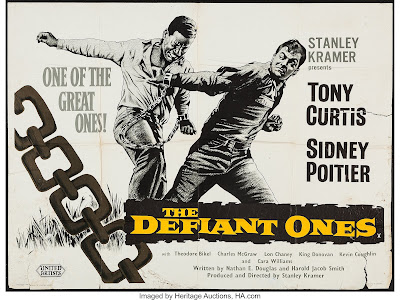
Fifty Years of Film in 50 Weeks, #38: The Defiant Ones, 1958

"You can't go lynchin' me--I'm a white man!"

The Defiant Ones, 1958

Director: Stanley Kramer
Writer: Nedrick Young, Harold Jacob Smith
Cinematographer: Sam Leavitt
Producer: Stanley Kramer
Starring: Tony Curtis, Sidney Poitier, Theodore Bikel, Charles McGraw, Lon Chaney, Jr., Cara Williams

Why I chose it
I had just heard about the death of icon Sidney Poitier at age 94, and immediately searched his filmography to see which of his films I hadn't seen, and this one from 1958 popped up. With the good reviews it garnered, it was the perfect choice.

'No-spoiler' plot overview 
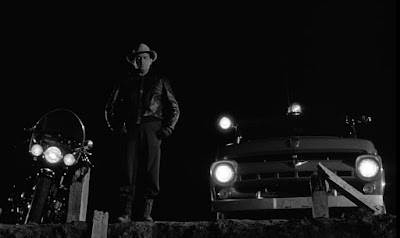
A prison van transporting convicts crashes in a rainstorm at night in the rural South. Most of the convicts are injured, but two, John Jackson (Tony Curtis) and Noah Cullen (Poitier), have escaped when the authorities respond to the crash. The catch: the two, one Black and one white, are chained together at the wrists and must work together to avoid capture. The swamps, rushing rivers, and cold rain that they deal with serve as metaphors for the racism that they must also confront to both become free. During their experience, John ("Joker") and Noah begin to form a bond that leads to some surprising choices. All along, we also follow the efforts of the local sheriff (Theodore Bikel) and a state police sergeant (Charles McGraw), whose inability to get along may hinder their efforts to capture the convicts.

Sheriff Muller (Theodore Bikel) surveys the wreckage
that allowed two convicts to escape.

Production Background
Aram Goudsouzian's excellent biography of Poitier, Sidney Poitier: Man, Actor, Icon, goes into great detail about this film. I learned that Poitier's participation in the 1959 film Porgy and Bess, a role that he didn't want, came about largely as a negotiation piece because he coveted the role of Noah in The Defiant Ones. The latter story he believed was much more relevant to the state of racial politics and true to Black dignity. It didn't hurt that Stanley Kramer, a socially progressive director, was helming the piece. Interestingly, Tony Curtis, who had made his reputation on lighter or comedic roles, copped the role of "Joker" over many others who Kramer had sought, like Marlon Brando, Frank Sinatra, Gregory Peck, and Burt Lancaster, and during filming Poitier praised Curtis to Kramer, helping him to be satisfied with the casting.

During filming, both men punished themselves during the rigorous scenes by rarely using stuntmen. At one point, the latter, when standing around waiting for the stars to finish their scene in the river, had to rescue them downstream when they got in a bit of trouble in the rapids!

The film became a critical and commercial hit after its premiere at the Berlin Film Festival in June 1958, where Poitier won Best Actor.  He was presented with the trophy by Eleanor Roosevelt at her home in New York. Later, both Curtis and Poitier were nominated for Best Actor Oscars. The film also was an early step in breaking the blacklist, as its writer, Nedrick Young, one of those writers having refused to testify in front of the House UnAmerican Activities Committee (HUAC), won an Oscar for the screenplay. At first he was credited in the film with his pseudonym, Nathan E. Douglas, but when he revealed his involvement in the script prior to the Oscar ceremony, the Academy had to make an exception to their policy of not allowing awards for blacklisted writers. 

Not surprisingly, the film didn't get shown in many places in the South because theater owners feared white backlash. And even in the Black communities, the reception was mixed, because of the sacrifices the script demands of Noah Cullen, which played better to white liberals. Ultimately Poitier was proud of the picture, but downplayed the script's role, and his, in making an impact toward greater societal goals. The Civil Rights Movement was not yet in full swing.

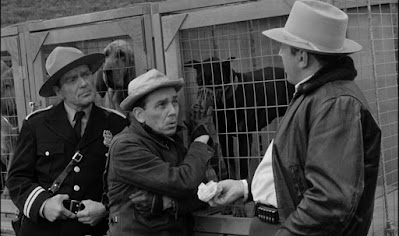
In a bit of recurring comic relief, King Donovan as Solly is always
fussing over his dogs that he is loaning to the convict search.

Some other notable film-related events in 1958 (from Filmsite.org):

  • The number of drive-in theaters in the U.S. peaked near 5,000.
  • Orson Welles' Touch of Evil (1958), with its breathtaking, three-minute, uninterrupted crane tracking shot under the opening credits, was the last of the film noirs in the classic period (from the early 40s to the late 50s). Universal was so unimpressed with the film that it was double-billed as the second B-movie film when first released, following the main feature The Female Animal (1958).
  • The Best Picture-winning musical Gigi, directed by Vincente Minnelli, set a new Oscar record by winning nine awards. It remains one of the few films to win all the awards for which it had been nominated. It also has the shortest title of a film to win a Best Picture Oscar.
  • A 21 year-old Jack Nicholson made his screen debut in producer Roger Corman's low-budget juvenile delinquent drama The Cry Baby Killer (1958).
My Random Observations
  • If anyone has any doubt that Poitier was a top-tier actor, I present this film as evidence. Two things stood out to me. First, his perfect accent and mannerisms convinced us that he could only be a Black man in the southern U.S. Remember, Poitier himself was born and raised in the Bahamas and spent his early adult years in New York City.  Second, his line readings sparkle. Listen to his short speech to "Joker" bemoaning how as a Black man he would have to suppress any instinct to stand up to injustice; his wife would always remind him to "be nice." And every time he repeated the words "be nice," his pitch went up as he imitated his wife, making it a brilliant and believable little speech. Watch that speech in the clip below.
  • Tony Curtis was excellent, too. He projected just the right blend of toughness, or rather "punk", and vulnerability that made his interactions with Poitier's character poignant. Yes, he's racist, but he's not a villain. What about that fake nose, though? Ugh! The makeup department added a prosthetic to his nose that was just enough to be noticed...and I was constantly distracted trying to determine if that really was his real nose or not. It turns out that it was used to make him look tougher and maybe uglier. Results are mixed. 
    Tony Curtis in profile: his nose looks like it may have been broken.
    Nope, just the makeup department trying to make him look tougher.
    It's still Tony Curtis, though, and he gets to attract women,
    even as an escaped convict.
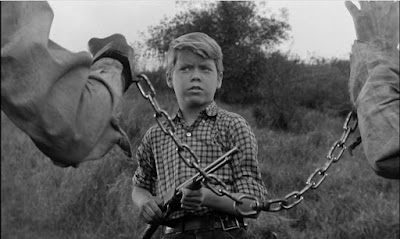
  • The script by Young and Smith, among other things, poignantly and unapologetically dealt with systemic racism. In the 21st century in which there is such an active discourse about the extent and power of systemic racism, I felt that the film could have been made so much more recently. The fact that it was made before the launch of the Civil Rights Movement in the U.S., is even more remarkable. There is a scene where Joker says, referring to a racial epithet, "I didn't make up those names!" Noah retorts: "No, you breathe it in when you're born, and you spit it out from then on." The visual representation of this truth happens later in the film where a young boy, roaming the fields with a gun, comes across the two prisoners and immediately assumes Noah is up to no good and Joker needs rescuing.
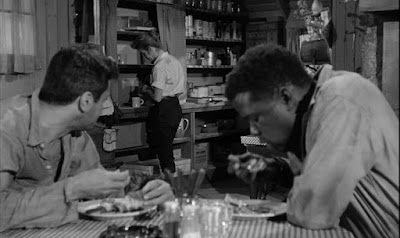
The men eat after Billy's reluctant Mom is told to feed
Noah as well as Joker.
Billy wonders what the white man must have done to be
shackled together with a Black one.

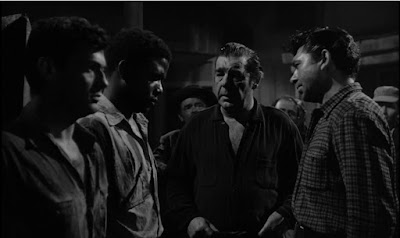
In small roles, Lon Chaney Jr., and Claude Akins discuss
the lynching of the two convicts they caught trying to steal food.
  • With one major theme being "coming together as a team when forced to confront challenges together", I couldn't help but think of the various "wilderness experiences" that are designed for groups as varied as corporate executive teams and troubled adolescents, as a way of enhancing leadership, empathy and collaboration. This film was literally a "wilderness experience" for John and Noah, and it certainly had the desired effect.
  • John "Joker" Jackson and Noah Cullen a little worse for
    wear after digging themselves out of a clay pit while shackled together.
  • In this week's edition of 'Bit Player Bingo", I present Carl "Alfalfa" Switzer, in his final film role as one of the locals called out to hunt for the escaped convicts. He would sadly die a few months after filming as a result of an altercation with guns. Like many child stars, he gained fame and fortune early in life but then struggled as an adult.
    Carl "Alfalfa" Switzer, with cap, center.
Where to Watch
At this writing, the film is streaming for Amazon Prime Video subscribers. It's also available on DVD.

Further Reading
Read the article on TCM here, and check out the excellent biography of Poitier here.

RIP, Mr. Poitier, and thank you.
Sunday, January 9, 2022

Fifty Years of Film in 50 Weeks, #37: What's Opera Doc?, 1957

"Kill da wabbit!!"


What's Opera, Doc? 1957

Director: Chuck Jones
Writer: Story by Michael Maltese
Animators: Ken HarrisRichard ThompsonAbe Levitow
Producer: Edward Selzer for Warner Bros.
Starring: Mel Blanc, Arthur Q. Bryan (voice actors)

Why I chose it
I admit that my ambitious schedule for the posts in this series has slipped (the holidays and all). I even understood, when I picked the film for 1957, that I needed to give myself a break from a two-hour feature film. Luckily, the perfect option appeared: a 6 minute and 36 second animated short that, as an opera fan, I'd heard about most of my adult life. I've never been a fan of animated films, and have not seen very many, which likely makes me an outlier among my classic film-loving tribe. 

'No-spoiler' plot overview 
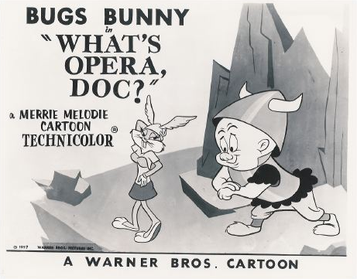
Elmer Fudd and Bugs Bunny find themselves facing off in a Wagnerian-style opera where Fudd as Siegfried is initially duped by Bugs disguised as the beautiful Valkyrie Brünnhilde, and he must win "her." Fortunately, he possesses a trusty magic helmet that gives him power over the elements and a chance to "kill da wabbit."

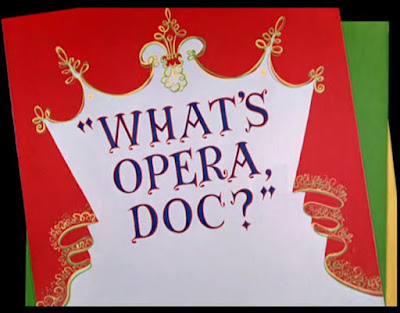
Opening titles

Production Background
Disney Studios found success with animation in the silent film era, which extended into the sound era with iconic characters as Mickey Mouse and Donald Duck. Not to be outdone, Warner Bros., which had effectively launched the commercial sound film revolution, purchased and distributed cartoons developed by the independent Leo Schlesinger Studios, the first to introduce Bugs Bunny and Elmer Fudd through its Looney Tunes and Merrie Melodies series. The short cartoon films were produced both in black and white and in color, and the 'wascally wabbit', created by Tex Avery and voiced by Mel Blanc, starred in ~160 of them. These were primarily shown as a bonus prior to a feature film.

Chuck Jones, the director of What's Opera, Doc?, and a long-time affiliate of Warners' animation team, loved to combine his cartoon characters with classical music, and writer Michael Maltese had already introduced a Wagnerian scenario to an earlier cartoon Herr Meets Hare from 1944. The all-Wagner musical arrangements were deftly arranged by Milt Franklyn, and the considerable vocal skills of both Mel Blanc (Bugs Bunny) and Arthur Q. Bryan (Elmer Fudd) were up to the task of singing the "recitatives" and "arias" with perfect nuance. The only time that Bryan yielded to Blanc was when Elmer had to shout SMOG!, and Blanc's version won out.

What's Opera, Doc? was the first animated film selected for the National Film Registry.

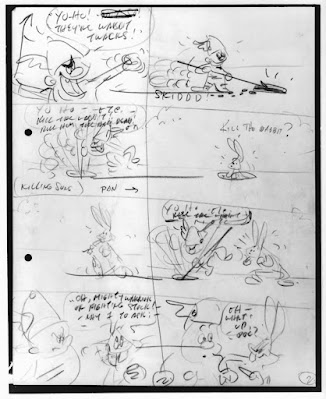
M. Maltese sketch for What's Opera Doc?

Some other notable film-related events in 1957 (from Filmsite.org):

  • The Caribbean romance film Island in the Sun (1957) was noted as groundbreaking in the late 50s for its two inter-racial romances. There was hugging and kissing in the romance between local West Indian dime store clerk (Dorothy Dandridge) and the governor's white aide (John Justin). In another parallel romance, however, there was only the holding of hands between Joan Fontaine as a socialite and Harry Belafonte as a politically-ambitious black union official.
  • The high-grossing teenage-oriented horror film and cult classic from the exploitation studio American-International, I Was a Teenage Werewolf (1957), starred Michael Landon in a dual role. This rock and roll horror film (the first?) made popular the term "I Was A Teenage..."
  • The famed Universal monster Frankenstein appeared for the first time in color, in UK Hammer Studio's version The Curse of Frankenstein (1957) directed by Terence Fisher, with Peter Cushing as Baron Victor Frankenstein, and Christopher Lee as the Monster. This monster film, bloodier than its predecessors, marked the advent of a long cycle of the studio's stylistic gothic horror films for the next few decades, with Lee also playing the famed Dracula vampire.
  • Swedish director Ingmar Bergman's allegorical and influential classic art film The Seventh Seal  (aka Det Sjunde Inseglet), the filmmaker's most influential work, told of a symbolic chess game during the time of the Black Plague between black-robed Death (the Grim Reaper) and a 14th-century knight (Max von Sydow). 
My Random Observations
  • At the very beginning of this short, my ears immediately perked up, because the music playing along with the opening credits was that of an orchestra warming up prior to the start of a piece - how perfectly appropriate here. And the little snips of melody that emerge are exaggerated just enough to remind you that you're watching a cartoon opera. When I did a quick search on YouTube, several videos of live orchestral accompaniments to cartoon screenings were returned. I suppose not surprisingly, because live orchestral film accompaniment is popular as entertainment these days.
  • It struck me as a bit odd that while Wagner wrote 17 hours of music for The Ring Cycle, which contains the Siegfried/Brünnhilde story, much of the music comes from his other works, specifically Tannhäuser and The Flying Dutchman. Yet, it still worked, due to the genius of Milt Franklyn.
  • Many operas have a ballet in the middle, and this one is no exception. (Remember the scene in Amadeus where the Emperor is confronted with the fallout when his own rule to eliminate ballet from opera results in dancers jumping around with no music? It's hilarious). The excellent ballet moves by Elmer and Bugs come to us courtesy of some actual dancers with the Ballet Russe de Monte-Carlo, who were on set at Warner Bros set for another production and helped Chuck Jones with the sketches for those scenes.
  • While I appreciated the artistry and the love of classical music that clearly shone through (who knew you only need 6+ minutes for an entire opera?), this short alone isn't enough to get me interested in watching more animated films from the classic era. But at least now when someone sings "Kill the wabbit! Kill the wabbit!" to the Ride of the Valkyries tune, I'll be able to smile just a bit more knowingly.
Screenshots

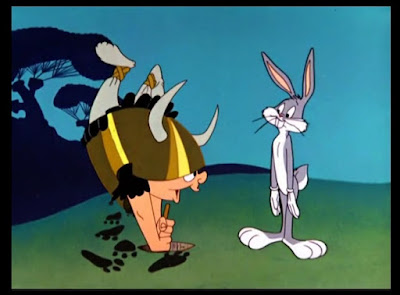
Bugs surprises Elmer hot on the trail.

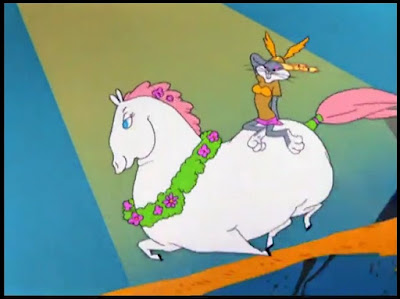
Bugs as Brunnhilde riding down the mountain, soon to
win Elmer's heart.

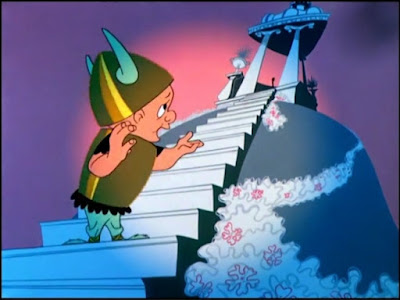
"Siegfried" serenades "Brünnhilde" as he approaches her perch.

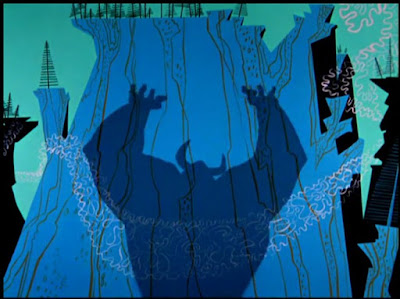
Elmer's mighty shadow reflects the power of his magic helmet.

Where to Watch
The film is on various DVD collections, and can be currently streamed at Archive.org.

Further Reading
I love this 2007 article in Slant Magazine digging into all the wonders of this little gem of a film. Also, for a bit more on the production, watch this appropriately "short" documentary about the making of What's Opera, Doc? :