Search This Blog

Thursday, March 24, 2022

Fifty Years of Film in 50 Weeks, #43: 8½, 1963

 "All the confusion of my life... has been a reflection of myself! Myself as I am, not as I'd like to be."
-Guido Anselmi


, 1963

Director: Federico Fellini
Writers: Fellini, Ennio Flaiano, Tullio Pinelli, Brunello Rondi
Cinematographer: 
Music: Nino Rota
Producer: Gianni di Venanzo
Starring: Marcello Mastroianni, Claudia Cardinale, Anouk Aimee, Sandra Milo

Why I chose it
I have made multiple attempts to watch this classic of Italian cinema, but for various reasons that I believe are completely unrelated to the quality or watchability of the film, like the film's protagonist, I couldn't complete it. Here was a golden opportunity.

'No-spoiler' plot overview 
Popular and celebrated film director Guido Anselmi (Mastroianni) is trying to make a new movie. While on the verge of commencing shooting, he can't seem to finalize the script and faces increasing pressure from his producers, actors, and the press. At the same time, he takes a working vacation in a sumptuous spa, but cannot escape his own personal stresses. He juggles dysfunctional relationships with various women, most notably his wife and (primary?) mistress. To cope with what seems an increasingly vague line between the film's script and his own life, he retreats into fantasies and visions of his past.

Mastroianni as Guido looks in the mirror and is not happy with 
what he sees.

Production Background
I've discovered there are books written about the making of this film, multiple interviews with cast and crew, and commentaries by eyewitnesses. So here are just a few tidbits that I picked up as I dipped into the tip of the proverbial iceberg. First, it's true that director Fellini wrote into the script much of his own life's memories and his struggles as a famed director on the way up. In fact, the title refers to the total number of films Fellini had made at the conclusion of production of this one. Yet unlike Guido, Fellini was a more confident director, and the film is widely believed to be only semi-autobiographical. In fact, Fellini described the film as portraying "three levels of which our minds live: past, present, and conditional (fantasy)." But he apparently struggled with the tone of the film, as he had a note taped to his camera, which read, "remember, this film is a comedy."

Fellini (left) on the set of 8 1/2 with Mastroianni.

At what was probably the apex of his career, Fellini apparently had a great gift for being the center of gravity on set such that everyone orbited around him or wanted to be close to him. Actress Sandra Milo (Carla) confesses to having intense feelings for Fellini. 

Fellini was obsessed with actors' physical characteristics and made casting choices accordingly. The American singer Eddra Gale, who had never acted in a film, was cast as Saraghina because her voluptuous body had just the right look. But with the exception of megastar Marcello Mastroianni, no other actor in the film was hired more than twice by Fellini in his long career. 

8½ wowed the critics around the world and was a big hit in the U.S. as well. It went on to win the Oscar for best foreign-language film. As an important piece of film history, the film is lauded especially by directors today who see it as being an authentic portrayal of the struggles of film-making.

Some other notable film-related events in 1963 (from Filmsite.org):

  • Elizabeth Taylor was the first actress to sign and be paid a record $1 million for a film, for her lead role in the legendary epic film Cleopatra (1963) from 20th Century Fox.
  • Ampex, which had developed the world's first practical videotape recorder in 1956 for TV studios, began to offer its first consumer version of a videotape recorder, sold through the Neiman-Marcus Christmas catalog for $30,000 - a non-consumer-friendly price.
  • Director Tony Richardson's Best Picture-winning UK film, a period comedy titled Tom Jones (1963), was noted for its many freewheeling cinematic tricks (a slapstick mock-silent prologue with inter-titles, quick edits, stop-motion, freeze-frames, wipe-cuts, sped-up motion, audience asides, and breaking of the fourth wall, tongue-in-cheek narration), and the eating scene that cross-cuts between roguish Tom Jones (Albert Finney) and Mrs. Waters (Joyce Redman).
  • Sidney Poitier won the Best Actor Academy Award (awarded in 1964) for Lilies of the Field (1963), thereby becoming the first Black actor to win this award for a leading role, and the only one in the 20th century.
My Random Observations
  • On first viewing, I found the film fascinating but frustrating, and I even stopped periodically to check to see how much time was left. I liked it better the second time with the commentary track running. Its scenes are consistently odd, and they are linked together with the slimmest of plots. Those with obvious surrealism blend into others that may also be surreal, but can we be sure of anything that's happening? I would compare this in an odd way to some of David Lynch's work. No doubt that 8½ has riches to be uncovered, with views on identity crises, the vagaries of fame, traditional and modern gender relationships, religion and superstition, to name the most obvious, but to have any hope of decoding those messages, you'll need to commit to multiple viewings.
    In a possible fantasy, Guido and his wife dance as all his players
    parade in a circle on his location set.

  • I don't mind surrealism, as my commentary on another Italian film with surreal elements, Miracolo a Milano (1951)will attest. In fact, the scene in which Guido flies high into the sky to then be pulled back down reminded me of the broomstick riders taking off into the sky near the Duomo in the earlier film. Another film that I absolutely adored, also with some surreal and spooky visuals but a clearer plot through-line, is Ingmar Bergman's Wild Strawberries (1957).

    Guido flies into the air.

    A very creepy surreal scene at the film's beginning.

  • Despite everything, I will say that the visuals grab you with their brilliance, whether it's the lighting, the costumes, or how the camera captures the revealing expressions of the actors. Here are just a few snaps: 
    From a childhood memory of Guido's, an old woman in her house.

    The spectacular spaceship launchpad set at night.
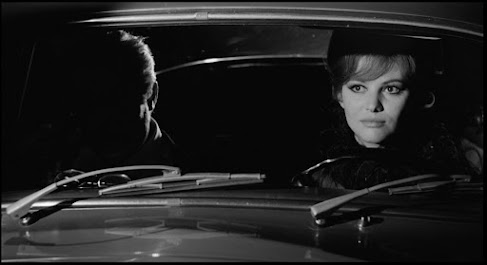
    Claudia Cardinale shares the frame with Mastroianni, but we 
    never see both their faces at the same time.

    A strange scene in a cafe. Carla, in her furs, is the center of attention.

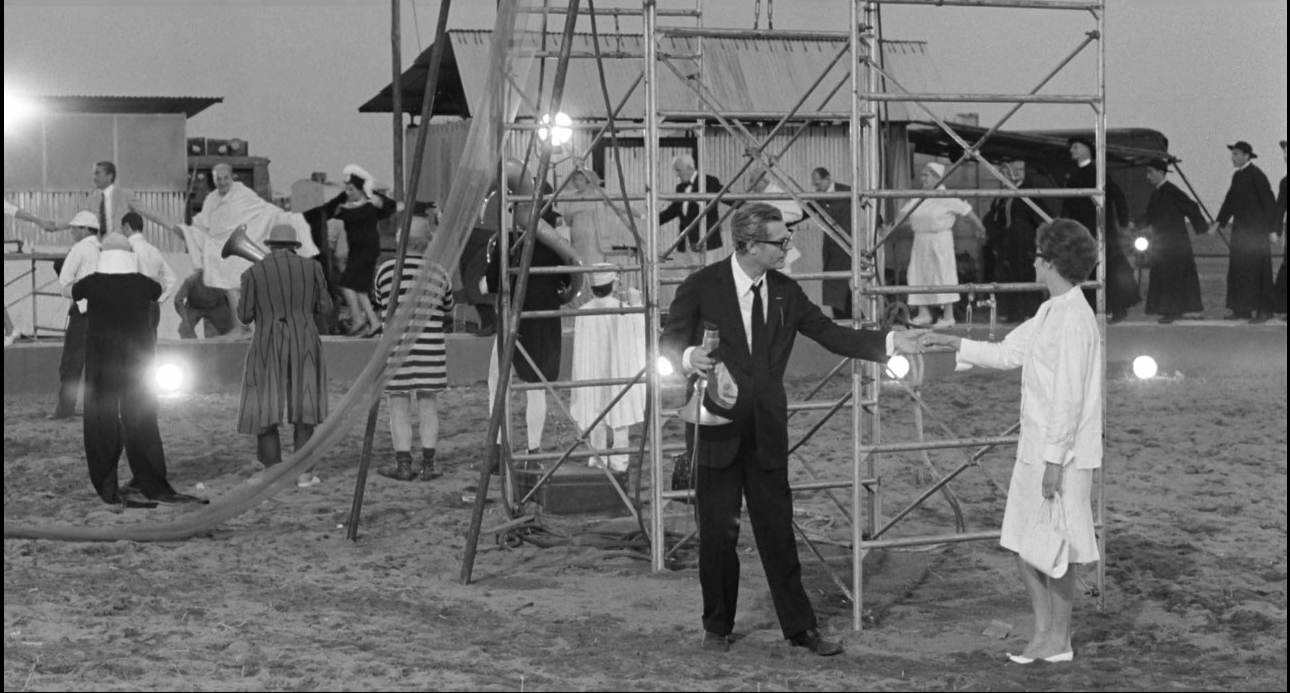
  • This week's Bit Player Bingo features the French actress who I didn't realize had a career outside of her brief but memorable role as the patriot in Casablanca (1942) who shouts "vive la France!" at the end of a rousing rendition of the Marseillaise: Madeleine Lebeau. To be fair, her role in 8 1/2 (as a French actress!) is arguably more than a bit part, but she has a totally different manner here.

    Madeleine Lebeau (right) as actress Madeleine pumps Guido (Mastroianni)
    for info about her part in his film.

    Lebeau in her memorable scene in Casablanca.
Where to Watch
The film has been released on DVD by the Criterion Collection, and is currently streaming for subscribers of their online channel. It's also available for free now for subscribers of HBO Max, Kanopy, and Direct TV. It can be streamed for a small fee on other services as well.

Further Reading
Go here for a detailed discussion of the film background as well as interviews with Fellini and Mastroianni.

Monday, March 14, 2022

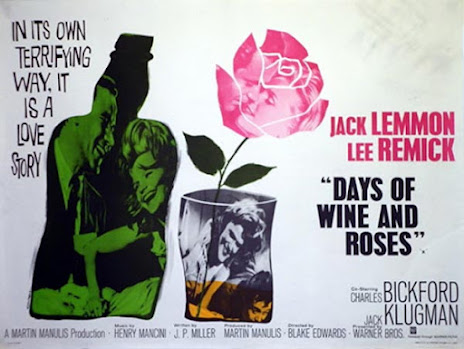
Fifty Years of Film in 50 Weeks, #42: The Days of Wine and Roses, 1962

Days of Wine and Roses, 1962

Director: Blake Edwards
Writers: J. P. Miller
Cinematographer: Philip H. Lathrop
Music: Henry Mancini
Producer: Martin Manulis for Jalem Productions, distributed by Warner Bros.
Starring: Jack Lemmon, Lee Remick, Charles Bickford, Jack Klugman

Why I chose it
After last week's veering into farce, I decided to once again dip into hard-hitting drama. This film had been on my radar for years as it's been on TCM a number of times, and I was curious about how difficult it was going to be to watch. As difficult as Who's Afraid of Virginia Woolf? I decided to find out.

'No-spoiler' plot overview 
Joe Clay is a successful and somewhat smarmy public relations worker at a large ad firm in San Francisco. Among his important job duties is procuring women for visiting high-ranking clients and tossing back copious amounts of liquor. One evening he meets Kirsten, the teetotaling secretary in his firm and mistakenly assumes she is expected to be part of the "entertainment". Angry, she rejects his later advances, but then gives in to his courting and finds drinking may be fun after all. They get married, have a baby, but in the next few years, the drinking dominates and destroys, first Joe's career, then the marriage, and finally their mental and physical health. Joe finds AA, and Kirsten returns to her father's house, but they struggle through sobriety and relapse.

Production Background
Director Blake Edwards was a director on his way up, mostly working on TV series until the early 1960s. His first big hit was the ever-popular Breakfast at Tiffany's (1961), and after Days of Wine and Roses, he mostly helmed comedies like the blockbuster Pink Panther series. When he had the opportunity to direct this extremely serious feature film, which was originally presented in 1958 as a play on TV (teleplay) by J.P. Miller, he got megastar Lemmon to help boost the picture. (In the TV version, Cliff Robertson played Joe and Piper Laurie played Kirsten. Charles Bickford portrayed Kirsten's father in both the TV and theatrical film.)

According to the book Film: A World History by Borden, Duijsens, Gilbert, and Smith, Edwards and his two leads actually drank quite a lot during production. It's not clear if their drinking added verisimilitude to some of the most intense scenes! Both apparently also attended AA meetings and visited jails and hospitals that housed and treated drunks.

The film accrued 5 Oscar nominations, including Best Actor for Lemmon and Best Actress for Remick, but only took home Best Song for Johnny Mercer and Henry Mancini.

Some other notable film-related events in 1962 (from Filmsite.org):

  • The 7th and final "Road to..." film (starring Bing Crosby, Bob Hope, and Dorothy Lamour) was released -- The Road to Hong Kong (1962). It was the last of seven escapist 'Road pictures' (beginning in 1940 with The Road to Singapore). 
  • 36-year-old sex symbol Marilyn Monroe was discovered dead (August 5) in the Los Angeles area in her Mexican style bungalow of an apparent drug overdose, a death the coroner ruled as "a probable suicide." She was in the midst of filming with director George Cukor in Something's Got To Give (1962). 
  • The action/spy film Dr. No, which launched in the UK in 1962, inaugurated the successful, long-running, and highly profitable James Bond series of action films. Based upon Ian Fleming's works, this film cast as the series' first Agent 007, unknown actor Sean Connery. Ursula Andress also starred as Honey Ryder, the first iconic Bond girl. 
  • Patty Duke won the Best Supporting Actress Oscar for her performance as young Helen Keller in The Miracle Worker (1962). She was the first minor (under age 18) to win a competitive Oscar.
My Random Observations
*
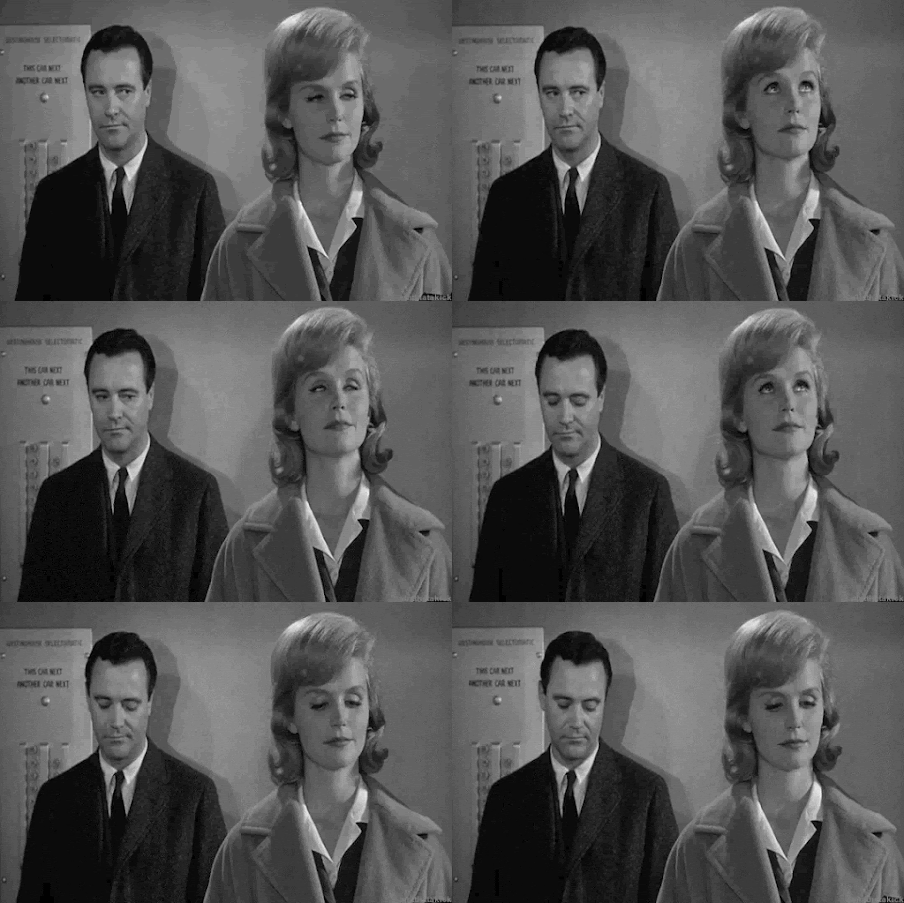
Special thanks to my friend Vânia for her gif image files, which I've featured throughout this post. Check out her blog at aintthatakick.tumblr.com.

Camerawork can be striking.
  • Considering Joe's initial happy-go-lucky corporate persona, who is a willing conspirator  to sexist debauchery, the film rather struck me The Apartment (1960) meets The Lost Weekend (1945). The latter was a film from the 1940s showing one man's weekend battle with a serious alcohol problem, considered quite realistic and forward-thinking for the era. In some ways, the present film may be more painful because of the extended family devastation not really the focus of the earlier film.
The Apartment, anyone?

Joe in the throes of a harrowing withdrawal.
  • The film is superb in letting us feel that all-consuming power of the bottle. Through the excellent performances, script, and cinematography we feel we are in the heads of our protagonists.
The lure of alcohol: one can have fun when drinking.

Kirsten realizes that the bottle makes for poor
company, when all is said and done.
  • This is my third film in this blog series featuring character actor (and one-time leading man) Charles Bickford. Last time we saw him was in the noir Fallen Angel (1945), and before that in Anna Christie (1930) opposite Greta Garbo. He's a good actor, and versatile, but it seems all his characters have one trait in common: they are strong and rugged. As Kirsten's father, he initially seems stern and to be feared, but we learn that he is an upstanding man who tries to help as his daughter's life spins out of control, and it's appropriate that the couple find him attractive to lean on.
  • So the verdict on if I find the film hard to watch: yes, but, not as difficult as I was expecting. There surely are painful scenes: when Joe is suffering withdrawal, when the couple's daughter suffers neglect or abuse, or when they confront how much love is able to overcome addition. The choice of black and white at once sets a somber tone and helps us keep slightly distant from the horror. Considering how these issues may be filmed in the modern era (Leaving Las Vegas comes to mind), I couldn't help but feel a bit spared from the worst.
    This can't be the life together that Joe and Kirsten
    had envisioned.
Where to Watch
The film can be rented to stream on a variety of the most popular streaming services, and can be purchased on DVD and Blu-Ray.

Further Reading
An excellent article on TCM.com provides interesting production tidbits, while this blogger posts a detailed comparison between the TV movie and the film.

Saturday, February 26, 2022

Fifty Years of Film in 50 Weeks, #41: Lover Come Back, 1961

"Okay, so I've sewn a few wild oats.:
- Jerry Webster
"A few? You could qualify for a farm loan!"
- Carol Templeton

Lover Come Back, 1961

Director: Delbert Mann
Writers: Stanley Shapiro and Paul Henning
Cinematographer: Arthur E. Arling
Producer: Robert Arthur, Stanley Shapiro, and Martin Melcher for 7 Pictures Corporation-Nob Hill Productions, Inc.-Arwin Productions, Inc. Production
Starring: Rock Hudson, Doris Day, Tony Randall, Edie Adams, Jack Oakie

Why I chose it
After a few ultra-serious films, I was in the mood for a frothy comedy. When this one popped up on my list, I was especially attracted to it as a way to start filling in the gaping hole in the Rock Hudson-Doris Day films. When I saw Jack Oakie was in the cast, that sealed the deal for this secret Oakie enthusiast!

'No-spoiler' plot overview 
Carol Templeton (Day) and Jerry Webster work for rival ad agencies on Madison Avenue. Even though they haven't met, they often fight to win the same potential client, which engenders a bit of an (un)friendly 'in name only' rivalry. Womanizer Jerry doesn't hesitate to go to extreme lengths to win a client, much to the consternation of his neurotic boss and company owner, Pete Ramsey (Tony Randall). A major ruse is unleashed when in the midst of trying to keep one of his girlfriends (Edie Adams) from walking out, he makes up a product name (Vip) and promises she can be the "Vip Girl". Jerry then has to actually get Vip to materialize and enlists the help of brilliant chemist Linus Tyler (Jack Kruschen) to come up with something (anything). Hot on the trail of Vip, and not knowing there is no such product, Carol is introduced to Jerry who pretends to be Tyler to access to some of her business secrets. Of course, the two begin a relationship. Viewers must stay tuned to see what Vip will really turn out to be, and how long Jerry can keep his real identity hidden from Carol!

Carol (Day) tries to console Linus (Jerry in disguise) when
he just doesn't know what to do with his feelings for her (!).

Production Background
The first film pairing of the dynamic Rock Hudson and Doris Day in Pillow Talk (1959) was a huge success with late 1950s audiences, and co-producer Stanley Shapiro, who also wrote Pillow Talk, looked to pair them again in a similar tale of mistaken (or unknown) identities, and personality mismatches. 

Lover Come Back was also a hit, and oft-grumpy NY Times critic Bosley Crowther even loved it. He said, "Pillow Talk was but a warm-up for this springy and spirited surprise, which is one of the brightest, most delightful satiric comedies since It Happened One Night."

Despite the lauds it received from critics, Lover Come Back only garnered one Oscar nomination, for Best Writing, Screenplay.

Some other notable film-related events in 1961 (from Filmsite.org):

  • The action war film The Guns of Navarone (1961) starring Gregory Peck, had one of the most expensive budgets of films at the time, at $6 million, and was one of the top-grossing films of 1961, along with Disney's animated 101 Dalmatians (1961).
  • Method actor and maverick auteur John Cassavetes' low-budget film Shadows (1961) was his first directorial effort - deliberately created as a contrast to Hollywood's studio system. The self-financed, self-distributed cinema verite film was a story set in New York about an inter-racial couple. Shot on 16-mm film and using a non-professional cast and crew, the film symbolized the emergence of the New American Cinema movement, and inspired the growth of underground films and other independent ("indie") and personal works.
  • A search commenced for the first James Bond actor, after UA announced it would produce seven films based upon Ian Fleming's 007 British super-spy, to be produced by Albert R. Broccoli and Harry Saltzman. Cary Grant, James Mason, Patrick McGoohan, and David Niven, were considered for the role, ultimately given to 30 year-old actor Sean Connery.
  • Marilyn Monroe's last completed film, before her death in 1962, was director John Huston's anti-western The Misfits (1961) -- it was also the last film of screen icon Clark Gable.
My Random Observations
  • ANOTHER film in which a chemist is portrayed as a socially-awkward misfit? Oh my. So it's especially hard to imagine that Doris Day is supposed to believe gorgeous Rock Hudson is a chemist, even if he wears a beard, along with an ill-fitting suit and bowtie, and acts ultra naive. That's OK, I suppose we are supposed to believe that Doris as Carol is a bit naive herself, even if she is a savvy marketing executive.
    The chemist vs. the leading man - which do you choose?

    Hudson as Jerry as Linus (!) feigns shock watching a strip show
    with Carol. Carol either doesn't like the show or is embarrassed by 
    Rock's wardrobe.

  • With the prevalence of social media, business sites like LinkedIn, etc., it did strike this modern viewer as quaint that the main plot revolved around Carol having no idea what her well-known but hated rival Jerry actually looked like!
  • Jack Oakie's role was much too small. This comedy star of early talkie cinema had a unique slapstick style and loved to put on accents (think 'Napaloni' in The Great Dictator (1940)). Here he is a rich Virginia gentleman who plays into the hands of Jerry and Carol who duke it out to win his account. As a mere tool to set up the characters and scenario for the film, he disappeared after the first ten minutes, much to my chagrin. This film was the last Oakie made.
    Jack Oakie (right) being treated to a good time by
    Rock Hudson as a prelude to a deal.

    The good time was just a bit too good. Carol 
    (Day, left) looks at the aftermath in horror.

  • How much inspiration did Matthew Weiner, the creator of TV's smash hit Mad Men, get from this movie, set in precisely the same era, with the focus on sexual politics interfering with work politics? For fans of the series, I would strongly recommend this film, even if the romantic comedy angle is not the main theme of the series. I really enjoyed the film and felt that the pacing, performances, script were perfect, and the set and costume design were scrumptious.
    Jon Hamm (left) and John Slattery in a scene from Mad Men

  • Tony Randall is wonderful. He underplays a comic role that could tempt most actors to slice the ham a bit too thick, but his interactions with Hudson are believable enough to be downright hysterical.
Tony Randall (left) as the boss uses a horn to beckon moose as 
the clearly unamused Jerry wishes here were anywhere else.
  • For Bit player bingo this time, I present Ann B. Davis, well known as the smart-aleck but loveable maid Alice in The Brady Bunch, here playing Day's assistant.
    Ann B. Davis (right) looks uncannily like Alice when she helps
    Doris Day with her outfit.
Where to Watch
It's available on DVD and can be streamed for a small fee on many standard streaming services.

Further Reading
Check out this piece in Vanity Fair detailing the lives of Doris Day and Rock Hudson, and how they intersected inside and outside the movies they made together.

Thursday, February 17, 2022

Fifty Years of Film in 50 Weeks, #40: Elmer Gantry, 1960

Jim Lefferts: You look like a man who could use a drink.
Elmer Gantry: You know somethin', Jim? There oughta be a law against drinkin'.
Jim Lefferts: There is. Prohibition.
Elmer Gantry: That's against sellin', not drinkin'.
Jim Lefferts: Amen.
Elmer Gantry, 1960

Director: Richard Brooks
Writer: Richard Brooks, from the novel by Sinclair Lewis
Cinematographer: John Alton
Producer: Bernard Smith for Elmer Gantry Productions (Richard Brooks' company)
Starring: Burt Lancaster, Jean Simmons, Arthur Kennedy, Dean Jagger, Shirley Jones

Why I chose it
As an Academy Award nominee from 1960, and an adaptation of one the  early 20th century's most provocative novels, this one just grabbed more of my attention than any other potential films. 

'No-spoiler' plot overview 
Elmer Gantry (Burt Lancaster) is a small-time con man during the Prohibition era, who as an itinerant salesman finds he can win sell anyone almost anything, even religion, with his speaking abilities and charisma. He wanders into a traveling Revivalist show headlined by "sister" Sharon Falconer (Jean Simmons), a lovely, sincere preacher who has the gift of connecting with rural folk and converting them to an active, evangelical Christianity. At first resistant to Elmer's charms, Sharon recognizes his gift for preaching even if he crosses boundaries of propriety, but then begins to fall for him. Their burgeoning relationship is threatened by both his past involving another woman (Shirley Jones) and his ambition, which also threatens the existence of their troupe.

Elmer Gantry (Lancaster) wows a rural crowd of the faithful with his
fiery preaching.

Production Background
The success of Elmer Gantry owes much to producer/director/writer Richard Brooks. He was intrigued by the 1927 Sinclair Lewis novel, and decided to adapt the first half of it to the big screen, although with reportedly significant alterations to some of the main characters. Burt Lancaster was cast after it was originally reported that Brooks had considered Montgomery Clift for the lead role. Brooks had already worked with Lancaster, having written two of his earliest films: The Killers (1946) and Brute Force (1947) Lancaster made the character of Gantry his own, even incorporating the "slide" moves of baseball player-turned evangelist Billy Sunday. As for Brooks, he married his leading lady, Jean Simmons, shortly after production wrapped.

The film did well upon release, earning over three times its $3 million production budget at the box office. The film also won three Academy Awards: Best Actor for Burt Lancaster (his sole Oscar win), Shirley Jones for Best Supporting Actress, and Richard Brooks for Adapted Screenplay. The film was nominated but did not win for Best Picture and Best Score (André Previn).

In an interview available here, Shirley Jones revealed that she had a major crush on Burt Lancaster when she was growing up, and covered her walls with his posters. About Elmer Gantry Jones said that Lancaster was a great help to her on set, and then the day they both won Oscars for their portrayals was the proudest day of her career.

Sister Sharon Falconer (Simmons) turns to call out Jim Lefferts (Arthur Kennedy),
the perpetually doubting news reporter out for dirt.

Some other notable film-related events in 1959 (from Filmsite.org):

  • Alfred Hitchcock received his fifth and last nomination as Best Director for Psycho (1960). His four previous nominations (all losses) were for Rebecca (1940), Lifeboat (1944), Spellbound (1945), and Rear Window (1954).
  • The talented scriptwriter Dalton Trumbo, one of the Hollywood Ten, received full credit for writing the screenplays for Preminger's Exodus (1960) and Kubrick's Spartacus (1960), thus becoming the first blacklisted writer to receive screen credit. In 1960, Trumbo was finally reinstated in the Writers Guild of America. This official recognition effectively brought an end to the HUAC 'blacklist era'. 
  • Although the tradition of embedding 5-pointed pink stars in the sidewalk ("the Hollywood Walk of Fame") along Hollywood Boulevard and Vine Street was established by the Hollywood Chamber of Commerce in 1958, it wasn't until February 9, 1960, that the first star to be unveiled was awarded to actress Joanne Woodward.
  • Director Jean-Luc Godard's low-budget, mostly improvised A Bout de Souffle (1960, Fr.) (Breathless), his first feature-length film, became the cornerstone film of the French New Wave, with startling jump cuts and bold visuals shot with a hand-held camera on location. It paid homage to B-gangster films with star Jean-Paul Belmondo, in the role of a young hoodlum, modeling himself on Humphrey Bogart. 

My Random Observations
  • Jean Simmons had quite the range. It seems that she was especially good at saintly young evangelists, considering her role here and as Sarah Brown in Guys and Dolls (1955). Nevertheless, she has no problem attracting (and keeping) eligible young rogues in both films. But she's the opposite of saint in the ironically titled Angel Face (1953)- while her face is cherubic, she's one of the most "fatale" of all "femmes" in film noir.
Simmons as Sister Sharon Falconer calling on the Lord.
Simmons as the femme fatale Diane Tremayne in Angel Face
  • The controversial nature of the film prompted an extensive on-screen warning prior to the opening titles of the film. Considering that the film did not mock religion or faith, per se, but rather pulled the curtain back on the hypocrisy of some of its practitioners, these warnings seemed at least quaint, at most completely unnecessary. Of course, charismatic preachers taken to task for fleecing their flocks is old news today. I've not read the novel, but what I've learned is that the themes there are more powerful social commentary than those translated into the film.
  • The attraction that Elmer displays toward charismatic religious practices is really not explained. The only explanation that I'm left with that he just enjoys hamming it up and being the center of attention. This tendency is shown early in the film where he joins a group of Black worshippers and belts out gospel songs.

  • The bug-eyed leering of Lancaster does get a bit tiresome.
Typical visage of Lancaster as Elmer Gantry.
  • Shirley Jones was a revelation. Sadly, I have to admit that I'm familiar with her only as the Mom in The Partridge Family, and to a much lesser extent from her star turn in Oklahoma! Here, she perfectly captures the cynicism and anger of a still young woman who was taken advantage of by a man and as a result is leading a dissolute life. Her Oscar was well deserved.
Shirley Jones as Lulu Bains, contemplating the revenge she'll take
on Gantry.
Where to Watch
The film can currently be streamed for free for DirectTV subscribers, and is available on DVD/Blu-Ray.

Further Reading
Read the original review of the film in the New York Times here. And don't miss this insightful piece on TCM.com describing more of the film's backstory and the career of director Richard Brooks, and this one on the American Film Institute site here.

Friday, February 4, 2022

Fifty Years of Film in 50 Weeks, #39: Compulsion, 1959

"We're told it was a cold-blooded killing because they planned and schemed. Yes, but here are officers of the state who for months have planned and schemed - and contrived - to take these boys' lives. Talk about scheming."
Defense Attorney Jonathan Wilk
Compulsion, 1959

Director: Richard Fleischer
Writer: Richard Murphy, from the novel by Meyer Levin
Cinematographer: William C. Mellor
Producer: Richard D. Zanuck
Starring: Orson Welles, Diane Varsi, Dean Stockwell, Bradford Dillman, E.G. Marshall, Martin Milner

Why I chose it
A movie friend suggested it, and knowing that we just lost Dean Stockwell and that I hadn't seen many (or any?) of his movies of this era, I picked this one immediately.

'No-spoiler' plot overview 
In 1920s' Chicago, Judd Steiner (Stockwell) and Arthur Straus (Dillman) are two precocious and wealthy law students who seem intent on doing mischief just because they can get away with it. With Steiner under the thrall of the more controlling Straus, mischief turns into the murder of a young neighbor boy. They avoid suspicion even while acting oddly with their friends Sid (Martin Milner) and his girlfriend Ruth (Diane Farsi). Since there is no perfect crime, a personal item left at the scene starts to unravel their alibis. Finally, forced to confess to the District Attorney (E.G. Marshall), their fate lies in the hands of renowned attorney Jonathan Wilk (Orson Welles), who is employed to defend them.

Shades of The Birds and Psycho here, but it's our young killers discussing
their latest alibi stories (Dillman, left, and Stockwell, right)
Production Background
Now well into the TV and post-studio system era, the first generation of moguls was giving way to the next. Twentieth Century Fox founder Darryl Zanuck's son, Richard, was now in the business and his first major producing project was this film. The story of the true-crime Leopold & Loeb case was back in the public consciousness due to a number of factors: the release on parole of Leopold, who subsequently started a new life and had just published his autobiography, the success of the novel Compulsion by Meyer Levin, and the turning the novel into a play on Broadway.

Former child star Stockwell got the part of Steiner (Leopold stand-in) in the stage version, and he was a natural to play the part in the film. Roddy McDowell, Straus in the play, was not cast in the film, but Bradford Dillman got the part. This supposedly prompted Stockwell to initially give Dillman a hard time on set. Eventually, they mended fences and got along. Orson Welles, who played the Clarence Darrow stand-in provided his own challenges. His time constraints put pressure on the production schedule, with a few portions of his record monologue near the end of the film being dubbed after, and he bullied nearly everyone on the production.

Even with the names changed, and the homosexual angle played down, Leopold had sued for invasion of privacy, but the case was dismissed. The film got no Oscar nominations, but all three lead actors (Stockwell, Dillman, Welles) won 'best actor' at the Cannes film festival that year. The Leopold & Loeb story was an inspiration for the play and subsequent Hitchcock classic film Rope, and a more provocative version of the two perpetrators, Swoon, from 1992.
Orson Welles, with trademark fake nose, makes his appearance over halfway into the
film.

Some other notable film-related events in 1959 (from Filmsite.org):

  • The chariot race sequence in director William Wyler's Best Picture-winning, wide-screen Technicolor epic blockbuster Ben-Hur (1959) set the standard for all subsequent action sequences. The Biblical epic was the first film to win 11 Oscars, breaking the record of 8 Oscar wins originally set first by Gone With the Wind (1939) and 9 Oscar wins set a year earlier by Gigi (1958). 
  • After over 25 years of creating low-budget shorts, the comic team of The Three Stooges, known for farces and physical slapstick, made their last (190th) film. It was Columbia's short Sappy Bull Fighters (1959) - a low-budget remake of their own earlier film, What's the Matador? (1942)
  • Doris Day and Rock Hudson were paired for the first time in the romantic comedy Pillow Talk (1959). Due to the film's success, the acting duo also appeared together in two 'sequels': Lover Come Back (1961), and Send Me No Flowers (1964).
  • Aroma-Rama, an experimental, short-lived scenting system developed by inventor Charles Weiss, was introduced to add over 50 scents to Carlo Lizzani's Italian documentary film about China titled Behind the Great Wall (narrated by Chet Huntley) by filtering 'Oriental' aromas into the auditorium through the air-conditioning system. The following year, a competing process, Smell-O-Vision, was introduced.
My Random Observations
  • This was my first film in the 1950s' CinemaScope widescreen, which produced an aspect ratio of 2.55 :1. I call it super skinny. I'm not a particular fan of this aspect ratio, but it certainly provided lots to look at. In many scenes, Fleischer used extreme close-ups, so not necessarily taking advantage of the widescreen, but in others, he positioned characters in all dimensions to allow us to view multiple simultaneous interactions.
    Artie Straus (Dillman, center) is happy that his "Mummsie" is distracting
    local reporters Tom Daly (Edward Binns, left) and Sid Brooks (Milner, right).

    Artie shoots a menacing look at Judd while driving together late at night.

  • Another atypical feature of this film: black and white cinematography. In a decade that I usually associate with brightly saturated color movies, most of those I've picked for this blog series were made in just-fine-by-me B&W. I can only take away that far more films were made in B&W in the 1950s than I had thought.
I enjoyed Martin Milner in this role - he seemed so...normal...compared with
the leads.
  • Was the character of Ruth (as played by Diane Varsi) for real? While dating a perfectly nice guy (Sid/Martin Milner), she is attracted to Judd, gets completely abused and almost raped by him, yet feels sorry for him in an icky motherly-like way. Even after she's confronted with him being a cold-blooded murderer, she *still* doesn't believe he's a bad person, or so we are led to believe. Perhaps she is there to help justify Attorney Wilk's courtroom argument but her feelings seem to go way overboard here. Spoiler: she does end up back with Sid.
  • Ruth looks at Judd and extends a friendly hand. Her boyfriend Sid (left) is
    appropriately skeptical.
About to be raped, Ruth applies the motherly treatment toward Judd, who 
finally breaks down, revealing he has emotions after all. 
  • Much of the detective work in breaking open the case involves Judd's glasses that he dropped where the dead boy's body was dumped. Even though the police eventually found a distinguishing feature that tracked the glasses back to Judd, early on there was so much talk about the glasses being so common as to be no help at all. As a result, I seriously was wondering why Judd didn't run out and buy himself another pair (discreetly of course) so he didn't have to run around revealing to everyone that he was missing his glasses and bringing suspicion on himself.
I liked this quirky visual.
  • Much is made of Wilk's (Orson Welles) 10-minute monologue arguing to spare his clients from the death penalty near the end of the film. It was a fine performance, but the actual words didn't do much for me. Of course, as I'm someone who abhors the death penalty, maybe my already being convinced of the points he was making had me yawning. See what you think. The entire text of the actual speech Darrow delivered, excerpted faithfully in the film, can be found here.
  • For this week's edition of Bit Player Bingo, I present Gavin MacLeod (Mary Tyler Moore Show, Love Boat) as an associate of the state attorney played by E.G. Marshall. MacLeod just passed away recently (May 2021).
    Gavin McLeod (left with red squiggly arrow). Welles in center.
Where to Watch
Look for the film on DVD and Blu-Ray, and a copy is currently on YouTube here.

Further Reading
As usual, I find the TCM article on the film a great overview with background and context.